

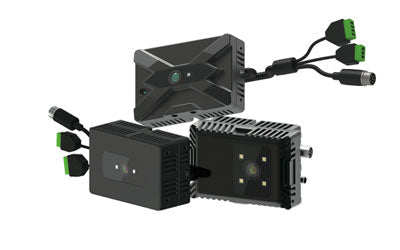
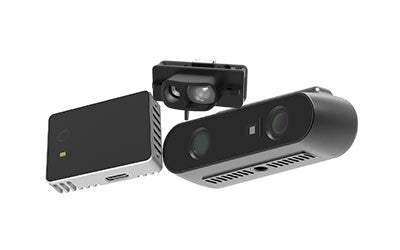
ToF Depth Cameras for Intelligent Forklift Pallet Recognition
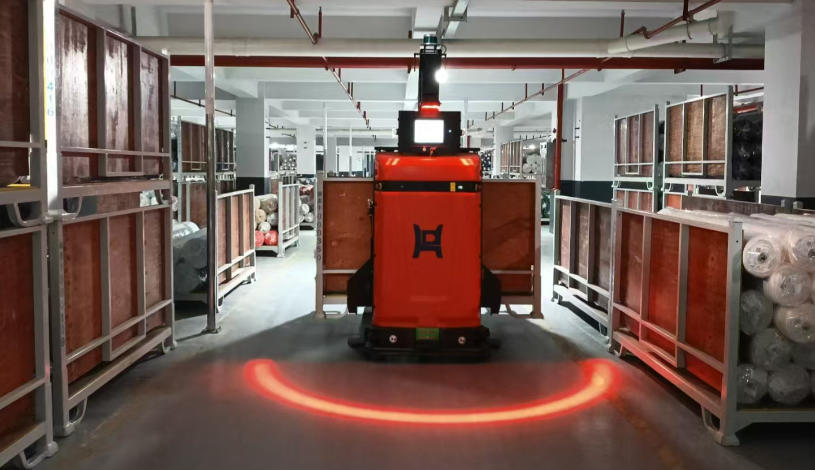
How Can ToF Depth Cameras Improve Pallet Recognition Accuracy in Intelligent Forklifts?
Powering Efficient Upgrades in Smart Logistics and Automated Warehousing
With the continuous advancement of Industry 4.0 and smart logistics, the warehousing and logistics industry is rapidly moving toward automation and unmanned operations. As core handling equipment, automated forklifts (AGV forklifts / AMR forklifts) place increasingly high demands on environmental perception, pallet recognition, and precise positioning capabilities.
Among these, automatic pallet recognition and accurate fork insertion have become critical technical challenges that directly affect the efficiency, safety, and reliability of intelligent forklift operations.
Compared with traditional 2D vision or LiDAR-based solutions, 3D depth camera solutions based on ToF (Time-of-Flight) technology are gradually becoming the mainstream choice for intelligent forklift pallet recognition.
I. Core Challenges in Intelligent Forklift Pallet Recognition
In real-world logistics and warehousing environments, pallet recognition is far more complex than in laboratory conditions and mainly faces the following challenges:
1. Complex environments with extremely high perception requirements
-
Large variations in lighting conditions (indoor/outdoor, backlighting, shadows)
-
Cluttered backgrounds and densely stacked goods
-
Floor reflections, dust, and partial occlusions
2. Diverse pallet types with non-unified standards
-
Wooden pallets, plastic pallets, and metal pallets
-
Different sizes, colors, and levels of damage
-
Multi-layer stacking or tilted placement
3. High requirements for both accuracy and real-time performance
-
Fork insertion positioning errors typically must be controlled within ±10 mm
-
Recognition speed directly affects the overall operation cycle of the forklift
-
Any misjudgment may lead to collisions, dropped goods, or system downtime

II. Limitations of 2D Vision and LiDAR in Pallet Recognition
In intelligent forklifts, AGVs, and automated warehousing systems, pallet recognition and precise positioning are key enablers of unmanned handling. However, both traditional 2D vision solutions and LiDAR-based solutions show clear limitations in real industrial environments and struggle to simultaneously meet the combined requirements of accuracy, stability, and real-time performance.
1. Limitations of 2D Vision-Based Pallet Recognition
2D vision pallet recognition solutions based on standard industrial cameras mainly rely on color, texture, edges, and contour features in images. While basic recognition can be achieved in ideal conditions, significant issues arise in real warehousing and logistics environments.
(1) Highly sensitive to lighting variations
-
Strong light, backlight, shadows, and reflections easily cause recognition failures
-
White or light-colored pallets are prone to overexposure in high-brightness environments
-
Additional lighting is often required at night or under uneven illumination, increasing system complexity
(2) Lack of true 3D spatial information
-
2D images cannot directly obtain height, depth, or fork pocket position of pallets
-
Difficult to accurately determine whether a pallet is tilted, warped, or not fully grounded
-
Two-dimensional information is insufficient to meet millimeter-level positioning requirements for automatic fork insertion
(3) High false detection rates in complex backgrounds
-
Pallets with colors similar to the floor or surrounding goods are easily misdetected
-
Stacked goods, forklift shadows, and background clutter interfere with edge detection
-
Target segmentation becomes difficult in dense multi-pallet scenarios
(4) Poor adaptability to abnormal pallets
-
Limited ability to recognize damaged, deformed, or non-standard pallets
-
Even slight tilting or partial occlusion may cause recognition failure
-
Frequent manual calibration and parameter tuning are required
Overall, 2D vision pallet recognition solutions have low deployment costs but insufficient stability. In complex warehouse environments, maintenance costs are high, making them unsuitable for truly reliable automated forklift operations.
2. Limitations of LiDAR-Based Pallet Recognition
LiDAR (Light Detection and Ranging) provides distance measurement and environmental modeling capabilities and performs well in outdoor navigation and obstacle avoidance. However, it also has clear limitations in intelligent forklift pallet recognition and precise fork insertion positioning.
(1) Sparse point clouds and insufficient structural detail
-
Traditional 2D or low-line-count LiDAR generates limited point cloud density
-
Difficult to accurately reconstruct pallet fork pockets, edges, and structural details
-
Insufficient accuracy for determining pallet pose (tilt angle, fork pocket height)
(2) Limited resolution at close range
-
LiDAR is better suited for mid- to long-range perception
-
At the 0–2 m working distance required for fork insertion, depth resolution is often insufficient
-
Difficult to meet the ±10 mm positioning accuracy required for precise fork insertion
(3) High system cost and integration complexity
-
Industrial-grade LiDAR significantly increases the forklift’s BOM cost
-
Large sensor size imposes constraints on vehicle structural design
-
Point cloud processing algorithms are complex and require high computational power
(4) Not natively optimized for pallet recognition
-
LiDAR is primarily designed for environmental contour and obstacle detection
-
Pallets, which are regular but detail-rich objects, require complex additional algorithms
-
Target segmentation and recognition become challenging in dense multi-pallet scenarios
LiDAR is more suitable as a navigation and obstacle avoidance sensor, but in fine-grained pallet recognition and fork insertion positioning, its cost-effectiveness and precision advantages are limited.

Why Traditional Solutions Fail to Meet Intelligent Forklift Requirements
| Technology | Accuracy | Stability | Close-Range Performance | Cost | Pallet Adaptability |
|---|---|---|---|---|---|
| 2D Vision | Low | Low | Medium | Low | Poor |
| LiDAR | Medium | Medium | Medium | High | Medium |
| 3D ToF | High | High | Excellent | Controllable | Excellent |
For these reasons, an increasing number of intelligent logistics systems are adopting 3D ToF depth cameras as the core sensor for pallet recognition, laying a solid foundation for high-precision automatic fork insertion, AI-driven decision-making, and fully unmanned operations.
What Is a Time-of-Flight (ToF) Sensor?
A Time-of-Flight (ToF) sensor is an active 3D perception sensor that emits modulated infrared light and measures the time or phase difference between emission and reflection from a target. By directly calculating the distance between the sensor and the object, it generates high-precision depth maps and 3D point cloud data.
Because ToF does not rely on ambient light or object texture, it operates stably under strong light, low light, or even no-light conditions. With high real-time performance, accuracy, and robustness, ToF sensors are highly compatible with AI algorithms and are widely used in smart logistics (such as forklift pallet recognition and automatic fork insertion), industrial automation, robotic vision, consumer electronics, and 3D imaging—all scenarios that require reliable spatial perception.
III. ToF Depth Cameras: The Ideal Choice for Intelligent Forklift Pallet Recognition
ToF (Time-of-Flight) depth cameras actively emit modulated infrared light and precisely measure the flight time of the reflected signal, directly generating high-accuracy, low-noise 3D depth maps and point cloud data. Compared with traditional 2D vision or structured-light solutions, ToF provides more stable and realistic spatial perception for intelligent forklifts, making it one of the key vision sensors for unmanned forklifts and high-precision AGV/AMR operations.
Core Advantages of ToF-Based Pallet Recognition
1. High-Precision 3D Positioning (±10 mm)
-
Accurate acquisition of pallet 3D position, spatial pose, and fork pocket height
-
Supports high-precision depth measurement within 0–2 meters, the optimal working range for forklifts
-
Significantly improves automatic fork alignment accuracy, reducing repeated adjustments and mis-insertions
-
Effectively lowers the risk of pallet damage and cargo tipping
This makes ToF especially suitable for automatic pallet alignment, precise fork insertion, and unmanned warehouse handling scenarios with high accuracy requirements.
2. Strong Environmental Adaptability and High Reliability
-
Active illumination design, independent of ambient lighting, insensitive to strong daylight or low-light conditions
-
Stable operation in indoor warehouses, semi-outdoor loading docks, and outdoor logistics yards
-
High robustness against dust, shadows, and cluttered industrial backgrounds
-
Effectively avoids recognition failures common to traditional RGB vision under complex lighting conditions
As a result, ToF-based pallet recognition solutions are ideal for complex logistics and industrial environments.
3. Automatic Recognition and Adaptation to Multiple Pallet Types
-
Automatic recognition of wooden, plastic, and metal pallets
-
Compatible with pallets of various sizes and structural standards
-
No frequent manual calibration or complex parameter tuning required, enabling faster deployment
-
Reliable recognition of damaged, tilted, or partially occluded pallets
This significantly reduces deployment costs, commissioning time, and long-term maintenance costs.
4. Real-Time Processing for Enhanced Operational Efficiency
-
Supports high-frame-rate real-time output of 3D depth data and point clouds
-
Seamless integration with AI and 3D vision algorithms for rapid pallet detection and precise localization
-
Suitable for dynamic scenarios, enabling real-time recognition while the forklift is in motion
-
Meets the demands of continuous, high-frequency logistics operations
The complete workflow enables:
Pallet detection → 3D pose estimation → fork path planning → automatic fork insertion,
forming a truly closed-loop fully automated operation system.
With its high precision, strong environmental adaptability, multi-pallet compatibility, and real-time performance, ToF depth cameras have become the core perception solution for intelligent forklift pallet recognition and automatic fork insertion systems. They not only improve operational success rates and safety but also provide a solid foundation for the large-scale deployment of logistics automation and smart warehousing.
IV. ToF + AI: Intelligent Forklift Pallet Recognition System Architecture
A typical system architecture includes:
-
3D ToF depth camera (acquisition of depth maps and point clouds)
-
Edge computing unit (AI inference and point cloud processing)
-
Pallet recognition and pose estimation algorithms
-
Forklift control system interface
Through ToF combined with AI algorithms, the system can output in real time:
-
Pallet center coordinates
-
Fork pocket height
-
Pallet tilt angle
-
Optimal fork insertion path
V. Typical Application Scenarios
-
Automated forklifts (AGV / AMR)
-
Unmanned warehouse pallet handling
-
Loading and unloading at logistics center docks
-
In-plant material transportation
-
Cold chain, pharmaceutical, and e-commerce warehousing

VI. Why ToF Is the Key Sensor for the Future of Smart Logistics
In high-value logistics scenarios such as intelligent forklift pallet recognition, unmanned handling, smart warehousing, and automated sorting, the core challenges always revolve around three factors:
accuracy, response speed, and environmental adaptability.
ToF (Time-of-Flight) depth cameras are currently one of the most suitable 3D perception sensors to meet these requirements.
1. Compared with 2D Vision: More Stable and Reliable
Traditional 2D cameras rely heavily on ambient lighting and texture features, which leads to frequent issues in logistics environments:
-
Drastic lighting changes (day/night, strong backlight)
-
Uniform pallet colors and weak texture
-
Severe interference from shadows, reflections, and contamination
ToF depth cameras obtain true depth information through active illumination, independent of object color or texture:
-
Stable operation under strong light, low light, or even no-light conditions
-
Higher robustness to dust and background clutter
-
Depth data naturally eliminates color-related interference, ensuring consistent recognition
In critical actions such as pallet alignment and fork pocket detection, stability directly determines success rates and operational safety.
2. Compared with LiDAR: Better for Close-Range Precision Operations
LiDAR performs well in large-scale mapping and obstacle avoidance but has clear limitations within the forklift’s core working range (0–2 meters):
-
Sparse point clouds at close range with insufficient detail
-
High cost and large size, limiting vehicle integration
-
Limited capability in recognizing fine structures such as pallet fork pockets and edges
In contrast, ToF depth cameras offer:
-
Millimeter-level depth accuracy at close range (±10 mm)
-
High-density point clouds suitable for detecting pallet pockets, edges, and pose
-
Compact size and low power consumption, enabling flexible multi-camera deployment
For automatic fork insertion, precise alignment, and fork guidance, ToF provides superior cost-effectiveness and engineering advantages.
3. Naturally AI-Friendly: Structured 3D Data That Is Easy to Use
The depth maps and point clouds generated by ToF sensors are highly structured:
-
Each pixel corresponds to a real-world distance
-
Depth data is naturally aligned with image coordinates
-
Controlled noise levels simplify algorithm modeling
This makes ToF highly compatible with:
-
3D object detection
-
Pallet pose estimation
-
Point cloud segmentation and registration
-
Deep learning and multimodal fusion
For smart logistics, data usability is often more important than raw hardware specifications.
4. Industry Trends Are Driving ToF Toward Mainstream Adoption
From an industry perspective, ToF technology is rapidly maturing:
-
Continuous reduction in ToF sensor costs, enabling large-scale deployment
-
Increasingly mature depth algorithms, AI models, and computing platforms
-
Chip-level ToF modules offering greater stability and easier integration
-
Growing demand in the logistics industry for automation, safety, and efficiency
More and more unmanned forklifts, AMRs, and AGVs are adopting ToF as their core short-range perception sensor, often in combination with LiDAR, IMUs, and encoders in multi-sensor fusion architectures.
5. ToF Is Defining the “Vision Standard” of Smart Logistics
Overall, the value of ToF depth cameras in smart logistics lies in their ability to:
-
See more truthfully (direct distance measurement)
-
See more precisely (high-density close-range point clouds)
-
See more stably (insensitive to lighting conditions)
-
See more intelligently (AI-friendly data)
ToF is not just a sensor—it is a foundational capability enabling precise execution in intelligent forklifts and automated logistics systems.
With declining costs, technological maturity, and growing real-world validation, ToF depth cameras are transitioning from an optional solution to a key sensor for smart logistics. In future automated forklifts, smart warehouses, and unmanned handling systems, the ability to accurately perceive 3D space will define the core competitive advantage in efficiency and safety.
Conclusion
ToF depth camera–based pallet recognition solutions are becoming the core perception technology for intelligent forklifts and automated logistics systems. Through high-precision 3D perception, strong environmental adaptability, and seamless integration with AI algorithms, ToF technology addresses the limitations of traditional solutions while delivering higher efficiency, safety, and reliability.
Against the backdrop of Industry 4.0 and rapidly evolving smart logistics, ToF + AI will continue to drive automated forklifts and intelligent warehousing systems toward higher levels of automation and intelligence.
Synexens 3D Of RGBD ToF Depth Sensor_CS30

Our professional technical team specializing in 3D camera ranging is ready to assist you at any time. Whether you encounter any issues with your TOF camera after purchase or need clarification on TOF technology, feel free to contact us anytime. We are committed to providing high-quality technical after-sales service and user experience, ensuring your peace of mind in both shopping and using our products.
