

3D Camera Filter Explained: How ToF Depth Cameras Improve Accuracy
- 投稿者LidarSensor
How Do 3D Camera Filters Improve ToF Depth Camera Accuracy and 3D Vision Performance?
With the rapid development of artificial intelligence (AI), robotics, smart manufacturing, and automation applications, 3D Cameras have become an essential component of modern machine vision systems. Unlike traditional 2D cameras that can only capture color and image information, 3D Depth Cameras can obtain spatial position, distance information, and three-dimensional structures through depth data, providing more accurate perception capabilities for robot navigation, industrial inspection, smart logistics, and AI vision applications.
In real-world environments, the data captured by 3D cameras can be affected by various factors, including ambient light, object materials, surface reflectivity, and sensor noise. Therefore, 3D camera filter technology has become a critical solution for improving depth map quality, optimizing measurement accuracy, and enhancing the stability of 3D vision systems.
Through advanced ToF Camera Filtering algorithms, depth cameras can effectively reduce noise, remove abnormal depth points, and improve the ability of robots and intelligent devices to understand and interact with the physical world.
What Is 3D Camera Filter Technology?
3D Camera Filter is a technology used to process and optimize depth data captured by 3D cameras. By analyzing output data from ToF sensors, filtering algorithms can correct unstable measurements and generate more accurate and smoother 3D Depth Maps.
In a typical 3D vision system:
- RGB Camera captures color and texture information;
- Depth Camera collects distance and spatial data;
- 3D Camera Filter improves depth data quality.
After filtering optimization, depth information can help intelligent devices achieve:
- Accurate object recognition;
- Robot obstacle avoidance;
- Autonomous navigation;
- 3D measurement;
- Intelligent robotic grasping;
- 3D modeling and reconstruction.
Therefore, 3D depth camera filter technology has become an important component of industrial 3D vision solutions.

Why Do ToF 3D Cameras Need Filter Technology?
Although Time-of-Flight (ToF) Cameras provide advantages such as fast response, low power consumption, and accurate distance measurement, complex environments can still affect depth data stability.
1. Reducing Ambient Light Interference
In outdoor environments or industrial scenarios, strong sunlight and infrared interference sources may affect the signal reception of ToF sensors.
This is especially important in applications such as:
- Smart warehouses;
- Outdoor robots;
- Autonomous driving systems;
- Industrial inspection equipment.
Changes in ambient lighting conditions may cause depth fluctuations and measurement errors.
By applying advanced 3D camera filter algorithms, systems can effectively remove abnormal data and improve the reliability of Outdoor 3D Cameras.
2. Improving Measurement Accuracy for Different Materials
Different object surfaces have different infrared reflection characteristics.
For example:
- Black objects may absorb more infrared light;
- Metallic surfaces may create strong reflections;
- Transparent materials may cause signal distortion.
3D Camera Filtering technology can identify unreliable depth information and improve measurement stability across various object materials and environments.
3. Reducing Depth Image Noise
For mobile robots, AGVs, AMRs, and autonomous machines, continuous and stable depth data is essential.
Without effective filtering:
- Depth images may flicker;
- Edge regions may generate incorrect points;
- Object recognition accuracy may decrease.
Through Depth Image Filtering, depth information becomes smoother and more reliable, improving overall machine vision performance.
Common Types of 3D Camera Filter Technology: How Do They Improve ToF Depth Camera Data Quality?
In 3D Cameras, ToF Cameras, and Depth Sensors, raw depth data can be affected by ambient light, object materials, reflection intensity, multipath interference, and sensor noise. These factors may cause unstable depth values, incorrect distance measurements, or discontinuous depth information.
To improve depth accuracy and 3D vision system stability, modern 3D cameras integrate different filter algorithms to optimize captured depth data.
These filtering technologies can reduce noise, enhance edge information, remove unreliable points, and improve applications including:
- Depth Map processing
- 3D Object Detection
- Robot Vision
- Industrial Automation
The most common 3D Camera Filter technologies include Temporal Filter, Spatial Filter, Confidence Filter, and Flying Pixel Filter.
1. Temporal Filter
Temporal Filter is a depth optimization technology based on continuous frame analysis. It compares depth changes between multiple consecutive frames and applies smoothing algorithms to improve measurement stability.
During ToF Camera operation, depth values may fluctuate due to environmental changes, lighting interference, and sensor noise. Even when an object remains stationary, the measured distance may slightly change between frames.
For example, an object located one meter away from the camera may show several millimeters of depth variation during continuous capture. Such instability can affect robot positioning, people detection, and 3D scanning performance.
Temporal Filter analyzes the relationship between previous frames and the current frame. If the depth change is small, the system identifies it as possible noise and smooths the data. If the object is actually moving, the system preserves the real movement information.
The main benefits of Temporal Filter include:
- Reducing random noise;
- Improving distance measurement stability;
- Reducing depth map fluctuations;
- Creating smoother visual output.
For example, in People Counting applications, Temporal Filtering reduces human contour flickering. In robot navigation systems, it provides more stable environmental perception data.
Temporal Filter is widely used in:
- Human detection;
- Robot navigation;
- Smart surveillance;
- 3D scanning;
- Gesture recognition;
- Intelligent interactive devices.
2. Spatial Filter
Spatial Filter improves depth data quality by analyzing the relationship between neighboring pixels in a depth image.
Since a 3D Camera generates distance information for each pixel, nearby pixels usually have spatial connections. For example, pixels belonging to the same object surface should have relatively consistent depth values, while noise points often appear as sudden local changes.
Spatial Filter analyzes surrounding pixels and corrects abnormal depth values while preserving object edges, preventing excessive smoothing that may blur important structures.
The advantages of Spatial Filter include:
- Improving Depth Map smoothness;
- Reducing local noise;
- Enhancing surface continuity;
- Improving overall 3D vision data quality.
For industrial machine vision and 3D Object Detection applications, Spatial Filtering helps systems obtain clearer object boundaries.
For example, in robotic picking applications, stable depth edges improve object recognition and positioning accuracy.
Spatial Filter is commonly used in:
- Industrial inspection;
- Robot vision;
- Smart manufacturing;
- 3D measurement;
- Warehouse robots;
- Autonomous navigation systems.
3. Confidence Filter
Confidence Filter is an intelligent filtering technology that evaluates the reliability of each depth measurement.
In real-world environments, not every depth point has the same quality. For example:
- Dark objects;
- Reflective surfaces;
- Long-distance targets;
- Strong lighting environments;
may produce weak signals or inaccurate depth values.
If unreliable data enters an AI vision system directly, recognition accuracy may decrease.
Confidence Filter analyzes parameters such as:
- Depth pixel signal strength;
- Returned light quality;
- Measurement stability;
and assigns a confidence score to each depth point.
The system can automatically distinguish:
- High-confidence depth data;
- Low-confidence abnormal data.
By removing unreliable measurements, Confidence Filter improves Depth Map accuracy and enhances AI Vision performance in complex environments.
For example, in smart factories, robots need to identify different materials. If metallic surfaces generate strong reflections, Confidence Filtering helps remove incorrect information and improves detection reliability.
Applications include:
- AI vision systems;
- Industrial inspection;
- Smart retail;
- Robot navigation;
- Autonomous driving;
- Security monitoring.

4. Flying Pixel Filter
In ToF Cameras and 3D Depth Cameras, the Flying Pixel problem is one of the major challenges affecting image quality.
Flying Pixels usually appear around object edges.
When a camera receives reflected signals from both an object and the background, a single pixel may not accurately determine the real distance, resulting in incorrect depth measurements.
For example, if an object is one meter away while the background is five meters away, edge pixels may receive mixed signals from both areas. The system may calculate an incorrect intermediate distance, creating a false depth point known as a Flying Pixel.
Flying Pixel Filter identifies and removes these errors by analyzing:
- Depth changes;
- Pixel neighborhood relationships;
- Edge characteristics.
Its main benefits include:
First, removing abnormal depth pixels and reducing errors in Depth Maps.
Second, improving edge detection accuracy and producing clearer object boundaries.
Third, improving 3D Reconstruction quality and generating more accurate models.
For robotic grasping, industrial inspection, and 3D scanning applications, accurate edge information is extremely important.
5. Multi Filter Fusion Technology
As 3D Camera applications become more complex, a single filtering method is often insufficient for industrial requirements.
Modern high-performance ToF Sensors increasingly combine multiple filtering technologies.
A typical processing pipeline may include:
First, Confidence Filter removes unreliable depth points.
Then, Temporal Filter reduces time-based noise and improves stability.
Next, Spatial Filter optimizes Depth Map structure.
Finally, Flying Pixel Filter removes edge-related depth errors.
This multi-level filtering approach improves:
- Depth Accuracy;
- Measurement Stability;
- 3D Detection Performance;
- Robot Perception Ability.
Therefore, multi-filter fusion has become an important technology in advanced 3D Cameras, RGB-D Cameras, and industrial ToF Sensors.
Applications of 3D Camera Filter Technology in Industrial Fields
Intelligent Robot Vision
Modern robots require accurate environmental perception.
Combined with 3D ToF Cameras and filtering technologies, robots can achieve:
- Environmental sensing;
- Obstacle detection;
- Path planning;
- SLAM positioning.
Stable depth data enables robots to perform autonomous movement more accurately.
Automated Picking and Intelligent Sorting
In smart manufacturing and warehouse automation, robots need precise object recognition.
RGB-D Cameras combined with:
- RGB color information;
- Depth data;
- 3D Camera Filter algorithms;
can improve:
- Object positioning;
- Grasping accuracy;
- Sorting efficiency.
Pallet Recognition and Smart Warehousing
In modern logistics automation, 3D vision technology is widely used for:
- Pallet recognition;
- Cargo dimension measurement;
- Autonomous forklift navigation;
- Warehouse space management.
Optimized depth data allows industrial robots to better understand object positions and distances.
Future Trends of 3D Camera Filter and AI Vision Technology
Future 3D Camera Filter technology will continue to integrate with:
- Artificial Intelligence;
- Deep Learning;
- Computer Vision;
- Neural Network algorithms.
Next-generation 3D vision systems will provide:
- Higher precision Depth Mapping;
- Stronger environmental adaptability;
- Faster data processing;
- Smarter object recognition.
With the development of robotics, autonomous machines, and smart manufacturing, 3D ToF Cameras, RGB-D Cameras, and AI Vision technologies will become essential foundations for future industrial automation.
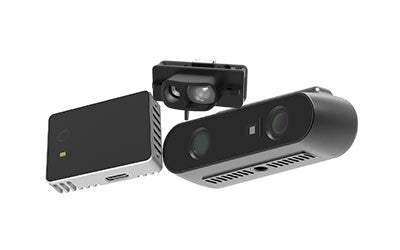
3D Safe Guarding Privacy RGBD Camera Synexens CS30

Conclusion: 3D Camera Filter Enables High-Precision 3D Vision Applications
In the era of intelligent robotics, industrial automation, smart logistics, and AI vision, reliable depth data has become the foundation of successful 3D perception systems.
Advanced technologies such as 3D camera filter, 3D depth camera filter, ToF camera filtering, depth image optimization, and 3D vision technology significantly improve depth accuracy, measurement stability, and environmental adaptability.
In the future, as ToF sensor performance continues to improve and AI algorithms become more integrated, 3D Camera Filter technology will play an increasingly important role in robotics, smart factories, autonomous driving, and intelligent interaction systems.
