

What Is Machine Vision? AI, Industrial Vision & Automation Explained
- par LidarSensor
How Does Machine Vision Work and Why Is It Key for Industrial Automation?
What Is Machine Vision?
Machine Vision, also known as industrial vision systems, and referred to in Spanish as visión artificial or vision artificial, is an advanced technology that integrates industrial cameras, optical lenses, lighting systems, sensors, image processing software, and artificial intelligence (AI) algorithms. It enables machines to possess human-like vision, allowing devices to automatically 'see,' recognize, analyze, and understand information in their environment, performing complex tasks such as inspection, measurement, positioning, and decision-making.
In simple terms, machine vision gives machines 'eyes' and a 'brain.' Industrial cameras act as the eyes, capturing images, while image processing systems and AI algorithms perform analysis and decision-making, functioning like a brain. Together, they allow machines to quickly acquire visual information and make accurate judgments based on pre-set rules or deep learning models.
Humans acquire approximately 80%-90% of external information through visual perception. We observe objects’ color, shape, size, and position through our eyes and then analyze and make decisions with our brain. Similarly, machine vision systems use high-resolution industrial cameras, 3D vision sensors, laser scanners, and intelligent image processing software to capture target images in real-time and analyze various features, including:
- Product dimension measurement
- Color recognition
- Barcode and QR code reading
- Character recognition (OCR)
- Defect detection
- Object positioning
- Shape recognition
- 3D spatial measurement
- Object tracking and classification
Compared to manual inspection, machine vision offers faster detection, higher precision, better stability, and continuous operation. It can complete complex image analysis in milliseconds and is unaffected by fatigue, emotions, or environmental changes, making it widely used in automated production lines and smart manufacturing.
With the rapid development of AI, deep learning, edge computing, and Industry 4.0 technologies, machine vision capabilities have significantly improved. Modern AI machine vision systems can not only recognize simple image features but also learn and understand complex scenarios, enabling autonomous analysis and intelligent decision-making. For example:
- In smart factories, machine vision can automatically detect surface defects.
- In logistics and warehousing, it enables package recognition and automatic sorting.
- In robotics, it helps robots perform precise grasping and autonomous navigation.
- In autonomous driving, it recognizes roads, vehicles, pedestrians, and traffic signs.
Today, Machine Vision has become an essential technology in intelligent manufacturing, industrial automation, robotics, semiconductor production, automobile manufacturing, electronics assembly, food packaging, medical inspection, and smart logistics. As global enterprises continue to pursue digital transformation and smart factories, visión artificial helps companies improve production efficiency, reduce operational costs, enhance product quality, and advance industrial automation to higher levels.
In the future, with the continuous development of AI visual inspection, 3D machine vision, industrial robot vision guidance, and intelligent perception technologies, machine vision will play a key role in more industries, serving as a cornerstone for Industry 4.0 and smart manufacturing.

The Development Background of Machine Vision and Visión Artificial
As global manufacturing enters the digital transformation and smart manufacturing era, companies demand higher production efficiency, product quality, and automation. Traditional manual inspection and operation can no longer meet the requirements for high-speed, high-precision, large-scale production. In this context, machine vision has rapidly evolved and become a core part of industrial automation and intelligent manufacturing.
From the Industrial Revolution to Industry 4.0, production equipment has evolved from mechanization to automation, digitization, and now intelligence. The rapid advancement of AI, IoT, big data analytics, cloud computing, and deep learning has significantly enhanced the application range and capabilities of machine vision. Modern systems can handle not only simple image capture and recognition but also complex data analysis, defect assessment, and autonomous decision-making, providing intelligent visual solutions for modern industry.
In Spanish-speaking markets such as Spain, Mexico, Argentina, Colombia, and Chile, machine vision is often referred to as:
- Visión Artificial
- Vision Artificial Industrial
- Sistema de Visión Artificial
- Inspección Visual Automática
- Sistema de Inspección por Visión
- Visión Artificial para Automatización
- Visión Artificial Industrial con IA
Rapid Growth of the Global Machine Vision Market
The global machine vision market has been growing rapidly. Key drivers include:
- Increasing demand for manufacturing automation
- Rising labor costs
- Higher product quality standards
- Maturity of AI and deep learning algorithms
- Growth in smart factory implementation
- Proliferation of industrial robots
- Rapid development of e-commerce and smart logistics
Industries like electronics manufacturing, automotive, semiconductors, new energy batteries, and medical devices require high-precision visual inspection and automated quality control, further driving machine vision development.
Enterprises are moving from traditional sampling inspection to 100% online inspection. By deploying machine vision systems, companies can monitor production in real-time, detect defects quickly, and improve product consistency and efficiency.
AI Drives Machine Vision into the Intelligent Era
Early machine vision relied on fixed-rule image recognition, such as color judgment, edge detection, and template matching. However, these methods struggled with complex scenes, product variations, or environmental disturbances.
With AI and deep learning, AI visual inspection (AI Vision Inspection) has become a key trend. By training neural network models, modern machine vision can autonomously learn large image datasets to achieve:
- Automatic defect detection
- Product classification
- Object detection
- OCR character recognition
- Facial recognition
- Behavior analysis
- 3D spatial perception
Compared to traditional systems, AI machine vision offers higher accuracy and stronger environmental adaptability, handling complex industrial scenarios efficiently.
Main Applications of Machine Vision
Machine Vision and Visión Artificial are widely used across multiple industries and scenarios:
Smart Manufacturing
For product inspection, dimension measurement, assembly verification, and production monitoring, enabling automated quality management.
Automated Production Lines
Detect defects in real-time, replacing manual inspection, improving efficiency and product consistency.
AGV (Automated Guided Vehicles)
Use vision navigation to identify paths, obstacles, and environment information for automatic transport and warehousing.
AMR (Autonomous Mobile Robots)
Use vision sensors and AI algorithms for environmental perception, path planning, and dynamic obstacle avoidance.
Industrial Robot Guidance
Provide precise positioning to assist robots with picking, assembly, welding, and palletizing.
Autonomous Driving and Intelligent Transportation
Recognize lane lines, traffic signs, pedestrians, and vehicles for assisted and autonomous driving.
Medical Imaging
Assist doctors in analyzing X-rays, CT, and MRI data for efficient and accurate diagnosis.
Warehousing and Logistics
Barcode reading, package recognition, automatic sorting, and inventory management to optimize logistics operations.
Food and Packaging
Inspect packaging integrity, labeling accuracy, and product appearance to ensure safety and compliance.
Semiconductor and Electronics Manufacturing
Detect micro- and nano-level defects in chips, PCBs, and precision components.
How Machine Vision Helps Enterprises Upgrade Intelligently
Implementing Machine Vision and Visión Artificial allows companies to:
- Increase production efficiency
- Reduce labor costs
- Minimize human errors
- Improve product quality
- Enable real-time monitoring
- Optimize production processes
- Increase equipment utilization
- Accelerate digital transformation
With continuous progress in AI, 3D vision, edge computing, and robotics, machine vision will play a greater role in industrial automation, smart logistics, intelligent robots, and digital factories.
Components of a Machine Vision System
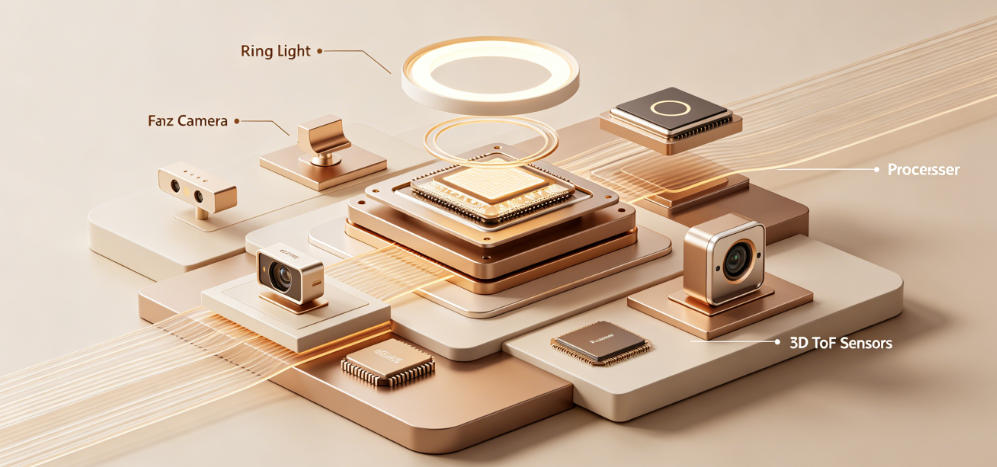
A complete machine vision system usually includes hardware and software components:
1. Lighting System
Good lighting is essential for accurate inspection.
Common industrial lighting:
- LED ring lights
- Bar lights
- Coaxial lights
- Infrared lights
- Structured light projectors
Optimized lighting improves image quality and inspection accuracy.
2. Industrial Camera
Captures images and data.
Types:
- Area-scan cameras
- Line-scan cameras
- RGB cameras
- ToF cameras
- 3D industrial cameras
High-resolution cameras detect micron-level defects.
3. Vision Sensors
Sense the environment:
- Depth sensors
- LiDAR
- 3D ToF sensors
- RGB-D sensors
Help robots with spatial perception and autonomous navigation.
4. Image Processing Software
Analyzes captured images using:
- Image enhancement
- Edge detection
- Template matching
- OCR recognition
- Defect detection
- Object tracking
5. AI and Deep Learning Algorithms
Modern systems increasingly use AI, e.g.,
- CNN (Convolutional Neural Networks)
- YOLO object detection
- Image classification
- Semantic
Below is the continuation and completion of the English translation, with important SEO keywords bolded throughout:
5. AI and Deep Learning Algorithms
Modern Machine Vision Systems increasingly rely on Artificial Intelligence (AI) and Deep Learning technologies, including:
- CNN (Convolutional Neural Networks)
- YOLO Object Detection
- Image Classification
- Semantic Segmentation
- Instance Segmentation
AI-powered Vision Systems can continuously learn and improve their recognition capabilities, significantly enhancing inspection accuracy and reliability.
How Does Machine Vision Work?
A typical Machine Vision workflow consists of the following steps:
Step 1: Image Acquisition
Industrial cameras capture images of the target object or production process.
Step 2: Image Preprocessing
The system performs image optimization, including:
- Noise Reduction
- Image Enhancement
- Image Correction
- Filtering
These processes improve image quality before analysis.
Step 3: Feature Extraction
The system identifies important product characteristics such as:
- Color
- Size
- Shape
- Texture
Step 4: AI Analysis
Using Deep Learning Models and AI Algorithms, the system performs:
- Defect Detection
- Product Classification
- Object Recognition
- Target Localization
Step 5: Automated Action Execution
Based on the analysis results, the system automatically performs tasks such as:
- Product Sorting
- Quality Inspection Decisions
- Robotic Picking and Placement
- AGV Navigation
The entire process is typically completed within milliseconds, enabling real-time inspection and decision-making.

Key Advantages of Machine Vision
Increased Production Efficiency
Machine Vision Systems can operate 24/7 without fatigue.
Compared with manual inspection, they offer:
- Faster inspection speeds
- Lower error rates
- Higher automation levels
As a result, manufacturers can significantly improve productivity.
Reduced Production Costs
Automated Vision Inspection Systems help reduce:
- Labor Costs
- Rework Costs
- Downtime Losses
This contributes to a higher return on investment (ROI) for manufacturing companies.
Non-Contact Inspection
Vision Artificial Systems can inspect products without physical contact.
This makes them ideal for industries such as:
- Food Processing
- Medical Devices
- Precision Electronics
Non-contact inspection reduces contamination risks and prevents product damage.
Improved Product Quality
Machine Vision can detect:
- Micro Cracks
- Surface Defects
- Dimensional Errors
- Incorrect Labels
This enables 100% Inline Inspection, ensuring consistent product quality.
Enhanced Workplace Safety
In hazardous environments, Machine Vision Systems can replace manual operations, including:
- High-Temperature Environments
- Chemical Processing Facilities
- Radiation Areas
- Automated Warehouses
This improves worker safety while maintaining operational efficiency.
Future Trends in AI Machine Vision
The future of Machine Vision, AI Vision Inspection, and Visión Artificial Industrial is being shaped by several key technologies.
1. 3D Vision
3D Machine Vision enables more accurate spatial perception and object measurement.
Applications include:
- Robotic Guidance
- Bin Picking
- Autonomous Navigation
- Precision Manufacturing
2. AI Vision Inspection
AI-powered Visual Inspection is becoming the industry standard.
Deep learning allows systems to identify complex defects that traditional rule-based algorithms may miss.
Benefits include:
- Higher Accuracy
- Better Adaptability
- Continuous Learning
- Reduced False Detection Rates
3. Edge Computing Vision Systems
Edge AI Vision Systems process data directly on devices instead of relying solely on cloud servers.
Advantages include:
- Lower Latency
- Faster Decision Making
- Reduced Bandwidth Usage
- Improved Data Security
4. Multi-Sensor Fusion
Future Machine Vision Solutions will combine multiple sensing technologies, including:
- RGB Cameras
- LiDAR
- IMU Sensors
- ToF Sensors
- Thermal Cameras
By fusing data from multiple sources, systems can achieve more reliable environmental perception and higher operational accuracy.
5. Autonomous Robot Decision-Making
The next generation of intelligent robots will not only "see" but also "understand" and "decide."
Combining:
- Machine Vision
- Artificial Intelligence
- Robotics
- Deep Learning
will enable robots to perform increasingly complex tasks autonomously in industrial and commercial environments.
3D Safe Guarding Privacy RGBD Camera Synexens CS30

Conclusion
Machine Vision, Visión Artificial, and Vision Artificial Industrial are transforming the future of Industrial Automation, Smart Manufacturing, and Digital Transformation worldwide.
Powered by Artificial Intelligence, Deep Learning, 3D Vision, advanced sensors, and intelligent image processing technologies, modern Machine Vision Systems can deliver highly accurate inspection, real-time analysis, autonomous decision-making, and robotic guidance capabilities.
As Industry 4.0, Smart Factories, Industrial Robotics, Autonomous Mobile Robots (AMR), Automated Guided Vehicles (AGV), and AI Vision Inspection Systems continue to evolve, Machine Vision will become an even more critical technology across manufacturing, logistics, healthcare, transportation, semiconductor production, and intelligent automation.
In the coming years, Machine Vision Technology will serve as a foundational pillar of intelligent industry, helping organizations improve efficiency, reduce costs, enhance product quality, and accelerate the transition toward a more connected, automated, and data-driven future.
