

The Evolution of Industrial Machine Vision: Applications & Trends
- par LidarSensor
What Is Industrial Machine Vision and How Is It Transforming Smart Manufacturing?
In modern industry and intelligent manufacturing, machine vision has become a key technology for improving production efficiency, ensuring product quality, and enabling automated control. With the rapid development of Industry 4.0 and smart factories, industriellen bildverarbeitung (industrial image processing) is gradually moving from laboratory research to large-scale industrial applications, bringing profound transformation to the manufacturing sector. This article provides a detailed overview of the development history, core technologies, and future trends of machine vision.
What is Industrial Machine Vision?
Industrial Machine Vision refers to the use of cameras, sensors, software, and algorithms to capture, analyze, and interpret images in industrial environments, enabling automated decision-making. It is a core component of modern automation and quality control systems.
Key Points:
-
Image Capture
High-resolution cameras or 3D sensors capture images or video of products, components, or production processes. -
Image Analysis
Software processes visual data using techniques such as pattern recognition, edge and contour detection, grayscale analysis, defect detection, and deep learning models. -
Decision & Control
Based on image analysis, machines can automatically perform actions such as sorting, inspection, packaging, measurement, or process adjustment.

1. Origins and Early Development of Machine Vision
The concept of machine vision first emerged in the 1960s, initially focusing on basic image processing, pattern recognition, and laboratory research. At that time, systems relied heavily on analog cameras, simple signal acquisition devices, and basic algorithms to identify object shapes, sizes, and positions. Although primitive in functionality, these early experiments laid the theoretical foundation for modern industriellen bildverarbeitung (industrial image processing).
-
1960s: Laboratory Exploration Phase
Researchers experimented with analog image capture devices to analyze simple geometric shapes and patterns, mainly for academic research and algorithm validation. -
1970s: Emergence of Digital Image Processing
With the early development of digital computing, the first digital image processing methods appeared. Scientists began applying digital techniques to industrial measurement tasks such as dimensional inspection and surface contour analysis. -
1980s: Computer-Assisted Image Analysis
Rapid improvements in computing power significantly increased image processing speed and accuracy. Machine vision systems gradually moved from laboratories to pilot applications in industrial production lines, enabling early automated inspection experiments.
Although early machine vision systems were limited in capability, they opened the path toward industrial image recognition and laid the groundwork for smart manufacturing and Industry 4.0 vision systems.
2. Development Driven by Computers and Algorithms
In the 1990s, with breakthroughs in computing power and algorithm research, machine vision shifted from academic research to real industrial applications, enabling automatic inspection, quality control, and process monitoring.
-
Widespread adoption of digital cameras and high-resolution sensors
Industrial-grade cameras enabled more precise image acquisition, providing reliable data for accurate inspection. -
Algorithm innovation and intelligent analysis
Edge detection, template matching, grayscale analysis, and early pattern recognition techniques were widely applied in production lines for defect detection and assembly verification. -
Integration with industrial automation systems
With PLC (Programmable Logic Controllers) and automated machinery, machine vision became a core component of industrial automation (industriellen bildverarbeitung). For example, in electronics manufacturing, it enabled fast inspection of PCB solder joints, improving production efficiency and yield. -
Data accumulation and early intelligence development
These systems began generating large amounts of inspection data, laying the foundation for the later adoption of AI and deep learning in machine vision systems.
Through these stages, machine vision evolved from theoretical research to industrial practice, forming a core technology chain for smart manufacturing and establishing the foundation for modern industriellen bildverarbeitung in Industry 4.0 environments.
3. Modern Machine Vision Technologies and Applications
In the 21st century, machine vision has entered a period of rapid development, driven by deep learning, artificial intelligence (AI), and 3D imaging technologies. Key characteristics include:
-
High-precision and high-speed processing
Advanced algorithms and high-resolution cameras enable millisecond-level image analysis. -
Multi-scenario adaptability
Modern systems can operate under varying lighting, angles, and environments, making them suitable for production lines, logistics sorting, and electronics assembly. -
3D vision and dimensional measurement
Stereo vision and laser scanning technologies enable not only defect detection but also precise measurement and spatial positioning. -
Deep integration with industrial automation
Machine vision systems connect with robots, AGV systems, and PLC controllers to achieve full production line automation.

4. Typical Industry Applications of Machine Vision
Machine vision technology has become an essential core technology in industrial automation and smart manufacturing, covering multiple key sectors from production to logistics.
-
Automotive Industry
Used for body dimension inspection, weld quality control, paint surface inspection, and component assembly verification, enabling highly automated and lean production lines. -
Electronics Manufacturing
PCB solder inspection, chip recognition, and SMT placement accuracy control. With industriellen bildverarbeitung, manufacturers maintain high yield rates in high-speed production environments. -
Food and Pharmaceutical Industry
Packaging integrity inspection, barcode and QR code recognition, bottle inspection, and pharmaceutical compliance verification ensure safety and regulatory compliance. -
Logistics and Warehousing
Automated sorting systems, barcode scanning, cargo tracking, and volume measurement combined with AGV systems and WMS solutions significantly improve warehouse throughput and efficiency. -
Other Industries
Metal processing, textile printing, plastic packaging, and semiconductor manufacturing also widely use machine vision for defect detection, measurement, and automation.
These applications demonstrate that industriellen bildverarbeitung is not just an inspection tool but a core 'neural system' of industrial automation and intelligent manufacturing.
5. Future Trends: Intelligence and Full Automation
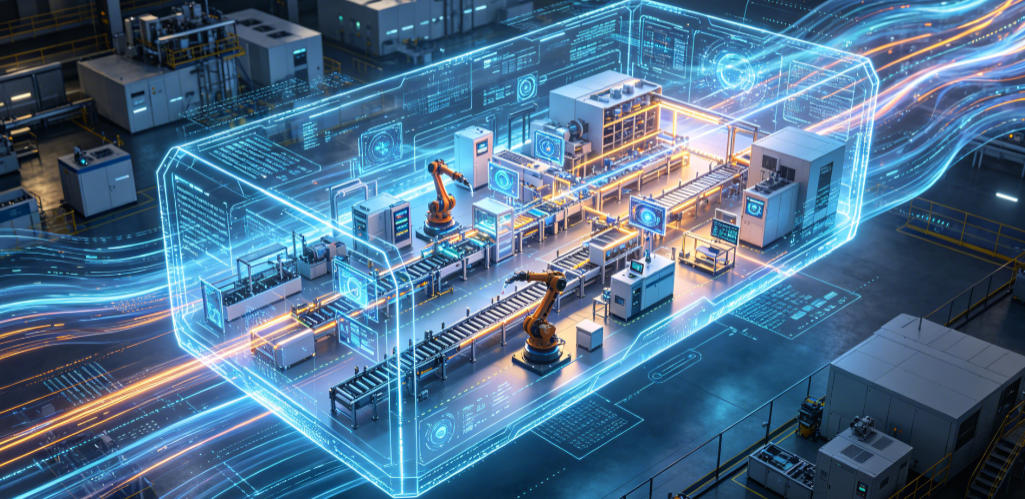
With the rise of Industry 4.0 and smart factories, machine vision is rapidly evolving toward intelligence, connectivity, and full automation, integrating AI, Industrial IoT (IIoT), and digital twin technologies:
-
AI + Machine Vision
Deep learning improves recognition accuracy, defect detection, and predictive optimization. -
Cloud-based visual analytics and big data integration
Centralized data processing enables cross-factory monitoring and intelligent production optimization. -
Industrial IoT (IIoT) integration
Machine vision systems work with robots, AGVs, PLCs, and sensor networks for real-time decision-making and automation. -
Low-cost high-performance sensors and cameras
Reducing costs allows small and medium enterprises to adopt advanced machine vision systems. -
Digital twins and virtual simulation
Virtual production lines enable real-time simulation, optimization, and predictive maintenance, improving operational efficiency and transparency.
In this trend, industriellen bildverarbeitung will evolve beyond an inspection tool into the core sensing, analysis, and decision-making engine of smart factories.
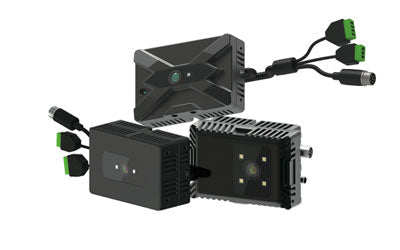
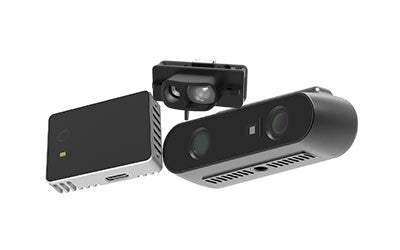
Synexens Industrial Outdoor 4m TOF Sensor Depth 3D Camera Rangefinder_CS40p

6. Conclusion
From early laboratory research to modern smart factories, machine vision and industrial image processing (industriellen bildverarbeitung) have evolved over more than half a century. With the integration of AI, 3D vision, and Industrial IoT, machine vision is playing an increasingly important role in industrial automation, smart manufacturing, and digital factories.
By deploying advanced machine vision systems, enterprises can not only improve production efficiency and quality control but also achieve full-process automation and intelligent decision-making under the vision of Industry 4.0, providing a solid foundation for digital transformation in manufacturing.
