

Structured Light Camera Explained: 3D Structured Light for Industry
What Is a Structured Light Camera and How Does 3D Structured Light Work in Industrial Applications?
With the rapid advancement of industrial automation, smart manufacturing, and robotics, the structured light camera has become a core sensor in industrial 3D vision systems. Powered by advanced 3d structured light technology, these cameras can efficiently capture accurate 3D data of objects, playing a critical role in applications such as robotic picking, 3D scanning, dimensional measurement, and quality inspection.
Compared to traditional 2D vision systems, structured lighting enables machines to gain true depth perception, allowing them to understand spatial structures and significantly accelerating the evolution toward intelligent manufacturing.
What is a Structured Light Camera?
A structured light camera is an advanced active 3D imaging device and one of the most important depth-sensing technologies in industrial 3D vision. It works by projecting encoded light patterns (known as structured lighting) onto an object’s surface and using high-resolution cameras to capture the deformation of these patterns. This information is then processed to accurately reconstruct the object’s 3D shape and spatial depth.
Unlike conventional 2D cameras, 3d structured light technology not only captures image data but also directly measures distance and geometry, giving machines human-like stereoscopic vision. As a result, structured light cameras are widely used in industrial automation, robot vision, 3D scanning, and intelligent inspection systems.

How Does a Structured Light Camera Work?
A structured light camera performs 3D reconstruction through three main steps:
-
Structured Lighting Projection
The projector emits pre-designed light patterns such as stripes, grids, or phase-encoded patterns onto the object surface. -
Image Capture
As the projected light interacts with the object, it deforms according to the surface geometry. The camera captures these deformed patterns in real time. -
3D Reconstruction
Advanced algorithms analyze the deformation of the light patterns to calculate the spatial coordinates of each pixel, generating accurate 3D models.
This 3d structured light approach enables fast and highly precise 3D reconstruction in real time.
Core Components of a Structured Light Camera
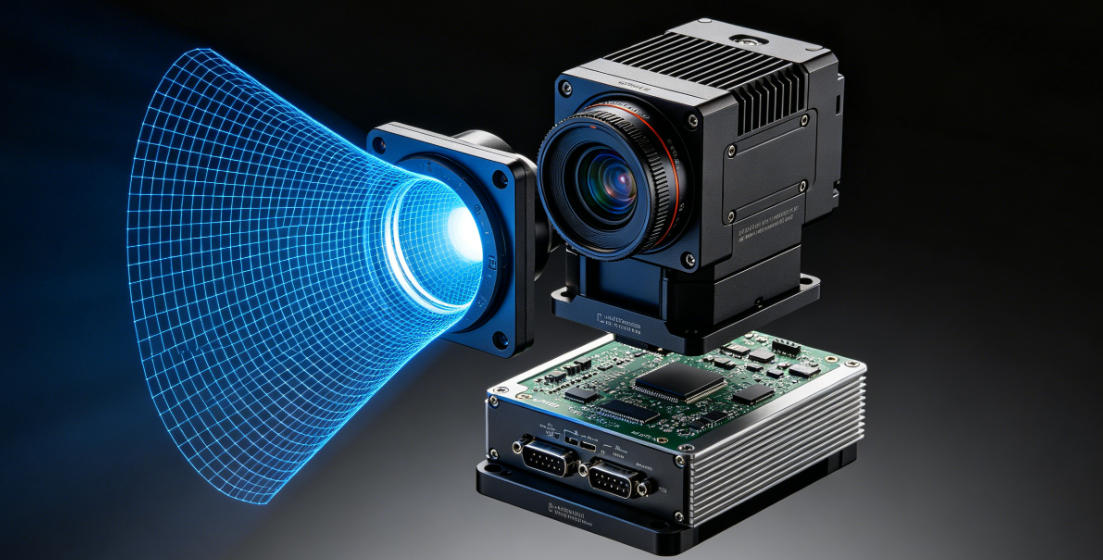
A complete structured light camera system typically consists of three main components:
-
Projection Module
Emits structured lighting patterns and serves as the active light source. -
Imaging Module
Captures reflected light signals with high resolution and frame rate. -
Processing Unit
Uses advanced algorithms to generate depth maps and 3D point clouds.
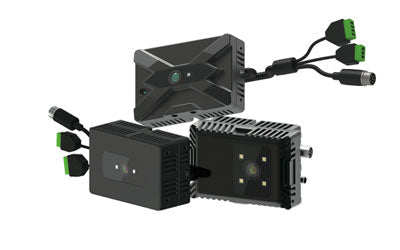
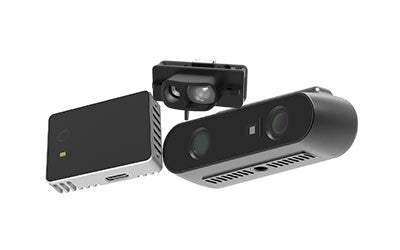
In high-end industrial applications, these components are often tightly integrated into a compact, industrial-grade depth camera.
Output Data Types of Structured Light Cameras
Using structured lighting, structured light cameras can output multiple types of data:
-
Depth Map
Provides distance information for each pixel, essential for positioning and navigation. -
RGB Image
Supplies visual information for object recognition and AI-based analysis. -
Amplitude Image
Reflects signal strength, helping improve data reliability and noise resistance. -
3D Point Cloud
A collection of spatial coordinates used for 3D scanning, modeling, and inspection.
Because of this multi-modal output, structured light cameras are often referred to as RGB-D cameras or industrial depth cameras, playing a vital role in industrial 3D vision systems.
Why Are Structured Light Cameras Important?
In modern smart manufacturing and robotics, traditional vision systems can no longer meet the demands of spatial understanding. 3d structured light technology fills this gap by providing precise depth perception.
From industrial 3D inspection and robotic picking to 3D modeling and smart logistics, structured light cameras are becoming indispensable components in next-generation automation systems.
Principles of 3D Structured Light Technology
The core of 3d structured light lies in light encoding and decoding. The system projects encoded patterns such as stripes, grids, or phase-shift signals onto an object. When these patterns deform, the camera captures the changes and reconstructs the object’s geometry.
Common techniques include:
- Fringe Projection
- Phase Shift Methods
- Gray Code Encoding
- Multi-frequency Structured Light
These techniques enable structured lighting to achieve:
- Extremely high measurement accuracy (down to microns)
- Strong resistance to environmental interference
- Excellent detail reconstruction
This makes it ideal for industrial inspection and precision measurement.
Key Advantages of Structured Light Cameras
1. High-Precision 3D Measurement
In industrial 3D vision, accuracy is critical. A structured light camera can achieve sub-millimeter or even micron-level precision, especially in short-range applications.
Compared to other technologies, 3d structured light excels at capturing fine details and complex geometries, making it ideal for:
- Precision manufacturing inspection
- Electronic component and PCB measurement
- 3D dimensional analysis and tolerance control
- Industrial 3D scanning and reverse engineering
2. Strong Performance on Low-Texture Surfaces
Traditional 2D vision relies heavily on surface texture. However, structured lighting actively projects patterns, effectively adding artificial features to the object.
This allows structured light cameras to perform reliably on:
- Dark or black objects
- Smooth or reflective surfaces (metal, glass)
- Texture-less or low-contrast objects
This capability is particularly valuable in robotic picking, bin picking, and automated assembly.
3. RGB-D Data Fusion
Modern structured light cameras support RGB-D fusion, combining visual and depth data:
- RGB Images for recognition and classification
- Depth Maps for positioning and navigation
- 3D Point Clouds for modeling and spatial analysis
This multi-modal capability enhances performance in:
- Robot vision and grasping
- AI-based object detection
- 3D reconstruction and digital twins
- Automated inspection systems
4. Strong Industrial Adaptability
Industrial environments are often challenging, with strong lighting, dust, and vibrations. Structured lighting offers:
- High resistance to ambient light interference
- Stable and consistent measurements
- Robust performance in complex environments
- Industrial-grade durability for continuous operation
This makes structured light cameras suitable for:
- Smart manufacturing lines
- Automated inspection systems
- Logistics and sorting systems
- Industrial robotic workstations
5. Easy Integration and Development
Modern structured light cameras are designed for flexibility and ease of integration:
- Cross-platform support (Linux / Windows / Ubuntu)
- ROS / ROS2 compatibility
- Multiple programming interfaces (C++, Python, SDK, API)
- Standard industrial interfaces (GigE, USB 3.0)
With comprehensive SDKs and development tools, engineers can quickly build:
- Industrial 3D vision systems
- Robotic picking solutions
- Automated inspection platforms
- 3D scanning applications

Applications of Structured Lighting in Industry
1. Robotic Picking and Bin Picking
Using 3d structured light to detect object pose enables:
- Bin picking
- Automated sorting
- Intelligent palletizing
2. Industrial 3D Inspection
Used for:
- Surface defect detection
- Dimensional measurement
- Deformation analysis
3. 3D Scanning and Modeling
Widely used in:
- Industrial modeling
- Reverse engineering
- Cultural heritage digitization
- Medical modeling
4. Smart Logistics and Warehousing
Applications include:
- Parcel recognition
- Volume measurement
- Automated sorting systems
5. Humanoid and Service Robots
Used for:
- Environment perception
- Obstacle detection
- Precision manipulation
Structured Light vs ToF vs Stereo Vision
Structured Light Camera
- Accuracy: ★★★★★
- Range: Short to mid-range
- Best for: Precision inspection and measurement
ToF Camera
- Accuracy: ★★★
- Range: Long-range
- Best for: Navigation and human detection
Stereo Vision
- Accuracy: ★★★
- Cost: Lower
- Best for: Basic depth sensing
Overall, structured light cameras offer the highest accuracy for industrial applications.
Why Choose Structured Light Cameras?
If your application requires:
- High-precision 3D measurement
- Industrial automation
- Robot vision
- 3D scanning and modeling
Then 3d structured light technology is one of the best choices.
It delivers reliable depth data and stable performance even in complex environments, making it a key technology in Industry 4.0.
Conclusion
Structured light camera, 3d structured light, and structured lighting technologies are rapidly transforming industrial 3D vision. From robotic picking to intelligent inspection, and from 3D scanning to automated production, these technologies are reshaping modern industry.
As AI and 3D vision continue to evolve, structured light cameras will play an even more critical role in enabling smarter, more efficient automation systems.

-
Publié dans
CS40P
