

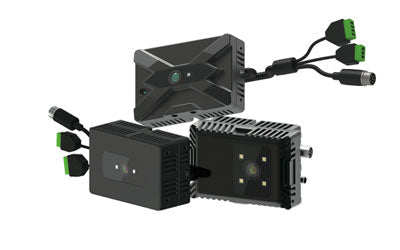
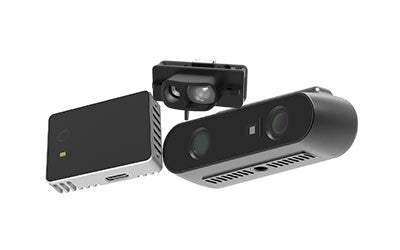
Applications of ToF Depth Cameras in Smart Warehousing AGV Automation
How Are ToF Depth Cameras Used to Improve Efficiency in Smart Warehousing?
A Core Enabler for Warehouse Robots, AGVs, and Automated Logistics
In modern warehouse management, efficiency and accuracy are the key indicators of operational performance. As e-commerce, cold-chain logistics, and express delivery industries continue to demand faster fulfillment and more precise inventory control, advanced technologies have become a critical driver of warehouse optimization.
Among these technologies, TOF (Time-of-Flight) depth cameras, with their high-precision 3D perception capabilities, are rapidly becoming a core component of smart warehousing and automated logistics systems.
1. What Is a ToF Depth Camera?
A ToF (Time-of-Flight) camera is an active 3D sensing device that emits modulated light and measures the time or phase shift of the reflected signal to achieve high-precision distance measurement.
Compared with traditional vision systems, ToF cameras offer several key advantages:
-
High-precision depth perception: Accurate measurement of object position and height
-
Strong resistance to lighting interference: Reliable operation under strong light, low light, and complex lighting conditions
-
High real-time performance: High-frame-rate depth output suitable for dynamic operations
-
AI-friendly data: Depth maps and point clouds can be directly used for intelligent algorithm processing
As a result, ToF technology is particularly well suited for automated material handling, AGV navigation, and pallet recognition in warehouse environments.

2. Typical Applications of ToF Depth Cameras in Smart Warehousing
1. Inventory Management
-
High-precision 3D scanning and measurement
ToF depth cameras can rapidly scan goods of different sizes and stacking configurations (regular stacks, irregular stacks, or mixed stacking), accurately capturing length, width, height, and overall volume. Stable measurement accuracy is maintained even in high-density shelving or multi-layer stacking scenarios. -
Intelligent recognition of stacking height and slot status
Based on real-time 3D point cloud data, the system can automatically identify slot conditions such as empty, partially occupied, fully occupied, or overstacked, avoiding common misjudgments associated with 2D vision or manual inventory checks. -
Real-time automatic inventory updates
ToF cameras can integrate with WMS / WES systems to enable real-time feedback and automatic updates of inventory quantity, slot status, and cargo dimensions, significantly reducing manual data entry and inventory checks while minimizing human error. -
Support for automated inventory counting and anomaly detection
Through scheduled or event-triggered scans, the system can automatically detect inventory discrepancies, abnormal stacking, or missing goods, providing reliable data support for warehouse management.
2. Autonomous Navigation & Obstacle Avoidance
-
3D environmental perception for AGVs and warehouse robots
ToF depth cameras continuously capture 3D depth information of the surrounding environment, enabling the construction of high-precision 3D maps. This allows AGVs, AMRs, and warehouse robots to accurately identify aisles, racks, pallets, and dynamic obstacles such as personnel or forklifts. -
Dynamic path planning and optimization
Based on real-time 3D perception data, the system can dynamically adjust routes according to aisle congestion, obstacle changes, and task priority, enabling more efficient and intelligent navigation while reducing unnecessary detours and waiting time. -
Real-time obstacle avoidance in high-density warehouses
In narrow aisles, high-density shelving, and human–robot collaborative environments, ToF cameras precisely detect obstacle distance and height, enabling centimeter-level obstacle avoidance and significantly reducing collision risks. -
Improved operational safety and system stability
Continuous 3D environment monitoring allows AGVs and autonomous forklifts to make early decisions such as slowing down, rerouting, or stopping, greatly enhancing safety and operational stability in human–machine collaboration scenarios.
3. Pallet Recognition & Handling
-
High-precision pallet detection and pose estimation
Using 3D point cloud data captured by ToF depth cameras, the system can accurately identify a pallet’s spatial position, orientation, fork pocket height, and boundary contours. Stable recognition is maintained even under complex lighting conditions, partial occlusion, or inconsistent pallet specifications. -
Pallet height and graspability assessment
ToF technology provides real-time measurement of the pallet’s relative height from the ground and the stacking condition of goods above it, automatically determining whether the pallet is suitable for handling by AGVs, AMRs, or autonomous forklifts, thus preventing mis-grabs or fork collisions. -
Automated handling and precise alignment
Integrated with AGV / AMR control systems, ToF cameras deliver accurate 3D pose data to enable automatic alignment, precise fork insertion, stable lifting, and safe placement, significantly improving handling success rates and operational reliability. -
Significant improvement in overall handling efficiency
By reducing manual intervention and idle positioning time, the system lowers AGV idle rates, increases per-unit task frequency, and maximizes overall warehouse throughput.
4. Automated Container Unloading & Picking
-
3D depth modeling of containers and bins
ToF depth cameras rapidly scan the interior of containers, trailers, or bins to generate high-precision depth maps and point cloud models, accurately capturing spatial distribution, stacking patterns, and gap information of the cargo. -
Intelligent unloading for diverse cargo types
For regular cartons, irregular packages, or mixed loads, ToF technology provides reliable 3D perception data to guide robots in grasp point selection, pose adjustment, and safe unloading operations. -
Vision-guided robotic sorting
During unloading, AI vision algorithms can be applied to classify and locate items, guiding sorting robots to perform automated sorting, stacking, or conveying, thereby integrating unloading and sorting into a single workflow. -
Reduced labor dependency and higher operational throughput
Automated unloading and sorting systems can operate continuously and reliably, significantly reducing manual labor intensity and safety risks while greatly improving overall processing speed and capacity.
5. Indoor Mapping & Intelligent Scheduling
-
High-precision warehouse 3D mapping and environment perception
By deploying multiple ToF depth cameras, a complete and continuously updated 3D warehouse map can be constructed, accurately reflecting rack layouts, aisle structures, slot distribution, and dynamic obstacles, providing comprehensive environmental understanding for AGVs and robots. -
Multi-robot collaborative perception and task sharing
Based on a unified 3D environment model, multiple AGVs / AMRs can share real-time perception data, enabling cooperative obstacle avoidance, path negotiation, and task collaboration, reducing congestion and conflicts while improving system efficiency. -
AI-driven intelligent task scheduling
Combined with AI algorithms and real-time 3D data, the system can dynamically optimize task allocation and transport routes according to task priority, device status, and environmental changes, enabling more intelligent and flexible scheduling strategies. -
Deep integration with WMS / WES systems
The ToF vision system serves as a critical bridge between perception and decision layers, providing WMS systems with accurate, real-time field data to enable closed-loop automation of task dispatching, status feedback, and inventory updates.


