

How Vision Guided Robotics Improves Smart Packaging Automation
- von LidarSensor
How Does Vision Guided Robotics Enable Smarter Robotic Packaging and Palletizing?
With the rapid development of artificial intelligence (AI), machine vision, robot control technologies, and smart manufacturing, industrial robots are evolving from traditional repetitive automation equipment into new-generation intelligent systems with environmental perception, intelligent decision-making, and autonomous operation capabilities. In the past, most industrial robots relied on fixed programs to perform tasks such as welding, assembly, and material handling on production lines. Although these robots significantly improved production efficiency, they had limited adaptability when facing product changes, environmental variations, and the growing demand for flexible manufacturing.
Today, with the development of Vision Guided Robotics, robots are gaining perception capabilities similar to human vision. By combining industrial cameras, 3D vision sensors, artificial intelligence algorithms, and robot control systems, vision guided robots can identify object positions in real time, understand spatial relationships, and autonomously perform complex tasks such as picking, sorting, packaging, and palletizing according to changing environments.
Especially in modern manufacturing, smart warehousing, and logistics automation, imballaggio e pallettizzatore robotizzati (robotic packaging and palletizing systems) have become important solutions for enterprises looking to improve production efficiency, reduce labor costs, and achieve intelligent manufacturing.
What Is Vision Guided Robotics?
Vision Guided Robotics is an intelligent automation solution that integrates machine vision, artificial intelligence (AI), 3D perception technology, and industrial robot systems. By using cameras, depth sensors, and vision algorithms, it gives robots perception capabilities similar to human eyes and brains, allowing them not only to execute predefined movements but also to understand their surroundings and adjust operations according to real-time changes.
Traditional industrial robots usually operate based on fixed coordinates, fixed trajectories, and pre-programmed instructions. For example, in automotive manufacturing, electronic assembly, or packaging production lines, robots repeatedly perform tasks such as picking, welding, assembling, or transporting materials at predetermined locations. However, this approach has limited adaptability. When product sizes change, object positions shift, or production lines are redesigned, manual robot recalibration is often required.
By introducing visual perception systems, Vision Guided Robotics enables robots to collect real-time environmental information and make intelligent adjustments. For example, in an automated packaging line, products may shift due to conveyor speed, placement angles, or positioning errors. Traditional robots may fail to accurately pick these products, while robots equipped with a vision guided robotics system can identify product location, orientation, and pose, automatically calculate the optimal picking position, and adjust motion paths to achieve more flexible and precise automation.
Simply put, Vision Guided Robotics provides robots with three core capabilities:
1. See the Environment
Robots first need to collect information about their surroundings through vision systems. Industrial vision equipment can capture product images, spatial positions, and depth information, including:
- Product appearance and color;
- Object size and shape;
- Product arrangement;
- Distance between objects;
- Obstacles within the working area.
Compared with traditional sensors that only detect simple positions, vision systems provide richer environmental data, allowing robots to achieve stronger perception capabilities.
2. Understand the Target
After collecting visual data, AI vision algorithms analyze images and spatial information to help robots understand target objects.
Through computer vision and deep learning algorithms, robots can perform:
- Product recognition;
- Object classification;
- Defect detection;
- Pose estimation;
- 3D positioning;
- Optimal picking point calculation.
For example, in smart warehouse environments, robots can recognize packaging boxes of different sizes, determine their orientation, position, and stacking condition, and select the most suitable grabbing method.
3. Act and Execute Tasks
After the vision system completes analysis, the data is transmitted to the robot control system, which converts visual information into physical actions.
These operations include:
- Robotic picking;
- Robotic packaging;
- Robot palletizing;
- Robotic sorting;
- Robot assembly.
Therefore, Vision Guided Robotics not only improves robot positioning accuracy but also enhances autonomous operation capabilities in complex environments.

Vision guided robots usually consist of three major components:
The First Component: Industrial Vision System
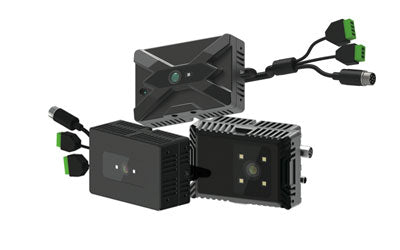
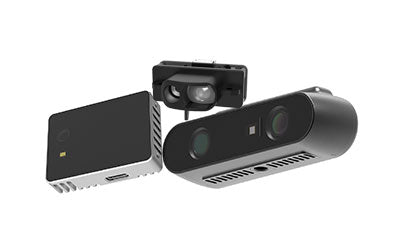
The industrial vision system is responsible for collecting environmental information and acts as the 'eyes' of the robot. Depending on application requirements, different types of vision devices can be used, including:
- RGB Industrial Camera: Used to capture color, texture, and image information;
- 3D Vision Camera: Used to obtain object structures and three-dimensional coordinates;
- Depth Camera: Used for distance measurement;
- ToF Camera (Time of Flight Camera): Calculates depth information by measuring light travel time and is suitable for high-speed industrial inspection and robot navigation.
Through these visual sensors, robots can obtain accurate spatial information and provide reliable data for intelligent decision-making.
The Second Component: AI Vision Algorithms
AI vision algorithms are the core technology that enables intelligence in Vision Guided Robotics. They transform camera data into information that robots can understand.
Main functions include:
- Image recognition;
- Object detection;
- Object localization;
- Pose estimation;
- 3D reconstruction.
For example, in robotic packaging applications, AI vision systems can quickly identify products from different brands and sizes and adjust picking strategies according to product position changes, improving automation efficiency.
The Third Component: Robot Control System
The robot control system executes commands generated by vision algorithms and converts visual results into actual movements.
It controls:
- Robotic arm trajectories;
- Gripping force;
- Movement speed;
- Working processes.
Through the cooperation of vision systems, AI algorithms, and robot control systems, Vision Guided Robotics enables more intelligent, efficient, and flexible automated production.
Currently, Vision Guided Robotics is widely used in multiple industries, including:
- Smart Manufacturing;
- Robotic Packaging Automation;
- Robot Palletizing;
- Smart Warehousing;
- Logistics Automation;
- Electronic Assembly;
- Automotive Manufacturing.
Especially in the field of imballaggio e pallettizzatore robotizzati (robotic packaging and palletizing systems), vision guided technology is playing an increasingly important role. It enables robots to handle products of different sizes, shapes, and random arrangements, improving packaging efficiency while reducing dependence on manual operations.
With the development of artificial intelligence, 3D vision, and robotics technologies, Vision Guided Robotics is transforming industrial robots from machines that simply follow programmed instructions into intelligent systems capable of understanding environments and completing tasks autonomously. In the future, robots combined with AI foundation models, advanced visual perception, and intelligent control technologies will be able to adapt to more complex production environments and become essential components of smart factories and automated manufacturing systems.
How Does Vision Guided Robotics Change Industrial Automation?
As manufacturing moves toward flexible production, companies increasingly require automation systems that can adapt to changing environments. Traditional production lines usually depend on fixed programs, meaning robot parameters must be manually adjusted whenever product models or production conditions change.
Vision guided robots solve these challenges through real-time visual feedback. Robots can automatically adjust their actions according to different products, positions, and working environments, making them ideal for modern smart manufacturing applications.
For example, in food processing, electronics, automotive components, and logistics industries, a single production line may handle products with different sizes and packaging formats. Through a vision guided robotics system, robots can automatically identify product types and adjust picking and packaging methods, creating a more efficient automated production process.
How Do Robotic Packaging and Palletizing Systems Improve Production Efficiency?
Packaging and palletizing are essential processes in manufacturing and logistics industries. Traditional manual packaging and handling often involve high labor intensity, limited efficiency, increased labor costs, and risks caused by repetitive work. Therefore, more companies are adopting robotic packaging automation and robot palletizing systems.
Among these technologies, imballaggio e pallettizzatore robotizzati has become an important direction in smart manufacturing. Robotic packaging and palletizing systems can automatically complete product picking, boxing, sealing, stacking, and transportation processes, significantly improving production efficiency.
Compared with manual operations, robotic systems provide advantages such as higher speed, greater accuracy, stable operation, and lower long-term costs. Especially in large-scale manufacturing environments, automated packaging robots and robotic palletizing systems can support continuous 24/7 production and improve overall supply chain efficiency.

Applications of Vision Guided Robotics in Packaging Industries
In automated packaging production lines, products may be randomly arranged or continuously change positions. Through AI vision guided robots, robots can identify product location, orientation, size, and quantity in real time and automatically calculate the optimal picking path.
For example, in the food packaging industry, robots can recognize packaging boxes with different shapes and adjust picking movements according to product position changes, improving packaging speed and accuracy.
In e-commerce and logistics industries, vision guided robots can also be used for automated sorting and packaging. Robots can quickly identify products, classify different items, and complete packaging processes automatically. This type of robotic packaging automation solution significantly improves warehouse logistics efficiency while reducing manual labor requirements.
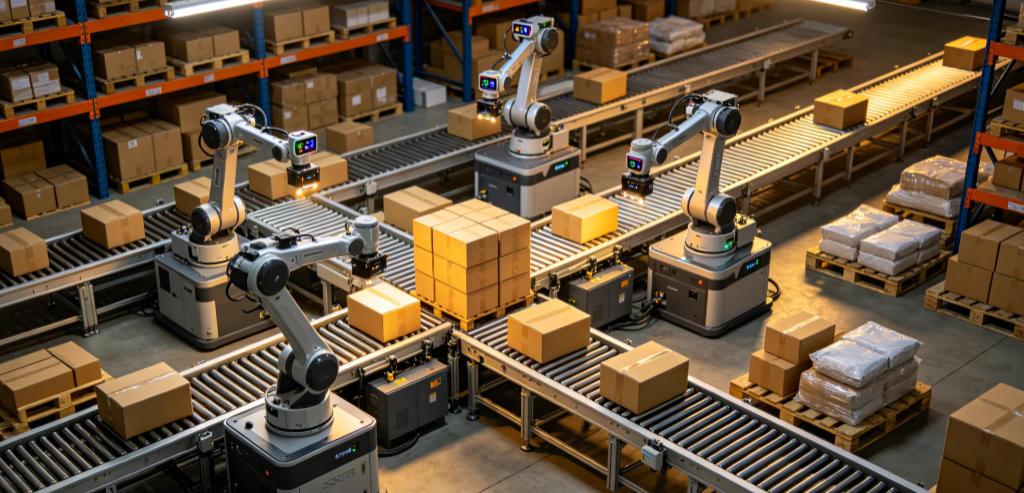
Robot palletizing is another important application of Vision Guided Robotics. Traditional manual palletizing has lower efficiency and may create physical strain due to repetitive lifting tasks. With vision technology, robotic palletizing systems can automatically determine box dimensions, product quantity, pallet position, and the optimal stacking strategy, achieving more stable and efficient automated palletizing. Therefore, robotic palletizer for warehouse automation has become an important solution in modern smart logistics centers.
What Are the Core Technologies Behind Vision Guided Robotics?
Vision guided robots rely on several advanced technologies, including 3D vision, depth perception, artificial intelligence machine vision, and robot control systems.
3D Vision Technology is one of the most important components of Vision Guided Robotics. Compared with traditional 2D cameras, 3D vision systems provide depth information and spatial coordinates, allowing robots to understand the true position and three-dimensional structure of objects. This enables robots to perform more complex industrial tasks such as bin picking, precision assembly, and intelligent packaging.
Depth Perception technology helps robots understand spatial distances between objects. Common technologies include ToF (Time of Flight), Structured Light, and Stereo Vision.
Among them, ToF technology calculates distance by measuring the travel time of light signals. It offers fast response speed and real-time performance, making it highly suitable for robot navigation, industrial inspection, and automated packaging applications. Structured Light technology obtains 3D information by projecting specific patterns onto objects and provides high measurement accuracy. Stereo Vision uses two cameras to simulate human binocular vision and calculates depth through visual disparity, providing strong environmental adaptability.
With the development of deep learning, AI Machine Vision has further improved robot recognition capabilities. AI vision algorithms enable robots to recognize complex objects, adapt to environmental changes, improve picking success rates, and achieve more intelligent automation.
The Future of Vision Guided Robotics and Smart Manufacturing
The future direction of manufacturing is shifting from automation toward intelligence. Robots will not only perform tasks but also understand environments, analyze data, and autonomously adjust their operations.
By combining artificial intelligence, machine vision, 3D cameras, robot control technologies, and edge computing, next-generation robots will achieve stronger autonomous capabilities.
Especially in smart factories, automated packaging, smart warehouses, unmanned production lines, and logistics automation, Vision Guided Robotics will become a key technology driving industrial transformation.
As AI technology continues to advance, robotic packaging automation and intelligent palletizing systems will become increasingly intelligent. In the future, imballaggio e pallettizzatore robotizzati, robotic packaging automation, robot palletizing system, vision guided robotics system, and industrial robot vision system will become essential foundations for achieving high-efficiency, flexible, and cost-effective manufacturing.

Conclusion
Vision Guided Robotics is redefining the future direction of industrial automation. By integrating machine vision, artificial intelligence, and robot control technologies, vision guided robots help companies achieve accurate recognition, autonomous operation, and intelligent production.
Whether in automated packaging, robotic palletizing, smart warehousing, or logistics automation, vision guided technology is enhancing industrial robot capabilities and transforming robots from simple task execution machines into intelligent systems capable of understanding environments and making autonomous decisions.
In the future, with the continued development of AI vision, 3D perception, and robotics technologies, imballaggio e pallettizzatore robotizzati, robotic packaging automation, robot palletizing system, vision guided robotics, AI vision guided robots, and industrial robot vision system will become essential technologies for the era of smart manufacturing.
