

How Robotic Cameras Improve Robot Obstacle Avoidance and Navigation
- von LidarSensor
How Do Robotic Cameras Help Robots See, Avoid Obstacles, and Navigate Smarter?
With the rapid development of Artificial Intelligence (AI), Computer Vision, robot control technologies, and automation industries, robots are evolving from traditional task-execution machines into new-generation intelligent systems with environmental perception, autonomous decision-making, and intelligent interaction capabilities. In the past, most industrial robots relied on fixed programs, predefined paths, or basic sensors to complete tasks such as material handling, assembly, and welding on production lines. Although these robots significantly improved manufacturing efficiency, they often required manual reprogramming and parameter adjustments when facing complex environments, dynamic changes, and flexible manufacturing requirements.
Today, with the development of Smart Manufacturing, Autonomous Mobile Robots (AMR), service robots, and AI technologies, robots need stronger environmental understanding capabilities. Robots must not only know how to move but also recognize surrounding objects, estimate spatial distances, predict obstacle movements, and adjust navigation paths according to real-time conditions. Therefore, robotic cameras and robots with cameras are becoming essential technologies for enhancing robot vision perception and autonomous navigation capabilities.
By integrating cameras, depth sensors, 3D vision technologies, AI algorithms, and robot control systems, modern robots can collect real-time environmental information and achieve intelligent obstacle avoidance, autonomous navigation, and precise task execution. Whether used in industrial automation, smart warehouses, logistics transportation, or service robotics, robotic camera systems are helping robots achieve human-like visual perception, transforming them from machines that simply follow instructions into intelligent systems capable of understanding environments and acting autonomously.
What Are Robotic Cameras?
Robotic Cameras are intelligent visual perception devices specifically designed for robotic systems. They combine Machine Vision, Artificial Intelligence, Depth Perception technologies, and robot control algorithms to provide robots with accurate and real-time environmental information. Simply put, robotic cameras act as the 'eyes' of robots, helping machines observe surroundings, identify objects, understand spatial relationships, and make intelligent decisions based on visual data.
Unlike ordinary cameras, robotic cameras are not only used for capturing images. They serve as a core component of a Robot Vision System, converting collected visual data into information that robots can understand, such as object position, distance, size, movement status, and environmental changes. Through this information, robots can perform precise picking, autonomous navigation, intelligent obstacle avoidance, automated inspection, and complex task execution.
Traditional robots usually rely on distance sensors, infrared sensors, ultrasonic sensors, encoders, or fixed navigation systems to operate. These sensors have advantages in simple environments, such as detecting obstacle distances or confirming equipment positions. However, they usually provide limited information and cannot truly understand complex scenes. For example, a traditional distance sensor can detect that an object exists in front of a robot, but it cannot determine whether the object is a person, a forklift, a package, or another machine. It also cannot analyze whether the object is moving or decide the safest action for the robot.
Robots equipped with robotic cameras can obtain a much more comprehensive understanding of their surroundings through visual data. Robotic cameras can combine RGB images, depth information, and AI vision algorithms to analyze environments in real time. For example, in a smart warehouse, an AMR robot transporting goods may encounter workers walking nearby, moving forklifts, or temporarily placed boxes. If the robot only relies on traditional sensors, it may struggle to understand these complex situations. However, with a robot camera system, the robot can identify obstacle types, calculate distances, and automatically adjust speed and movement paths, achieving safer and more efficient autonomous navigation.
Modern robotic cameras typically integrate multiple vision technologies, including RGB Cameras, Depth Cameras, 3D Vision Cameras, and ToF Cameras (Time of Flight Cameras). RGB cameras are mainly used to capture color, texture, and image information, helping robots identify different objects. Depth cameras provide spatial distance information, allowing robots to understand the three-dimensional position of objects. 3D vision cameras can build environmental models and provide accurate spatial perception. ToF cameras calculate distance by measuring the time taken by light signals to travel, offering fast response and real-time performance, making them highly suitable for robot navigation and industrial automation applications.

In addition, robotic cameras usually require AI Vision Algorithms to achieve advanced capabilities. Through deep learning, object detection, image recognition, and 3D positioning technologies, robots can perform more complex tasks, including human action recognition, product defect detection, component positioning, grasping pose estimation, and motion planning. This allows robots to move beyond repetitive programmed operations and adjust their behaviors according to real-world conditions.
Currently, robotic cameras are widely used in various fields, including industrial robots, AMR autonomous mobile robots, delivery robots, medical robots, service robots, and smart warehouse systems. In industrial manufacturing, robot cameras help achieve precise assembly, automated inspection, and intelligent material handling. In logistics, robots with cameras enable product recognition, path planning, and automated sorting. In service robotics, visual systems allow robots to recognize people, avoid obstacles, and complete complex interaction tasks.
With the continuous development of artificial intelligence, 3D vision, and robotics technologies, robots with cameras are becoming an important direction for intelligent robot development. Future robots will require not only mobility but also human-like visual perception and environmental understanding capabilities. By integrating robotic cameras, AI vision for robots, 3D vision technology, and robot perception systems, robots will be able to adapt to more complex real-world environments and accelerate the development of smart manufacturing, automated logistics, and future robotic applications.
How Do Robots with Cameras Enhance Intelligent Robot Perception?
Robots with cameras refer to robotic systems equipped with visual sensors that use image data for environmental analysis and task decision-making. Compared with robots without vision capabilities, robots with cameras can obtain richer information and automatically adjust their behaviors based on environmental changes.
A complete robot vision system usually consists of multiple components, including RGB cameras, depth cameras, 3D vision cameras, ToF sensors, and AI vision algorithms.
RGB Cameras mainly collect two-dimensional image information, helping robots recognize colors, textures, product appearances, and target objects. For example, in industrial production lines, robots can use RGB vision to identify different components and perform automated picking and assembly.
Depth Cameras provide distance information between objects and robots, allowing robots to understand spatial relationships. Compared with ordinary cameras that only capture 2D images, depth cameras enable robots to determine object distance, size, and position.
3D Vision Cameras further improve robot spatial understanding. By collecting 3D point cloud data, robots can build environmental models and perform complex tasks such as bin picking, path planning, and precise positioning.
Among these technologies, ToF Camera (Time of Flight Camera) is a commonly used depth sensor in robotic vision systems. It calculates distance by measuring the travel time of light signals and provides fast response and real-time performance, making it ideal for robot navigation, industrial inspection, and automation applications.
How Do Robotic Cameras Improve Robot Obstacle Avoidance?
Robot obstacle avoidance is one of the most important functions in autonomous robotic systems. For mobile robots, simply detecting obstacles is not enough. Robots must also understand obstacle position, size, movement status, and surrounding spatial conditions.
Traditional robot obstacle avoidance systems usually rely on ultrasonic sensors, infrared sensors, or LiDAR. These technologies can provide distance information but have limitations in complex environments. For example, traditional distance sensors cannot identify object categories or understand visual information in the environment.
However, robotic cameras combined with AI vision algorithms can provide much smarter obstacle avoidance capabilities.
First, robotic cameras can detect obstacles in real time. Through image recognition and object detection algorithms, robots can identify people, vehicles, packages, machines, and other objects that may affect movement.
Second, robots can calculate safe distances through depth information. For example, in warehouse environments, when workers approach robot operating areas, vision systems can detect their positions and control robots to slow down, stop, or change directions.
In addition, robotic cameras support dynamic path planning. When environments change, such as blocked passages, moved goods, or unexpected obstacles, robots can use visual information to recalculate optimal routes and achieve more flexible autonomous navigation.
How Does AI Vision Drive Robot Autonomy?
With the development of artificial intelligence technologies, robot vision systems have evolved from simple image capture tools into intelligent environmental understanding systems.
Modern robot vision systems typically combine:
- AI Vision Algorithms;
- Deep Learning;
- Computer Vision;
- 3D Perception;
- Sensor Fusion.
Through these technologies, robots can not only “see” environments but also understand them.
For example, in logistics centers, robots can identify objects ahead and determine their categories. If the object is a worker, the robot can reduce speed and maintain a safe distance. If it is a fixed shelf, the robot can plan an alternative route. If it is a moving object, the robot can predict its direction and adjust its path in advance.
This AI-based environmental understanding enables AI-powered robots to operate in more complex and open scenarios.
Applications of Robotic Camera Systems in Industry
With the growth of industrial automation and smart manufacturing, robotic cameras are widely used across multiple industries.
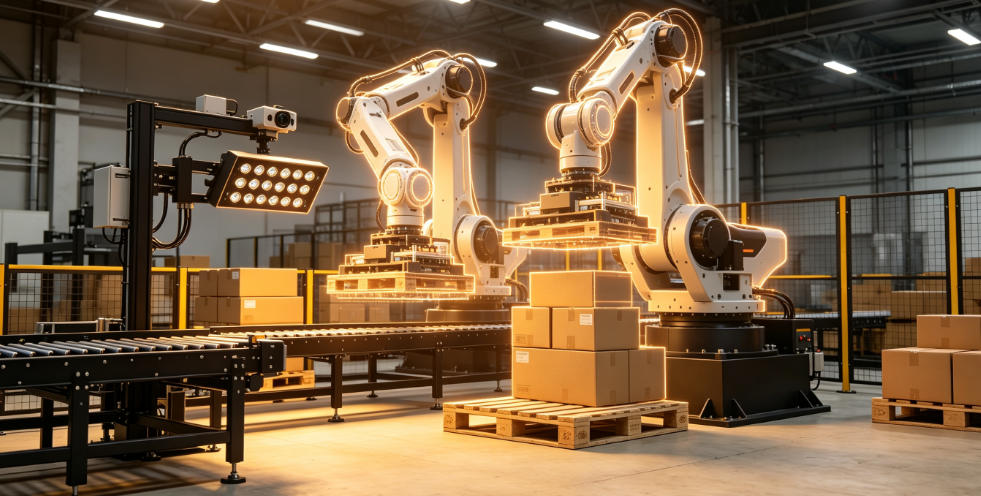
In smart warehouses, AMR robots need to transport goods in complex environments. Through robots with cameras, robots can automatically recognize pathways, detect obstacles, locate goods, and optimize transportation routes, improving warehouse efficiency.
In industrial manufacturing, robot vision systems are used for automated inspection, precision assembly, product positioning, and intelligent picking. For example, in electronics manufacturing, robots can use cameras to identify small components and improve assembly accuracy.
In logistics automation, robots equipped with vision systems can perform product sorting, packaging, and handling tasks. Through AI vision recognition, robots can quickly determine product locations and conditions, improving automated processing efficiency.
In service robotics applications such as hotels, hospitals, and commercial environments, robots face large numbers of dynamic obstacles. Camera-based perception systems allow robots to recognize people, avoid obstacles, and safely complete delivery and guidance tasks.

What Is the Difference Between Robotic Cameras and LiDAR?
In robot navigation, cameras and LiDAR are both important environmental perception technologies.
LiDAR mainly uses laser scanning to obtain spatial distance information. Its advantages include high measurement accuracy, long-range sensing capability, and excellent mapping performance.
Compared with LiDAR, robotic cameras can not only obtain distance information but also provide rich visual data, including colors, textures, object categories, and environmental semantic information.
Simply speaking:
LiDAR is better at precise distance measurement and long-range environmental scanning, while robotic cameras are better at visual understanding and object recognition.
Currently, more and more robots are adopting multi-sensor fusion solutions, combining cameras, LiDAR, ToF sensors, and IMU systems to improve navigation accuracy and environmental adaptability.
Future Development Trends of Robotic Cameras
In the future, with the continuous development of Artificial Intelligence (AI), Large AI Models, 3D Vision, Edge Computing, and robot control technologies, robots with cameras will achieve stronger environmental perception and autonomous decision-making capabilities. Robot vision systems are evolving from traditional image collection devices into intelligent modules capable of understanding environments, predicting changes, and supporting intelligent decision-making.
In the past, robotic cameras were mainly used for simple object recognition and visual inspection. In the future, robotic cameras will integrate more advanced AI algorithms and multi-sensor fusion technologies, enabling robots to achieve human-like visual capabilities. Robots will not only see their surroundings but also understand relationships between objects, predict potential risks, and adjust actions based on real-time conditions.
Future robot vision systems will further improve:
- Complex environment understanding: Through AI vision algorithms and 3D perception technologies, robots will better understand dynamic environments, including people, moving equipment, different objects, and spatial changes.
- Object recognition accuracy: By combining Deep Learning, Computer Vision, and high-resolution vision sensors, robots can achieve more accurate object detection, classification, and positioning for intelligent picking, automated assembly, and product inspection.
- Dynamic path planning capability: Future robots will no longer depend on fixed routes but will use robot obstacle avoidance systems and AI navigation algorithms to analyze environmental changes and automatically generate optimal paths.
- Human-robot interaction capability: Advanced camera systems will allow robots to recognize human movements, gestures, and behaviors, enabling safer and more natural collaboration.
- Autonomous learning capability: By combining AI foundation models and robot learning technologies, future robots can continuously improve performance through visual data and adapt to unknown environments.
Especially in Smart Factories, Autonomous Warehouses, Autonomous Mobile Robots, Service Robots, and Industrial Automation, robotic cameras, robot camera systems, AI vision for robots, 3D vision camera for robots, and robot obstacle avoidance systems will become key technologies driving intelligent robot development.
As robotic applications expand, future robot camera systems will continue evolving toward higher resolution, lower latency, and stronger AI processing capabilities. By integrating RGB vision, depth perception, ToF technology, LiDAR, and edge AI computing, robots will achieve more accurate perception and autonomous operation in increasingly complex environments.
Ultimately, robotic cameras will become more than just visual sensors for robots. They will serve as a foundation for robots to understand the world, interact with environments, and achieve autonomous intelligence. With deeper integration between AI and robotics, intelligent robots equipped with advanced vision systems will play increasingly important roles in manufacturing, logistics, healthcare, agriculture, and household services.
3D Safe Guarding Privacy RGBD Camera Synexens CS30

Conclusion
Robotic Cameras are becoming a fundamental technology for robots to achieve intelligent perception, autonomous navigation, and safe obstacle avoidance. By integrating visual sensors, artificial intelligence algorithms, and robot control systems, robots with cameras can understand environments in real time, recognize obstacles, and automatically adjust their behaviors.
Whether in smart manufacturing, warehouse logistics, industrial inspection, or service robotics, robotic camera systems are enhancing robot intelligence and transforming robots from simple task-execution machines into intelligent systems capable of perception, analysis, and autonomous decision-making.
In the future, with continuous advances in AI vision, 3D perception, and robotics technologies, robotic cameras, robots with cameras, robot vision systems, AI vision for robots, robot camera systems, 3D vision cameras for robots, and robot obstacle avoidance systems will become core technologies shaping the next generation of intelligent robots.
