

ToF 3D Vision for Warehouse Slot & Pallet Recognition in AGV Systems
- Posted by TofSensor
How Can ToF 3D Vision Improve Storage Slot and Pallet Recognition for AGVs?
ToF 3D Vision Empowering Precise Coordination Between WMS and AGVs
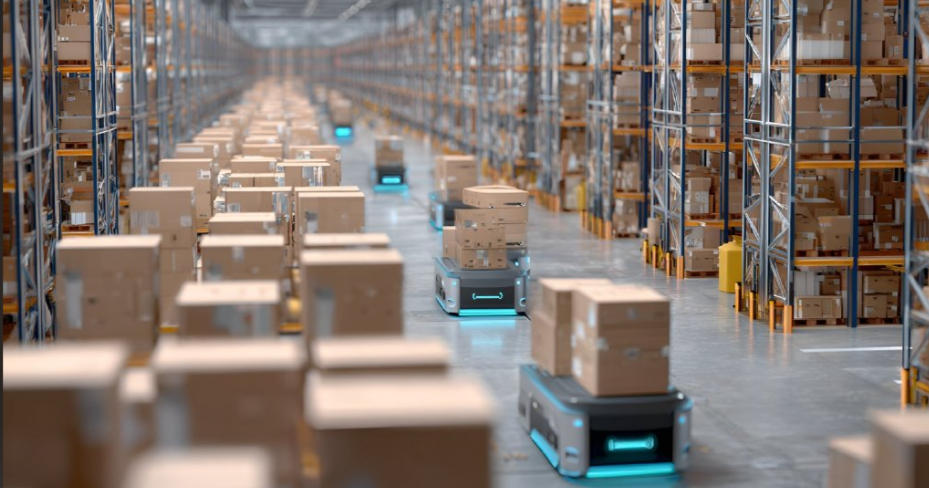
With the continuous development of Warehouse Management Systems (WMS) and automated warehouse solutions, modern warehouses are increasingly integrating IoT, artificial intelligence (AI), big data analytics, cloud computing, WES systems, and AGV/AMR robots to achieve more efficient and safer warehouse operations.
Within this ecosystem, storage slot occupancy detection and pallet position management are considered the “fundamental perception capabilities” of warehouse automation, as their accuracy directly affects AGV scheduling efficiency, automated handling success rates, and overall warehouse safety.
RGB-D 3D vision technology based on ToF has emerged as a key solution to address these challenges.
What is a 3D ToF Sensor?
A 3D ToF sensor TOF (Time-of-Flight) is an active depth-sensing device that emits modulated infrared light or short laser pulses and measures the time it takes for the light to travel to an object and return. By calculating this flight time, it directly determines the distance between the sensor and the object, generating high-precision 3D depth maps and point cloud data.
ToF sensors can operate reliably in dark or complex lighting environments, without relying on object color or texture. The native 3D output data can be used for AI applications such as object recognition, pose estimation, and collision detection, supporting real-time dynamic monitoring.
3D ToF sensors are widely applied in intelligent warehouse slot and pallet recognition, AGV/AMR navigation and obstacle avoidance, industrial robot picking and handling, and human-machine interaction, enabling equipment to “see” the true spatial shape and distance of objects.

1. Core Perception Requirements for Storage Slots and Pallets in Intelligent Warehouses
In smart warehouses, the system must have real-time knowledge of key information, including:
-
Whether a storage slot is occupied
-
Whether a pallet is present and intact
-
Whether cargo stack height exceeds limits
-
Whether the current state matches WMS data
Only when these data are real-time, accurate, and automatically updated can AGVs, autonomous forklifts, and automated stacking systems operate reliably.
2. Three Major Pain Points of Traditional Slot and Pallet Recognition Solutions
Pain Point 1: AGV and Manual Operations Cause WMS Data Desynchronization
Even in warehouses equipped with AGVs, manual shelving and temporary placement are often unavoidable. This can result in:
-
Delayed updates of WMS slot status
-
Mismatch between actual occupancy and system data
-
AGVs receiving incorrect instructions, leading to empty picks or misplacement
Ultimately, this may cause path conflicts, handling failures, and even safety incidents, a highly discussed issue in intelligent warehouse operations.
Pain Point 2: Single-Point LiDAR Lacks Detection Accuracy
Some warehouses use single-point LiDAR to determine slot occupancy, but this approach has significant limitations:
-
Captures only a single distance point, unable to reflect the overall structure
-
Easily misses gaps between pallets or boxes
-
May misidentify partially occupied slots as empty
In practice, such misjudgments can easily lead to stacking accidents and cargo damage.
Pain Point 3: Reliance on RGB Cameras Leads to Misidentification and Incomplete Information
Using RGB industrial cameras combined with deep learning for slot recognition also carries multiple risks:
-
Objects not in the training dataset entering slots may cause misclassification
-
Cannot capture cargo height, making stacking decisions unreliable
-
Fisheye cameras introduce severe distortion, complicating model training
-
High dependence on GPU servers increases system cost and maintenance burden
These issues are commonly discussed under search terms such as:
'RGB vision slot recognition unstable' or 'warehouse visual misjudgment'

3. How ToF Technology Addresses Core Challenges
Time-of-Flight (ToF) depth cameras measure the time it takes for light to travel from the emitter to the object and back, directly generating high-precision 3D depth data. They can operate reliably in complex warehouse environments, unaffected by ambient lighting.
When combined with RGB-D technology, ToF cameras can simultaneously output:
-
3D point cloud data, providing accurate depth information
-
Color images, offering texture, semantic, and visual details
This rich data provides a solid foundation for slot status recognition, pallet position detection, and stack height assessment, enabling warehouse systems to achieve precise perception even in high-density, dynamic environments.
2. Advantages of ToF-Based 3D Vision Slot Recognition Solutions
✅ Real-time and Accurate Slot Occupancy Monitoring
-
Precisely determine whether a slot is empty, partially occupied, or full
-
Support complex state recognition, such as partial occupancy or overstacking
-
Dynamically update slot status to prevent AGV errors like empty pickups or misplacement
-
Improve overall handling efficiency and reduce manual intervention
✅ Automatic Pallet and Cargo Height Recognition
-
Obtain real 3D height and volume data
-
Provide decision support for AGV automatic stacking, placement, and transport
-
Reduce collision or stacking safety risks caused by inaccurate height measurement
✅ AI Algorithm Deployment on the Edge, Reducing System Complexity
-
Recognition algorithms can be deployed on the ToF camera itself or an edge computing module
-
Reduce dependency on industrial PCs or GPU servers
-
Enable low-latency, real-time processing for instant decision-making
-
Lower system deployment and maintenance costs
-
Support continuous operation in high-density smart warehouses
✅ Seamless Integration with WMS / WES / AGV Systems
-
Support standard communication protocols: TCP/IP, UDP, HTTP
-
Real-time slot data feedback in JSON format
-
Enable automatic updates in WMS systems
-
Support multi-AGV coordination and human-machine collaboration
✅ Enhanced Safety and Operational Efficiency
-
Real-time monitoring prevents stacking errors, collisions, and human-machine conflicts
-
Supports high-density racks, improving warehouse space utilization
-
Provide reliable data for intelligent scheduling and operational optimization
In summary, ToF RGB-D 3D vision offers a comprehensive, high-precision, AI-friendly solution for modern smart warehouses, enabling AGVs and warehouse management systems to achieve real-time slot and pallet monitoring, automated stacking, safe handling, and efficient operations, making it an ideal choice for intelligent logistics automation.

4. Practical Industry Applications of ToF 3D Vision Solutions
Currently, ToF-based RGB-D 3D vision solutions for slot and pallet recognition have been successfully deployed across multiple industries, covering high-density warehousing and core smart logistics scenarios, including automated lithium battery warehouses, logistics distribution centers, and multi-tier storage in manufacturing and packaging.
By deploying ToF sensors at scale, companies have achieved significant improvements in warehouse management and operational efficiency:
-
Large-scale Real-time Slot Monitoring
-
Simultaneously monitor hundreds to thousands of slots, including cargo occupancy, stacking height, and stacking patterns
-
Update inventory information in real time, providing precise data support for WMS/WES
-
Improved AGV Handling Success Rate
-
High-precision 3D perception and AI decision support significantly reduce AGV errors during automated picking and placing
-
Effectively avoid empty picks, misplacement, and cargo collisions, improving handling efficiency and operational stability
-
Significantly Reduced Slot Misjudgment
-
Accurately recognize complex states like partial occupancy or overstacking
-
Reduce operation interruptions or anomalies caused by slot status errors
-
Enhanced Human-Machine Collaborative Safety
-
ToF cameras can perceive dynamic environments and human-machine interactions in real time
-
Provide safety alerts and collaborative decision-making to reduce collision risks
-
Support efficient coordination between AGVs and human operators, ensuring safe and intelligent warehouse operations
-
Support for High-density and Flexible Warehouse Layouts
-
Adapt to narrow aisles, high-density racks, and multi-layer stacking
-
Improve space utilization while maintaining handling accuracy and safety
Overall, ToF RGB-D 3D vision solutions not only improve automation and operational efficiency but also provide high-precision perception and AI edge processing to ensure safe human-machine collaboration, offering a reliable industry solution for smart logistics and automated warehousing.
5. Future Trends: ToF as the 'Standard Configuration' for Smart Warehousing
With the rapid development of smart warehousing, unmanned logistics, and flexible manufacturing, the industry demands higher levels of perception accuracy, operational stability, and automation. Against this backdrop, ToF 3D vision technology, with its unique advantages, is gradually moving from a high-end option to an industry standard, becoming an indispensable core sensing solution for intelligent warehouses.
Key Advantages of ToF Technology
-
High-precision 3D Perception
-
Real-time acquisition of 3D information of cargo and slots, including height, volume, stacking status, and gaps
-
Support centimeter-level or even millimeter-level precision for AGV stacking, pallet handling, and cargo recognition
-
Strong Environmental Adaptability
-
Insensitive to lighting, color, and material
-
Operates reliably in low-light, complex lighting, or enclosed warehouse environments
-
Handles dynamic changes and high-density rack scenarios, ensuring perception system reliability
-
Native AI Algorithm Compatibility
-
Raw 3D depth data can be directly used for AI training and edge inference
-
Enable automatic recognition, pose estimation, and collision warning
-
Support intelligent sorting, dynamic scheduling, and obstacle avoidance planning
-
Easy Deployment and Scalability
-
Compact design and edge computing allow flexible integration into AGVs, unmanned forklifts, and warehouse robots
-
Support large-scale deployment with hundreds to thousands of sensors for coordinated perception, meeting future warehouse expansion needs
Future Application Trends
As ToF technology matures and costs decrease, applications will become broader and deeper:
-
Slot Management: Full-warehouse real-time monitoring and automatic inventory updates, ensuring WMS/WES data accuracy
-
Pallet and Cargo Recognition: High-precision identification of varying sizes and materials, optimizing handling and stacking
-
AGV Collaborative Scheduling: Multi-robot real-time 3D data sharing improves handling efficiency and task scheduling flexibility
-
Unmanned Forklift Safety: Real-time perception of the surrounding environment and personnel, automatic path planning to reduce collision risks
-
High-density and Flexible Warehousing: Adapt to narrow aisles, multi-layer stacking, and dynamic rack layouts to maimize space utilization
Overall, ToF 3D vision technology is becoming the standard sensor for intelligent warehouse systems, enhancing operational efficiency, space utilization, and safety while laying a solid foundation for future unmanned, flexible, and intelligent logistics.
Conclusion
In smart warehouse systems, slot and pallet status recognition is a fundamental capability, not an optional feature. Compared with traditional LiDAR or 2D vision solutions, ToF-based RGB-D 3D vision solutions provide WMS, AGV, and warehouse robots with more reliable and precise data, representing a critical technological pathway for advancing warehouse automation to the next level.
Synexens 3D Of RGBD ToF Depth Sensor_CS30

Our professional technical team specializing in 3D camera ranging is ready to assist you at any time. Whether you encounter any issues with your TOF camera after purchase or need clarification on TOF technology, feel free to contact us anytime. We are committed to providing high-quality technical after-sales service and user experience, ensuring your peace of mind in both shopping and using our products.
-
Posted in
CS30
