

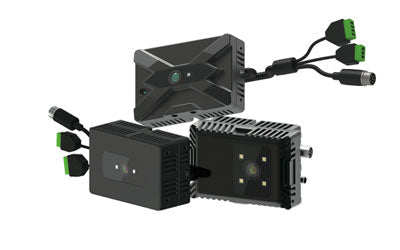
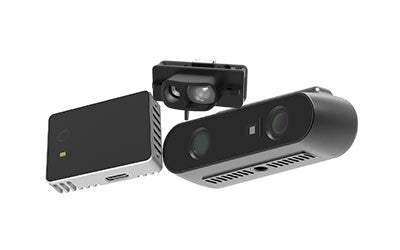
MRDVS 3D Cameras & ToF Technology for Smart Warehousing Automation
- por TofSensor
How Do MRDVS 3D ToF Cameras Improve AGV Navigation and Smart Warehousing?
High-Precision 3D Perception for Robot Navigation, Industrial Inspection, and Intelligent Warehousing
With the rapid development of automation and robotics, accurate perception and high reliability have become key factors for improving production efficiency and intelligent operations. The MRDVS 3D camera, integrating advanced Time-of-Flight (ToF) depth sensing technology, provides innovative solutions for industrial automation, warehouse logistics, intelligent robotics, and quality inspection.
1. Trends in 3D Vision Systems
As computer vision, sensor technology, and artificial intelligence continue to advance, the application scope of 3D vision systems is expanding rapidly. Early 3D cameras were mainly used in entertainment and consumer markets, enabling spatial perception and human interaction in augmented reality (AR) and virtual reality (VR) scenarios. Today, 3D vision technology has evolved from a 'visual experience tool' into an industrial-grade perception infrastructure, playing a central role in industrial automation, smart warehousing, robot navigation, and high-precision inspection.

From Consumer to Industrial Grade
3D cameras are transitioning from cost- and experience-sensitive consumer products to industrial-grade devices with high stability, reliability, and long operational life. Industrial applications demand continuous operation under complex environments, including vibration resistance, temperature tolerance, dust protection, and adaptability to lighting changes. MRDVS 3D cameras, with industrial-grade design, can be deployed reliably in production lines, warehouses, and semi-outdoor environments for long-term operation.
From 2D Vision to 3D Perception
Traditional 2D vision has limitations in distance measurement, spatial understanding, and pose estimation. 3D vision systems capture real-world depth information, providing machines with human-like spatial awareness. This capability is essential for AGVs, AMRs, industrial robots, and autonomous forklifts to make decisions and operate safely. MRDVS 3D cameras, with high-resolution imaging and precise depth measurement, deliver reliable data for complex 3D scene understanding.
From Single Perception to System-Level Intelligent Integration
Modern 3D vision systems are no longer isolated sensors; they are deeply integrated with robot control, WMS/MES systems, and AI platforms. The depth maps and point clouds generated by 3D cameras serve as critical inputs for path planning, task scheduling, quality analysis, and safety alerts. MRDVS 3D cameras, with excellent interface compatibility and AI-friendly features, seamlessly connect to edge computing and intelligent decision-making systems, accelerating the deployment of smart manufacturing and logistics.
From Experimental Use to Scalable Deployment
With the maturity of algorithms and hardware reliability, 3D vision technology is moving from demonstration projects to large-scale, standardized deployment. In smart warehousing, flexible manufacturing, and unmanned logistics centers, 3D cameras are becoming a standard configuration. MRDVS 3D cameras provide consistent imaging performance and stable depth output, supporting multi-device collaboration and large-scale system integration.
Overall, 3D vision systems are evolving toward higher precision, stronger environmental adaptability, deeper AI integration, and larger-scale deployment. In this trend, MRDVS 3D cameras, with high-resolution imaging, excellent depth accuracy, and industrial-grade reliability, have become indispensable perception devices for smart manufacturing, intelligent warehousing, and robotics, providing a solid foundation for automation and digital transformation.
2. Core Advantages of the MRDVS 3D Camera
-
High-Resolution Imaging
-
Utilizes advanced sensors for millimeter-level detail capture
-
Meets stringent accuracy requirements for robotic picking, cargo recognition, and industrial inspection
-
-
Advanced Depth Sensing
-
ToF technology directly measures light flight time, generating high-precision depth maps and point clouds
-
Provides accurate spatial information for pallet recognition, warehouse slot localization, and AGV/AMR navigation
-
-
Industrial-Grade Durability
-
Robust housing suitable for warehouse, factory, and outdoor environments
-
Resistant to dust, vibration, and lighting variations, ensuring long-term stable operation
-
-
Seamless System Integration
-
Compatible with WMS, AGV control systems, and industrial robot platforms
-
Supports multiple communication protocols and software platforms for rapid deployment
-

3. Application Scenarios of MRDVS 3D Camera + ToF Technology
1. Automated Handling and Intelligent Warehousing
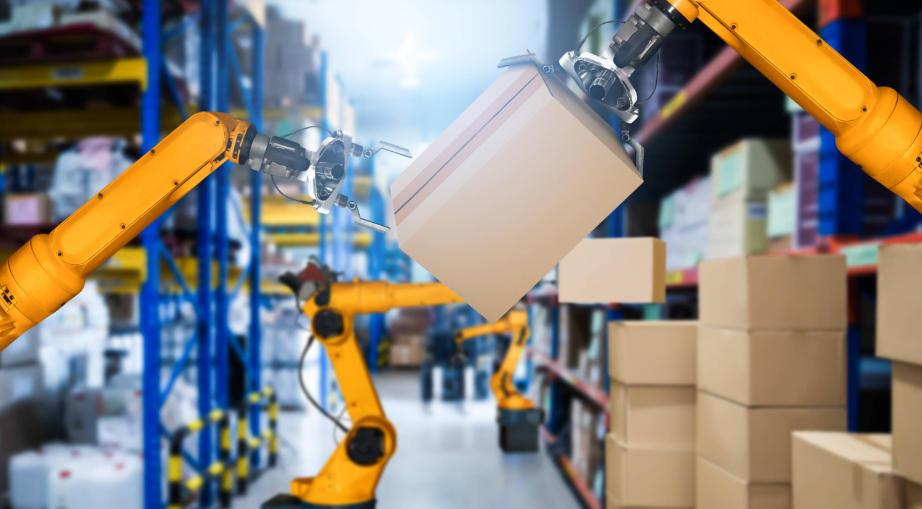
In intelligent warehousing and automated logistics scenarios, MRDVS 3D cameras leverage ToF depth-sensing technology to provide AGVs and AMRs with stable, real-time 3D environmental information.
-
AGVs and AMRs use ToF cameras to obtain high-precision depth data in real time, constructing dynamic 3D maps for accurate recognition of aisles, shelves, pallets, and personnel.
-
With ToF’s millimeter-level distance measurement capability, the position, orientation, and height of pallets can be precisely determined, supporting automatic alignment, accurate picking, and safe stacking.
-
In high-density storage and human-robot collaborative environments, ToF technology enables centimeter-level obstacle avoidance, significantly reducing collisions and cargo damage.
-
Enhances overall warehouse throughput and operational continuity, reduces manual intervention, and improves system efficiency.
2. Industrial Inspection and Quality Control
In industrial manufacturing, MRDVS 3D cameras combined with ToF technology provide reliable 3D data for quality inspection.
-
ToF cameras enable non-contact 3D measurement of products, accurately detecting dimensional deviations, deformations, and surface defects.
-
Insensitive to object color, texture, or ambient light changes, suitable for stable detection in complex conditions.
-
Supports online inspection and real-time feedback on high-speed production lines, seamlessly integrating with automated sorting or rejection systems.
-
Provides high-quality depth maps and point cloud data for AI quality inspection algorithms, improving defect recognition accuracy and consistency.
3. Warehousing, Logistics, and Inventory Management
In warehousing, logistics, and inventory management, MRDVS 3D cameras use ToF technology to achieve precise perception of goods and storage locations.
-
ToF 3D scanning captures volume, stacking height, and spatial occupancy of goods, providing data support for warehouse layout optimization.
-
Real-time output of storage status and inventory changes assists WMS systems in automated inventory counting and dynamic scheduling.
-
Accurately identifies multi-layer stacking, irregular goods, and complex shelf structures, reducing storage location errors.
-
Improves inventory accuracy, reduces manual counting costs, and enhances overall logistics efficiency.
4. Medical and Biomechanical Analysis
In medical and biomechanical applications, MRDVS 3D cameras use ToF technology to provide high-precision, non-contact 3D imaging.
-
ToF cameras can capture high-resolution 3D data of human movement, accurately recording joint positions, motion trajectories, and posture changes.
-
Independent of visible light textures, suitable for stable human modeling and motion monitoring under varying lighting conditions.
-
Widely applied in posture analysis, rehabilitation evaluation, sports performance assessment, and preoperative surgical planning.
-
Provides precise, quantifiable 3D data for medical AI and biomechanical analysis models, enhancing reliability and clinical value.
MRDVS 3D cameras, combined with ToF technology, demonstrate broad and mature application value across warehousing, logistics, industrial manufacturing, and healthcare, thanks to high-precision 3D perception, strong environmental adaptability, and AI-native compatibility.
What is a ToF (Time-of-Flight) Sensor?
A ToF (Time-of-Flight) camera is a 3D imaging sensor that emits modulated light (usually infrared) and measures the time or phase shift for the light to travel from the camera to the object and back. This allows calculation of the distance for each pixel, generating depth maps or 3D point clouds. Unlike traditional 2D cameras that only capture color and brightness, ToF cameras provide true 3D spatial information with high precision (millimeter to centimeter level), real-time performance (high frame rates), and strong environmental robustness (resistant to lighting, shadows, and reflections).
The depth data output can be directly used for object recognition, pose estimation, path planning, and AI inference, making ToF sensors widely applied in intelligent warehousing and logistics (AGV navigation, pallet detection, inventory management), industrial automation (workpiece inspection, robotic picking), AR/VR interaction, automotive and robot obstacle avoidance, and medical motion analysis. ToF is a core 3D perception technology for realizing intelligent and automated systems.

4. Core Advantages of MRDVS 3D Camera Empowered by ToF Technology
1. High Precision and Real-Time Performance: Meeting High-Speed Intelligent Warehousing and Robotics Needs
MRDVS 3D cameras, based on ToF depth-sensing technology, directly measure the light’s flight time, achieving millimeter-level distance accuracy and reliably capturing 3D spatial information of objects.
-
Real-time output of high-quality depth maps and 3D point cloud data.
-
Supports continuous tracking and precise localization of high-speed moving targets.
-
Meets the real-time perception and decision-making needs of AGVs, AMRs, and warehouse robots in dynamic environments.
2. Strong Environmental Adaptability: Stable Performance in Complex Industrial and Warehouse Settings
Thanks to the active illumination ToF principle, MRDVS 3D cameras exhibit strong robustness to external environment variations.
-
Unaffected by strong light, low light, or lighting changes; suitable for all-weather operation.
-
Insensitive to dust, shadows, complex backgrounds, or object surface textures.
-
Can operate stably over long periods in high-density shelves, narrow aisles, and confined spaces.
3. AI-Friendly: Native 3D Data Accelerates Intelligent Algorithm Deployment
MRDVS 3D cameras directly output standardized depth maps and point cloud data, seamlessly interfacing with various AI and machine vision algorithms.
-
Reduces complex feature extraction and image preprocessing required in traditional 2D vision.
-
Suitable for deep learning, object recognition, pose estimation, and dimensional measurement tasks.
-
Supports edge AI inference and on-device computation for low-latency, high-reliability intelligent decision-making.
4. Reduced System Cost and Complexity: Simplifying Intelligent Vision System Deployment
Integrating high-precision 3D perception into a single MRDVS 3D camera can effectively reduce overall system complexity.
-
Reduces reliance on multi-sensor fusion solutions (2D cameras + LiDAR).
-
Lowers integration and debugging costs for AGV and robot vision systems.
-
Improves system stability and maintainability, accelerating project deployment.
-
Achieves high cost-effectiveness while maintaining performance.
ToF technology provides MRDVS 3D cameras with high precision, real-time performance, excellent environmental adaptability, and AI-native compatibility, making them an ideal 3D vision solution for AGV navigation, pallet recognition, automated handling, and intelligent warehousing.
5. Conclusion
MRDVS 3D cameras, combined with ToF depth-sensing technology, offer reliable and efficient 3D perception for intelligent warehousing, industrial inspection, automated handling, and robotic navigation.
With the development of industrial automation, unmanned warehouses, and smart logistics, 3D ToF cameras are becoming a core tool for modern enterprises to improve efficiency, safety, and intelligence.

