

How Does Real-Time Localization Improve Indoor Robotics Navigation?
- por LidarSensor
How Does Real-Time Localization Improve Indoor Robotics Navigation in Warehouses?
With the rapid development of smart warehousing and industrial automation, indoor robotics navigation has become a critical technology in logistics, manufacturing, and warehouse systems. However, in complex indoor environments where GPS signals are unavailable, robots must rely on high-precision robotics localization and real-time perception systems to operate reliably.
By introducing advanced real-time localization technologies, enterprises can significantly improve robots’ path planning capabilities, obstacle avoidance performance, and overall operational efficiency, thereby accelerating the development of intelligent warehousing and unmanned logistics.
What Is Robotics Localization?
robotics localization refers to the technology that enables robots to determine their precise position, pose, and motion state in indoor environments using sensors, vision systems, LiDAR, inertial measurement units (IMU), and artificial intelligence (AI) algorithms.
Unlike traditional outdoor GPS positioning, indoor robotics environments are highly complex, with frequent occlusions, variable lighting conditions, and dynamic obstacles. These challenges make accurate localization a core requirement for autonomous navigation and efficient operations.
To overcome these challenges, modern indoor robots typically rely on a combination of technologies, including:
-
SLAM (Simultaneous Localization and Mapping)
Enables robots to build a map of an unknown environment while simultaneously determining their position within it. -
Visual-Inertial Odometry (VIO)
Combines camera-based visual data with IMU acceleration and angular velocity data to provide high-frequency motion estimation and improved stability. -
LiDAR-Based Localization
Uses laser scanning to capture precise spatial geometry for distance measurement and obstacle detection. -
UWB (Ultra-Wideband) Positioning Systems
Achieves centimeter-level accuracy through distance measurement between anchors and tags, suitable for large warehouses. -
AI-Based Visual Localization
Uses deep learning and image recognition to identify environmental features, markers, or shelving structures for intelligent positioning.
These technologies are typically combined through sensor fusion, forming a highly reliable indoor localization system that enables autonomous navigation, path planning, and dynamic obstacle avoidance.
In modern smart warehousing, industrial production lines, and service robotics, robotics localization is not only a key enabler of efficiency and accuracy but also the foundation of robotic indoor positioning solutions for warehouse automation. With high-precision positioning, robots can perform fully automated picking, transporting, sorting, and multi-robot collaboration, significantly reducing labor costs and operational risks.

Why Do Indoor Robotics Systems Need Real-Time Localization?
In warehouse and industrial environments, robots are commonly required to perform tasks such as:
- Automated goods transportation
- Warehouse path planning
- Dynamic obstacle avoidance
- Multi-robot collaboration
- Real-time inventory management
Without high-precision localization systems, robots may experience navigation errors, collisions, or task failures.
With real-time localization technology, indoor robotics systems can achieve:
- Millimeter-level positioning accuracy
- Dynamic path adjustment
- Multi-robot coordination
- Real-time environmental awareness
How Does Real-Time Localization Improve Robot Navigation?
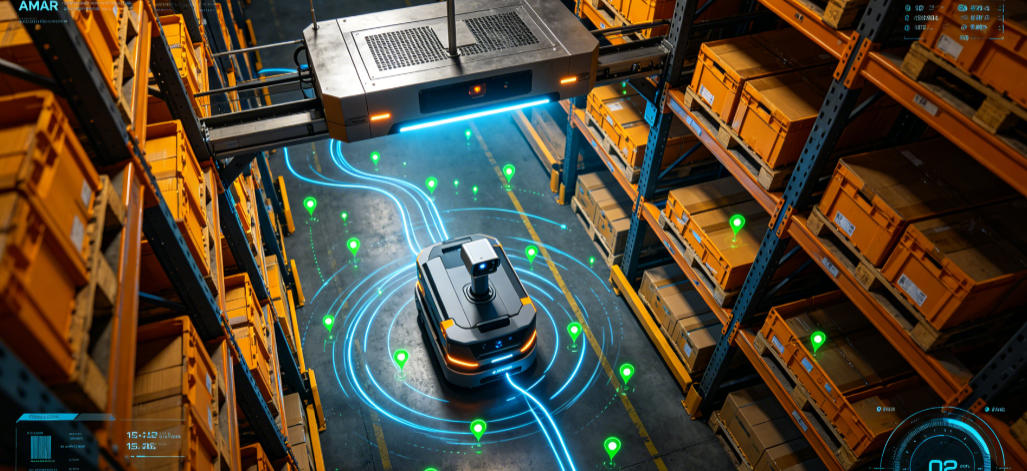
Real-time localization systems continuously collect environmental data and process it using AI algorithms and multi-sensor fusion. This allows robots not only to know their position in space but also to autonomously plan routes, avoid obstacles, and efficiently complete tasks in dynamic environments, significantly enhancing indoor robotics navigation performance.
The typical workflow includes the following key stages:
1. Environmental Perception
Robots use cameras, LiDAR sensors, depth sensors, or ultrasonic sensors to collect real-time environmental data, including shelves, corridors, obstacles, moving objects, and structural landmarks.
AI vision algorithms process image or point cloud data to recognize environmental features and generate accurate environmental models, providing the foundation for localization and path planning.
2. Sensor Fusion & Localization
At this stage, the system fuses multiple data sources, including:
- Camera-based visual data
- IMU acceleration and angular velocity data
- LiDAR point cloud scans
- Pre-built maps or real-time SLAM-generated maps
Through fusion computation, robots achieve high-precision localization, often reaching centimeter or even millimeter-level accuracy. This step is the core of robotics localization, enabling stable navigation in complex, occluded, or dynamic environments.
3. Dynamic Path Planning
Based on real-time positioning, the system calculates optimal routes dynamically to ensure robots can:
- Avoid obstacles and moving objects
- Optimize travel paths and reduce travel time
- Allocate tasks in multi-robot environments
- Adjust speed and direction for safety and efficiency
Modern path planning algorithms integrate AI predictive capabilities to anticipate environmental changes and proactively avoid risks.
4. Real-Time Execution & Adjustment
During navigation, robots continuously update their position and environmental awareness, dynamically adjusting behavior such as:
- Avoiding temporary obstacles
- Optimizing turning and maneuvering
- Adjusting routes based on workload or task changes
This closed-loop system ensures fully autonomous operation without human intervention, significantly improving warehouse automation efficiency. Through this approach, robotic indoor positioning solutions for warehouse automation enhance productivity while reducing operational risks.

Key Applications in Warehouse Automation
In modern logistics and smart warehouses, real-time localization has become a core infrastructure, especially in robotic indoor positioning solutions for warehouse automation.
Typical applications include:
Intelligent Warehouse Robot Navigation
Robots move accurately between shelves to perform picking and transportation tasks.
Automated Sorting Systems
Combines localization and vision recognition for high-speed parcel classification.
AGV & AMR Path Optimization
Automatically guided vehicles (AGVs) and autonomous mobile robots (AMRs) dynamically adjust routes for efficiency.
Multi-Robot Coordination Systems
Shared positioning data enables task allocation and collision avoidance among robots.
Core Technologies of Indoor Robotics
Modern indoor robotics systems typically include:
- Real-Time Location Systems (RTLS)
- SLAM mapping and localization algorithms
- AI-based path planning systems
- Visual recognition modules
- LiDAR sensors
- Cloud-based orchestration systems
Together, these technologies form a complete intelligent robotics ecosystem.
How AI Enhances Robotics Localization
Artificial intelligence plays a key role in robotics localization, enabling systems to:
- Improve positioning accuracy
- Predict robot motion trajectories
- Optimize path planning
- Automatically correct localization errors
- Enhance adaptability in complex environments
With the advancement of AI and edge computing, robot localization systems are becoming increasingly intelligent and real-time.
Trends in Indoor Robotics Localization
1. Continuous SLAM Improvements
Fusion of visual SLAM and LiDAR SLAM improves stability and accuracy.
2. AI-Driven Autonomous Navigation
Robots can learn from environments and optimize navigation paths.
3. Multi-Sensor Fusion Positioning
Combining vision, LiDAR, and UWB for higher precision.
4. Fully Automated Smart Warehouses
Future warehouses will rely on robotic indoor positioning solutions for warehouse automation for fully unmanned operations.
Why Are Enterprises Accelerating Adoption?
With the rapid growth of e-commerce and manufacturing, demand for warehouse efficiency is increasing.
Advanced indoor localization systems provide:
- Improved warehouse efficiency
- Reduced labor costs
- Fewer operational errors
- Faster order processing
- Enhanced logistics automation
- 24/7 unmanned operation capability
With the development of autonomous robots, 3D real time indoor localization provides accurate spatial positioning and continuous environmental awareness, helping mobile robots navigate complex indoor spaces more reliably and efficiently.
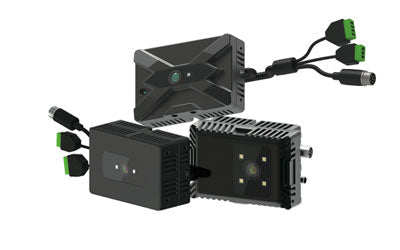
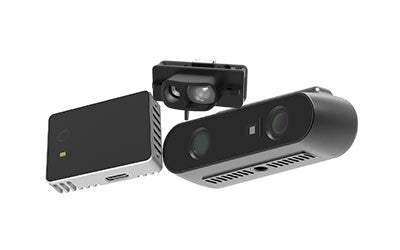
Synexens Industrial Outdoor 4m TOF Sensor Depth 3D Camera Rangefinder_CS40p

Conclusion
Real-time localization technology is redefining the future of indoor robotics. From smart warehouses to industrial manufacturing, robotics localization has become the core foundation of autonomous navigation.
With advancements in AI, SLAM, and multi-sensor fusion technologies, future robots will achieve higher precision and efficiency in complex indoor environments. Meanwhile, robotic indoor positioning solutions for warehouse automation will become a standard component of intelligent warehouse systems.
-
Postado em
CS40P
