

Laser vs Ultrasonic Distance Sensors: Which Is Better for Industry?
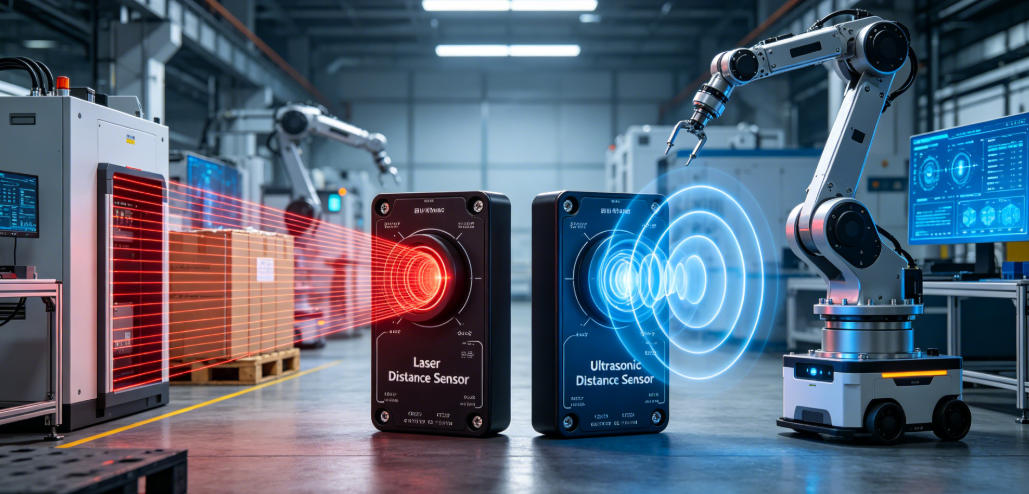
Laser vs Ultrasonic Distance Sensors: Which Distance Sensor Is Best for Industrial Applications?
Overview of Laser Distance Sensor and Ultrasonic Distance Sensor Technology
In industrial automation, robot navigation, and smart manufacturing, distance measurement technology is one of the most important sensing capabilities. Currently, the two most common solutions are Laser Distance Sensor and Ultrasonic Distance Sensor.
With the rapid development of smart factories and AIoT technologies, users are increasingly focusing on measurement accuracy, environmental adaptability, and long-term reliability. Therefore, 'laser vs ultrasonic distance sensors' has become an important comparison topic in the industrial sensing field.
What Is a Laser Distance Sensor?
A Laser Distance Sensor is a high-precision, non-contact measurement device that uses laser technology to measure distance. It works by emitting laser signals toward a target object and receiving the reflected signals from the surface of the object. The sensor then calculates the exact distance between itself and the target based on light travel time, phase shift, or optical triangulation principles.
Compared with traditional contact measurement devices, a Laser Distance Sensor does not require physical contact with the target, avoiding mechanical wear while providing faster measurement speed, higher accuracy, and better stability.
Today, Laser Distance Sensors are widely used in:
- Industrial automation
- Robot navigation
- Smart warehousing
- Drone distance measurement
- AGV/AMR mobile robots
- Smart manufacturing
- Machine vision systems
Modern laser distance sensors typically use ToF (Time-of-Flight) technology, phase shift measurement technology, or optical triangulation technology to calculate distance by analyzing laser propagation time or phase changes. These technologies enable fast, stable, and real-time distance detection for automated equipment.

How Does a Laser Distance Sensor Work?
A Laser Distance Sensor calculates distance by measuring the time difference or phase change of laser signals traveling from the sensor to the target and back.
The basic working process includes:
- The laser emitter sends short-pulse or continuously modulated laser signals toward the target.
- The laser beam travels to the surface of the object and is reflected.
- The optical receiver captures the returned laser signal.
- The system calculates the laser travel time (ToF) or phase difference.
- The distance between the sensor and target is calculated based on the speed of light.
- Real-time distance data is output to robots, industrial equipment, and control systems.
Key Features of Laser Distance Sensors
High-Precision Measurement Capability
Due to the strong directionality and stable transmission characteristics of laser light, Laser Distance Sensors can achieve highly accurate distance measurement.
Industrial-grade laser sensors can typically provide:
- Millimeter-level measurement accuracy
- Centimeter-level long-range detection
- High repeatability and stability
They are widely used in precision manufacturing, dimensional inspection, and position detection applications.
Long Measurement Range
Compared with traditional infrared sensors, Laser Distance Sensors provide longer detection distances.
They can support applications ranging from:
- Short-distance object detection
- Robot obstacle avoidance
- Long-distance industrial measurement
This makes them suitable for warehouses, outdoor equipment, robotics, and automated production lines.
Strong Resistance to Environmental Light Interference
In complex environments, sunlight, artificial lighting, and other optical interference sources may affect measurement accuracy.
Advanced Laser Distance Sensors use:
- Optical filtering technology
- Signal processing algorithms
- High-performance receivers
to reduce environmental interference and improve measurement stability in both indoor and outdoor applications.
Fast Response Speed
Laser Distance Sensors can quickly collect and process distance data, making them ideal for dynamic object detection.
Typical applications include:
- High-speed production line inspection
- Autonomous robot navigation
- Drone altitude measurement
- Real-time motion tracking
Fast response enables equipment to adjust movement accurately and efficiently.
Non-Contact Measurement
Because Laser Distance Sensors use optical measurement technology, they do not require direct contact with objects.
Advantages include:
- Reduced mechanical wear
- Longer service life
- No damage to measured objects
- Suitable for high-temperature and high-speed environments
Main Applications of Laser Distance Sensors
Industrial Automation and Smart Manufacturing
In Industry 4.0 applications, Laser Distance Sensors are used for:
- Product dimension measurement
- Machine positioning
- Object detection
- Automated control
They help improve manufacturing efficiency and precision.
Robot and AGV/AMR Navigation
Robots need accurate environmental perception to operate autonomously.
Laser Distance Sensors provide precise distance information for:
- Obstacle detection
- Path planning
- SLAM navigation
- Autonomous movement
This improves the environmental awareness and mobility of intelligent robots.
Drone Measurement and Smart Devices
Laser distance measurement technology enables drones to perform:
- Altitude measurement
- Terrain detection
- Automatic obstacle avoidance
- Precision landing
This improves flight stability and safety.
Smart Logistics and Warehouse Systems
In automated warehouses and logistics systems, Laser Distance Sensors are used for:
- Pallet recognition
- Cargo positioning
- Space measurement
- Automated forklift navigation
They help create more intelligent and efficient logistics operations.
Future Development Trends of Laser Distance Sensors
With the growth of artificial intelligence, robotics, and smart manufacturing, future Laser Distance Sensors will continue developing toward:
- Higher measurement accuracy
- Longer detection range
- Lower power consumption
- Smaller size
- More intelligent processing capabilities
Combined with ToF Sensors, 3D Depth Cameras, AI vision algorithms, and machine learning technologies, Laser Distance Sensors can not only measure distance but also help machines understand three-dimensional environments and achieve smarter automation.
In the future, Laser Distance Sensors, ToF technology, and 3D vision systems will become essential technologies for robotics, industrial automation, smart logistics, and next-generation machine vision applications.
What Is an Ultrasonic Distance Sensor?
An Ultrasonic Distance Sensor is a non-contact distance measurement device that calculates distance by transmitting ultrasonic waves and measuring the returning echo time.
It is a cost-effective sensing solution commonly used in basic distance detection applications.
Working Principle:
- The sensor emits ultrasonic waves.
- Sound waves travel through the air.
- The waves hit an object and are reflected.
- The receiver detects the returning echo.
- The system calculates the time difference and determines the distance.
Laser vs Ultrasonic Distance Sensor: Key Differences
In industrial automation, robot navigation, and intelligent sensing systems, Laser Distance Sensors and Ultrasonic Distance Sensors are two of the most widely used non-contact measurement technologies.
However, they differ significantly in measurement principles, accuracy, environmental adaptability, and application scenarios. Choosing between them depends on specific industrial requirements.
1. Measurement Accuracy Comparison
Laser Distance Sensors generally provide higher accuracy and better stability, especially for demanding industrial applications.
Laser Distance Sensor:
- Millimeter-level to centimeter-level precision
- Suitable for high-speed dynamic targets
- Stable performance over long distances
Ultrasonic Distance Sensor:
- Usually provides centimeter-level accuracy
- More affected by environmental conditions
For industrial automation, robotic positioning, and precision measurement, Laser Distance Sensors are usually the preferred choice.

2. Environmental Adaptability Comparison
Ultrasonic sensors perform well in simple enclosed environments but have limitations in complex industrial conditions.
Ultrasonic sensors:
- Easily affected by temperature and humidity changes
- Sensitive to airflow variations
- May experience errors with soft or irregular surfaces
Laser sensors:
- Less affected by air conditions
- Provide better stability over medium and long distances
- Suitable for demanding industrial environments
For long-term industrial operation, Laser Distance Sensors usually provide better reliability.
3. Performance in Dusty and Complex Environments
Industrial environments often include dust, smoke, particles, and oil mist, creating higher requirements for sensors.
For best distance sensors for dusty environments:
- Laser sensors generally provide more stable performance, especially ToF and LiDAR-based solutions.
- Ultrasonic sensors may experience measurement fluctuations due to sound scattering.
- Laser systems can use optical filtering and advanced algorithms to improve reliability.
- Industrial laser sensors can operate in mining, cement plants, steel factories, and other harsh environments.
Therefore, laser measurement technology has become a preferred solution in many complex industrial applications.
4. Response Speed and Real-Time Performance
For dynamic measurement and real-time control systems, response speed is critical.
Laser Distance Sensor:
- High-frequency measurement capability
- Fast response time
- Suitable for moving objects and real-time tracking
Ultrasonic Distance Sensor:
- Lower update frequency
- More measurement delay
For AGV/AMR robots, real-time obstacle avoidance, navigation, and dynamic object detection require low-latency sensing, making laser solutions more suitable.
5. Cost and Application Comparison
From a cost perspective, ultrasonic sensors still have advantages, but their performance has certain limitations.
Advantages of Ultrasonic Sensors:
- Lower cost
- Simple structure
- Easy integration
- Suitable for basic obstacle detection systems
Advantages of Laser Sensors:
- Industrial-grade high precision
- Wider application range
- Better environmental adaptability
- Easier integration with AI Vision and SLAM systems
Therefore, Laser Distance Sensors are becoming increasingly popular in smart manufacturing, industrial automation, and advanced robotics, while ultrasonic sensors are mainly used in cost-sensitive applications.
Applications of High Precision Ultrasonic Distance Sensors
Although laser technology is more suitable for advanced industrial applications, high precision ultrasonic distance sensors still have advantages in specific fields, including:
- Liquid level detection
- Basic obstacle detection
- Cost-sensitive equipment
- Short-distance measurement systems
However, ultrasonic sensors remain limited in high-precision industrial measurement applications.
Which Distance Sensor Is Better for Industrial Environments?
The best choice depends on the application requirements.
Recommended Applications for Laser Distance Sensors:
- Industrial automation production lines
- AGV/AMR robot navigation
- High-precision measurement systems
- Long-distance detection
- Dusty industrial environments
- Mining, warehouses, and factories
Recommended Applications for Ultrasonic Sensors:
- Low-cost obstacle detection
- Liquid level measurement
- Basic distance detection
Future Trend: Laser + AI Integration
With the development of AI Vision and edge computing, Laser Distance Sensors are increasingly integrated with:
- AI deep learning recognition
- 3D point cloud processing
- SLAM navigation systems
- Intelligent industrial inspection
In the future, laser-based distance sensors will become one of the core sensing technologies for intelligent industrial systems.
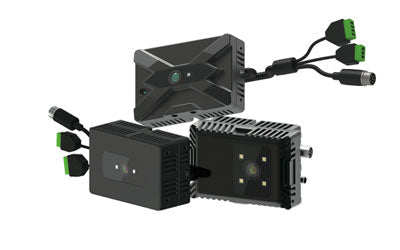
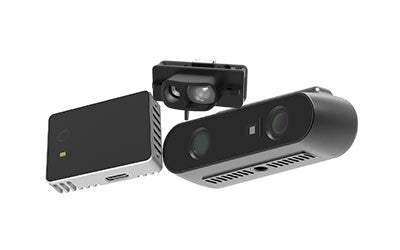
Synexens Industrial Outdoor 4m TOF Sensor Depth 3D Camera Rangefinder_CS40p

Conclusion
The comparison of 'laser vs ultrasonic distance sensors' shows that:
- Laser Distance Sensors = High precision + Industrial applications + Strong environmental adaptability
- Ultrasonic Distance Sensors = Low cost + Basic distance measurement
For modern smart manufacturing and robotic systems, especially in dusty and complex industrial environments, laser-based solutions are often the better choice.
For applications requiring best distance sensors for dusty environments, high-performance laser measurement technologies are increasingly becoming the preferred solution.
