

iToF vs Structured Light: Which 3D Sensing Technology Fits Factories?
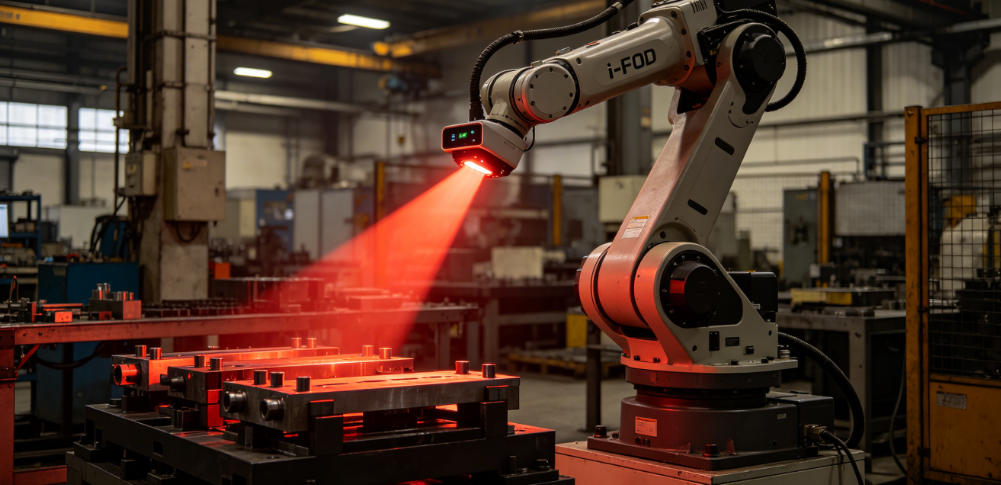
How do iToF and structured light technologies compare for industrial automation?
In smart manufacturing, industrial robotics, autonomous driving, and AR/VR, active 3D sensing technologies have become a core infrastructure. Common 3D sensing methods include Structured Light and iToF (Indirect Time-of-Flight). Both technologies differ in measurement principles, accuracy, application scenarios, and cost. This article provides a detailed comparison to help enterprises and R&D teams choose the most suitable 3D vision solution.
What is Structured Light Technology?
Structured Light technology is a typical active 3D vision measurement method. Its core principle is to project a known optical pattern (such as stripes, checkerboards, speckles, or grid patterns) onto the target object’s surface. A camera then captures the deformation of the pattern caused by the object’s surface, allowing the system to reconstruct the object’s 3D geometry.
In simple terms, it works like 'measuring the object with light,' analyzing how light bends in space to generate depth and 3D shape information.
How Structured Light Works
A structured light system typically consists of a projector, industrial camera, and calibration system, following these steps:
- The projector casts a pre-defined structured light pattern onto the object.
- Light deforms upon hitting the object surface (affected by bumps and recesses).
- The camera captures the deformed pattern from multiple angles.
- The system calculates depth information using triangulation algorithms.
- A high-precision 3D point cloud or depth map is generated.
This process converts 2D image data into a computable 3D model, enabling precise reconstruction of object structures.

Key Features of Structured Light
- High-precision depth measurement: Sub-millimeter or millimeter-level accuracy for precise industrial inspection.
- High-resolution 3D imaging: Dense point clouds with strong detail fidelity.
- Short-range measurement: Ideal for near-field, high-accuracy scanning.
- Environment-sensitive: Performance can degrade under strong light, reflective, transparent, or dark materials.
- Best for static or slow-moving objects: Limited suitability for dynamic targets.
Industrial Advantages of Structured Light
Structured Light’s primary value lies in high-precision 3D reconstruction, making it suitable for:
- Precision component measurement
- PCB and electronic component inspection
- Alignment and positioning in assembly
- 3D scanning and reverse engineering
- Small product quality inspection
It can improve measurement consistency and automation while reducing manual errors.
Limitations
- Performance drops in strong light or outdoor conditions
- Less effective on reflective, black, or transparent materials
- Requires stable working distance and angles
- Not suitable for high-speed or dynamic environments
- Complex system structure with precise calibration requirements
Thus, in smart manufacturing, Structured Light is mainly used in precision inspection, while dynamic sensing is often complemented by iToF.
Typical Applications of Structured Light
- Industrial robot vision inspection systems (defect detection, size measurement)
- 3D vision-guided picking systems (high-precision alignment)
- Electronics and semiconductor inspection (PCB and chip packaging)
- 3D scanning and digital modeling (reverse engineering, product design)
- Medical and biological 3D modeling (fine structure reconstruction)
Structured Light is a cornerstone technology for machine vision inspection in smart manufacturing.
What is iToF Technology?
iToF (Indirect Time-of-Flight) technology is an active 3D depth sensing method. It emits modulated light signals (typically infrared) and measures the phase shift or time delay of the reflected light to calculate object distance and 3D position. Compared with structured light and stereo vision, iToF offers advantages in speed, range, and environmental adaptability.
In simple terms, iToF acts like a 'light pulse radar,' calculating distances at light speed for fast and reliable 3D measurements.
Key Features of iToF
- High-speed measurement: Suitable for fast-moving objects or dynamic scenarios, such as production lines and robot grasping.
- Long-range depth sensing: Ranges from tens of centimeters to several meters, ideal for large-scale environments.
- Strong ambient light resistance: Works reliably under strong light, shadows, or complex illumination.
- Wide field of view: Captures large spatial areas in a single measurement.
- Low-latency output: Supports real-time control and closed-loop feedback.
- Non-contact measurement: Independent of object material or color; works on metal, transparent, and dark surfaces.
Industrial Advantages of iToF
iToF’s speed, range, and robustness make it valuable in industrial automation and smart manufacturing:
- Industrial robot navigation: Enables robots to perceive their environment in 3D for precise and safe movement.
- AGV/AMR smart logistics: Real-time obstacle avoidance, path optimization, and warehouse mapping.
- Autonomous driving and ADAS: Accurate distance measurement for dynamic environments.
- Smart security monitoring: Detects humans or objects in indoor and outdoor spaces for safety.
- AR/VR and indoor spatial modeling: High-precision, large-area 3D data capture for virtual reality and digital twins.
- High-speed dynamic perception: Supports millimeter-level positioning for robot grasping and automated assembly.
- Large-area coverage: Suitable for factory navigation, intelligent warehouses, and automated transport systems.
- Adaptation to complex lighting: Maintains stable depth measurements in strong light, reflective, or low-light environments.
- Integration with AI: Works with AI vision algorithms for defect detection, path planning, and human-robot collaboration safety.

Structured Light vs iToF Comparison
| Feature | Structured Light | iToF |
|---|---|---|
| Principle | Project patterns, reconstruct depth from deformation | Measure phase shift of modulated light to calculate depth |
| Accuracy | High (millimeter-level) | Medium-high (centimeter-level, depends on sensor) |
| Range | Short (0.1–2m) | Medium-long (0.5–10m) |
| Response Speed | Slow, static/low-speed scenes | Fast, dynamic scenes |
| Environmental Adaptability | Sensitive to strong light and reflections | Strong ambient light resistance |
| Cost | Medium-low | Medium-high |
| Typical Applications | Industrial inspection, precision assembly, 3D scanning | Robot navigation, AGV/AMR, AR/VR, autonomous driving |
Key Advantages of iToF in Industry
- High-speed dynamic perception: Ideal for robot grasping, AGV/AMR transport, and high-speed assembly lines.
- Large-area coverage: Real-time global environment perception for factories and warehouses.
- Adaptation to complex lighting: Stable depth measurement in strong light, reflective, or low-light conditions.
- Compatibility with AI algorithms: Enables defect detection, path planning, and collaborative robot safety monitoring.
Example Application Scenarios
- Industrial robots: Accurate picking, automated assembly, defect inspection
- AGV/AMR mobile robots: Navigation, obstacle avoidance, path planning
- Smart warehouse logistics: Material handling, inventory management, automated picking
- AR/VR spatial modeling: 3D scanning and real-time interaction
- Autonomous driving assistance: Depth perception in low and strong light
Using iToF technology, industrial enterprises can achieve high precision, speed, and environmental adaptability, providing reliable core vision capabilities for smart factories, automated logistics, and collaborative robots.
Key Considerations for Choosing iToF
- Required measurement accuracy: Millimeter-level or centimeter-level precision
- Scene dynamics: iToF recommended for fast-moving objects
- Ambient lighting conditions: Complex environments favor iToF
- Cost and deployment: Evaluate device cost, maintenance, and integration
- System integration: Need for deep integration with AGV/AMR, industrial robots, or AI algorithms
3D Safe Guarding Privacy RGBD Camera Synexens CS30

Conclusion
In 3D active sensing, Structured Light and iToF each have unique advantages. Structured Light is ideal for high-precision, short-range, and controlled environments, while iToF excels in dynamic scenes, long-range measurement, and complex lighting conditions.
For electronic manufacturing, smart factories, AGV/AMR navigation, AR/VR, and autonomous driving, iToF has become a preferred solution for industrial automation and smart vision.
By analyzing comparisons and applications, enterprises can select the appropriate 3D sensing technology to achieve accurate, efficient, and intelligent industrial automation.
