

What Is Stray Light and How Does It Affect 3D Vision Systems?
- 投稿者LidarSensor
Why Does Stray Light Affect 3D Vision Systems and How Can It Be Reduced?
In modern 3D vision systems and Time-of-Flight (ToF) cameras, image quality and depth accuracy directly determine system performance. However, in practical applications, one often-overlooked but highly impactful problem is stray light.
With the development of industrial automation, robotic vision, and smart manufacturing, more engineers are paying attention to a key question: what is stray light, and how does it affect depth cameras and machine vision systems?
This article explains stray light in detail from its principles, impact mechanisms, and mitigation methods, with in-depth examples from ToF cameras and industrial vision applications.
What is Stray Light?
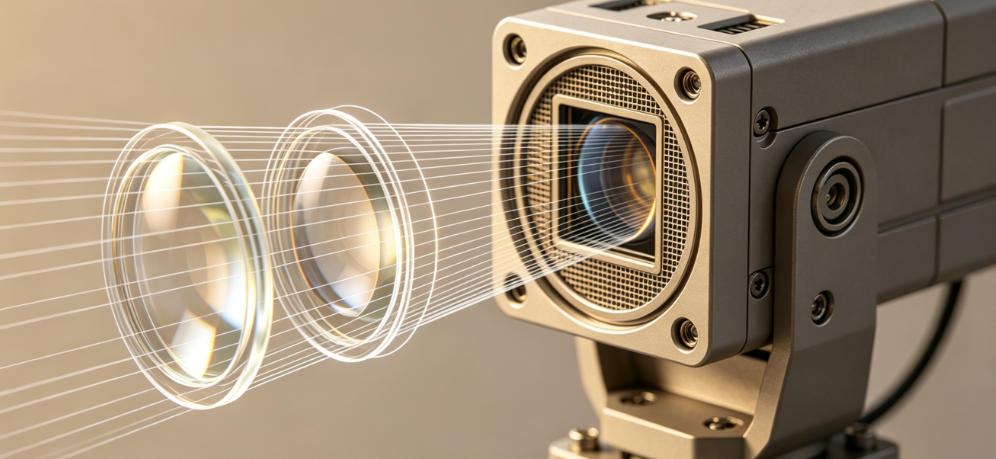
Stray light refers to light in an optical imaging system that does not follow the designed optical path but still reaches the imaging sensor or detector. These rays typically come from unintended paths, such as multiple reflections, scattering, refraction, or non-imaging reflections from internal structures, thereby interfering with the original optical signal and reducing image quality and measurement accuracy.
In modern machine vision systems and 3D vision systems, stray light not only affects image clarity but also directly impacts depth calculation results. In ToF cameras, it can cause distance errors, depth drift, and increased point cloud noise.
In an ideal optical model, light should strictly follow the main optical path: from the light source → through the optical lens system → focused onto the sensor surface, forming a clear, stable, and computable image signal. In real-world engineering environments, due to complex optical structures and external environmental factors, stray light is almost unavoidable.
Main Sources of Stray Light:
-
Internal lens reflections
Light reflects multiple times between lens elements or inside the lens barrel, creating non-imaging signals. -
Surface scattering of optical elements
Tiny defects, coating irregularities, or contaminants on lens surfaces cause light scattering. -
Mechanical reflections
Uncoated metal or plastic structures reflect light into the imaging area. -
Ambient light interference
LED lights, sunlight, or reflective surfaces in industrial environments introduce additional light signals. -
Multipath infrared reflection (ToF-specific)
In ToF cameras, infrared light may reflect off multiple surfaces before returning to the sensor, leading to distance calculation errors. This is the most typical stray light problem in 3D measurement systems.

Impact of Stray Light in ToF and 3D Vision
In ToF cameras and 3D vision systems, stray light significantly affects imaging quality and depth measurement results, especially in complex industrial environments.
Since ToF systems rely on 'time-of-flight' calculations for distance measurement, any non-ideal light path can be mistakenly interpreted as a valid echo, introducing system errors. Therefore, stray light not only affects image quality but also directly undermines the physical basis for depth calculations.
Main impacts include:
1. Increased Depth Errors
Stray light interferes with the emission and reception of infrared light in ToF systems, causing the sensor to receive 'incorrect echo signals,' which results in timing measurement offsets.
Effects include:
- Unstable distance measurements
- Overall depth value shifts
- Local “depth jumps”
- Amplified errors at longer distances
In high-precision applications such as robotics localization and AGV navigation, these errors affect path planning and environmental mapping accuracy, reducing depth accuracy and potentially compromising system reliability.
2. Increased Point Cloud Noise
In 3D point cloud generation, stray light introduces false spatial information, degrading point cloud quality.
Typical manifestations:
- Point drift: unstable object edges
- Geometric distortion: shape deformation
- Increased outliers: random noise points
- Fragmentation: discontinuities in continuous surfaces
This directly affects downstream algorithms such as 3D reconstruction, robot grasping, and SLAM mapping & localization, making stray light a system-level issue rather than just an image noise problem.
3. Reduced Image Contrast
In machine vision systems, stray light produces background light pollution on the imaging plane, causing images to appear washed out or overexposed.
Specific effects:
- Compressed dynamic range
- Edge blurring
- Reduced object-background separation
- Decreased accuracy in thresholding and edge detection
For industrial applications such as defect inspection, dimensional measurement, and automated sorting, reduced contrast decreases algorithm stability and recognition accuracy.
4. Difficulty Detecting Low-Reflectivity Objects
Many industrial objects have low reflectivity or complex surfaces, such as:
- Black plastics
- Rubber materials
- Shiny metals
- Semi-transparent or absorptive materials
These objects have weak signals and are easily overwhelmed by background noise in stray light environments.
Consequences:
- Incomplete or missing object contours
- Missing or abnormal depth information
- Increased misidentification rate
- Failed grasping or incorrect positioning
In indoor robotics and automated warehouse systems, this directly impacts robotic grasping success rates and task reliability.
Main Sources of Stray Light in Industrial Machine Vision
-
Internal optical system reflections
Multiple reflections between lens components produce non-imaging rays. -
Multipath infrared reflections (ToF-specific)
Emitted infrared light may reflect off multiple surfaces before reaching the sensor, causing distance errors. -
Ambient light interference
LED lights, sunlight, or reflective metal surfaces in industrial sites introduce extra light signals. -
Mechanical structure reflections
Internal uncoated structures can reflect light into the imaging area.

How to Mitigate Stray Light
To enhance 3D vision system stability and depth measurement accuracy, industrial cameras, ToF systems, and machine vision designs must employ systematic strategies from optical design, hardware, to algorithms.
Stray light control is no longer optional—it is a critical factor for imaging quality, measurement reliability, and system stability.
1. Optical Design Optimization
Optimizing lens structure and light paths can:
- Reduce non-imaging reflections between lens elements
- Improve anti-reflective coatings
- Control light incidence angles to avoid multiple reflections
- Increase overall optical system 'light path purity'
High-end ToF cameras also use baffle designs to block stray paths, reducing noise at the source.
2. Black Coating & Anti-Reflection Treatment
Any highly reflective surface inside the optical system can generate stray light. Industrial devices often implement:
- Matte black coating for internal structures
- Low-reflectivity surface treatment
- Micro-textured surfaces to absorb stray light
This significantly reduces background light contamination, enhancing stability in indoor robotics and AGV systems.
3. Optical Filtering
Filtering is crucial for suppressing ambient light interference, especially in industrial environments.
Techniques include:
- Band-pass filters
- IR-pass filters
- Multi-layer interference filters
Benefits:
- Allow only target wavelengths to reach sensors
- Block environmental light (LEDs, sunlight)
- Improve signal-to-noise ratio (SNR)
- Enhance ToF signal purity
This step is critical for depth stability in 3D vision systems.
4. Time Gating
In ToF cameras, time gating is a key hardware-level mitigation technique:
- Sensors only receive light within a defined return time window
- Filter out delayed multipath reflections
- Reduce interference from ambient and non-direct light
Benefits:
- Improved depth accuracy
- Stable long-distance measurements
- Enhanced anti-interference capability in dynamic scenes
This method also indirectly supports robotics localization in high-end systems.
5. AI-Based Denoising & Post-Processing
Software algorithms, especially AI, play a crucial role in mitigating stray light in complex industrial environments.
Methods:
Point Cloud Filtering
- Remove outliers
- Smooth spatial structures
- Improve point cloud continuity
Depth Completion
- Fill depth holes
- Restore edge structures
- Optimize occluded regions
Deep Learning Enhancement
- Improve detection in low SNR regions
- Distinguish real structures from noise
- Optimize performance in complex lighting
AI not only removes noise but also 'understands the scene,' enhancing overall system intelligence.
Practical Impact on Industrial Applications
Stray light affects:
- Reduced AGV/AMR navigation accuracy
- Increased misidentification in automated sorting
- Higher robotic arm grasping failure rate
- Distorted 3D scanning and modeling
- Increased errors in industrial inspection
In robotics localization and indoor robotics, stray light indirectly affects path planning and positioning precision.
Special Challenges in ToF Cameras
For Time-of-Flight cameras, stray light is more complex due to reliance on light travel time:
- Multipath reflections causing depth deviation
- High-reflectivity materials saturating the signal
- Low SNR in bright environments
- Increased depth map edge errors
High-end ToF devices combine hardware and software optimizations to mitigate these effects.
Trends in Industrial 3D Vision Systems
With the rise of smart manufacturing and AI vision technology:
- Higher integration in optical design to reduce internal reflections
- AI-driven image enhancement for depth data correction
- Multi-sensor fusion (LiDAR, ToF, RGB) to improve interference resistance
- Edge computing for real-time denoising and optimization
3D Safe Guarding Privacy RGBD Camera Synexens CS30

Conclusion
Stray light is a critical factor affecting the performance of 3D vision systems and ToF cameras. In industrial applications, it directly impacts depth accuracy, point cloud quality, and machine vision stability.
Understanding what is stray light and how to mitigate it is essential for improving the reliability of machine vision systems, robotic navigation, and smart manufacturing. With advances in AI and optical technology, future 3D vision systems will intelligently identify and eliminate stray light
