

What Is a ToF Sensor? How dToF Powers Modern Robotics
- 投稿者LidarSensor
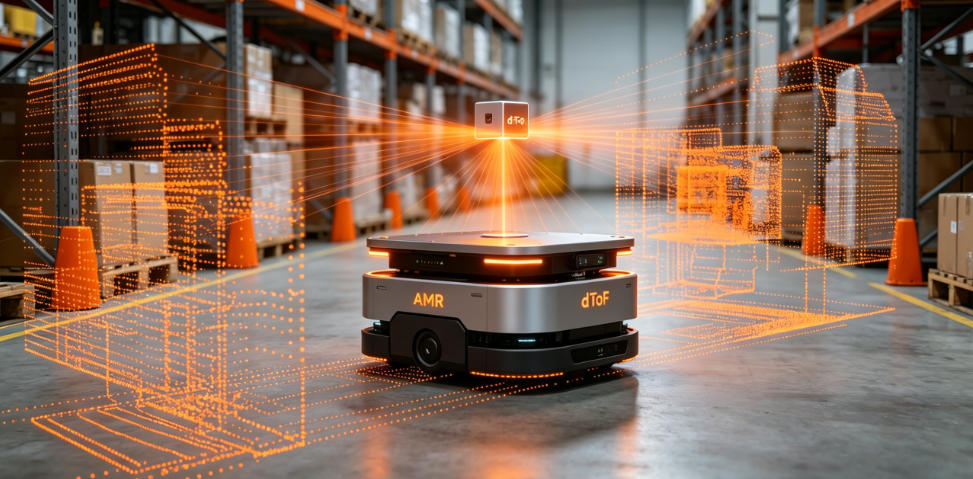
What Is a ToF Sensor and Why Are Robots Using It for 3D Vision?
With the rapid development of robotics, artificial intelligence, autonomous systems, and industrial automation, robots are becoming increasingly capable of understanding and interacting with the real world. However, intelligent robots require more than cameras and algorithms—they need accurate environmental perception to understand distance, space, objects, and movement.
In this evolution, the ToF sensor (Time-of-Flight sensor) has become one of the most important technologies for modern 3D vision systems.
From Autonomous Mobile Robots (AMRs) and AGV robots in smart warehouses to industrial robots, drones, autonomous vehicles, and service robots, ToF sensors provide reliable depth information that enables machines to perceive their surroundings and make intelligent decisions.
Unlike traditional RGB cameras that only capture 2D image information, a ToF depth sensor directly measures the distance between the sensor and objects by calculating the travel time of emitted light. This allows robots to create accurate 3D depth maps, detect obstacles, perform navigation, and understand spatial relationships in real time.
Among different ToF technologies, Direct Time-of-Flight (dToF) is gaining increasing attention because of its long-range measurement capability, high accuracy, and strong performance in challenging environments.
In this article, we will explore:
- What is a ToF sensor?
- How does Time-of-Flight technology work?
- What is the difference between dToF and iToF?
- Why are robots using dToF sensors?
- What are the main applications of ToF technology in robotics?
What Is a ToF Sensor?
A ToF sensor (Time-of-Flight sensor) is a distance measurement device that calculates the distance to an object by measuring the time required for emitted light to travel to the target and return to the sensor.
The basic distance calculation formula is:
D = (c × t) / 2
Where:
- D = Distance between the sensor and the target
- c = Speed of light (approximately 3 × 10⁸ m/s)
- t = Round-trip travel time of the light signal
Because light travels extremely fast, ToF systems require highly accurate timing circuits capable of measuring differences at nanosecond or even picosecond levels.
The working principle of a Time-of-Flight sensor is based on active optical measurement. The sensor emits infrared light toward an object, receives the reflected signal, and calculates the exact distance according to the light travel time.
Unlike traditional vision sensors, a ToF sensor does not rely on color, texture, or ambient lighting conditions to estimate depth. Instead, it directly obtains real-world distance information.
This makes ToF technology widely used in:
- Robot navigation
- Obstacle avoidance
- Autonomous driving
- Industrial automation
- Smart home devices
- 3D scanning
- Human detection systems
- AR/VR applications
A modern ToF depth sensor can also capture multiple distance points simultaneously and generate a complete 3D depth map or 3D point cloud, allowing machines to understand the structure of their environment.
Therefore, ToF technology is also commonly known as:
- Depth Sensor
- 3D Vision Sensor
- 3D Depth Camera
- Time-of-Flight Camera
- Laser Distance Sensor
- ToF Camera Sensor
The main purpose of a ToF sensor is not simply image capture, but enabling intelligent devices to understand spatial information.

Core Components of a ToF Sensor
A complete ToF sensor system consists of several key components that work together to achieve accurate distance measurement and 3D perception.
1. VCSEL Laser Emitter
The light source is one of the most important parts of a ToF system.
Modern ToF sensors commonly use VCSEL (Vertical-Cavity Surface-Emitting Laser) technology to emit infrared light toward the target object.
Typical wavelengths include:
- 850 nm
- 940 nm
Compared with traditional LED light sources, VCSEL lasers provide several advantages:
- Higher optical efficiency
- Lower power consumption
- Faster modulation speed
- More concentrated beam patterns
- Better outdoor performance
- Improved resistance to ambient light interference
Because of these advantages, VCSEL has become the preferred light source for many advanced ToF cameras, LiDAR systems, and robot perception sensors.
In robotic applications, stable infrared emission is essential because robots often operate in environments with changing lighting conditions, including warehouses, factories, outdoor areas, and nighttime scenarios.
2. Receiver Sensor
The receiver captures reflected infrared photons returning from objects.
Different ToF architectures use different receiver technologies.
dToF Sensors
Direct ToF sensors typically use:
- SPAD arrays (Single-Photon Avalanche Diodes)
SPAD sensors are extremely sensitive and can detect individual photons. This allows dToF systems to achieve:
- High ranging accuracy
- Long-distance measurement
- Fast response speed
- Strong low-light performance
This makes dToF suitable for:
- Robot navigation
- Drone ranging
- LiDAR systems
- Autonomous vehicles
iToF Sensors
Indirect ToF sensors usually use:
- CMOS image sensors
CMOS-based receivers provide:
- Higher resolution
- Lower manufacturing cost
- Easier integration
- Compact sensor design
They are commonly used in:
- Smartphone depth cameras
- AR devices
- Face recognition systems
- Short-range 3D imaging
3. Time-to-Digital Converter (TDC)
The Time-to-Digital Converter (TDC) is one of the core components that determines the accuracy of a ToF sensor.
Because the travel time of infrared light is extremely short, the system needs a highly precise timing circuit to measure the difference between emitted and returned signals.
In a dToF sensor, the TDC measures the exact arrival time of individual photons detected by SPAD sensors. This allows the system to calculate accurate distance information even when the reflected light signal is weak.
Advanced TDC technology provides:
- High timing resolution
- Improved distance accuracy
- Faster measurement speed
- Better performance in low-reflectivity environments
For robotics applications, precise timing measurement is especially important because robots need reliable distance information for navigation, obstacle avoidance, and real-time decision-making.
4. Optical Filter System
Since ToF sensors rely on infrared light measurement, they require optical filters to improve signal quality.
The optical filter blocks unwanted environmental light while allowing specific infrared wavelengths to pass through.
This helps reduce interference caused by:
- Sunlight
- Indoor lighting
- Reflections from surrounding objects
- Other infrared devices
A high-quality optical filter improves:
- Measurement stability
- Outdoor performance
- Signal-to-noise ratio
- Depth accuracy
This is especially important for robot ToF sensors used in factories, warehouses, and outdoor autonomous systems.
What Is dToF (Direct Time-of-Flight)?
dToF (Direct Time-of-Flight) is an advanced distance measurement technology that calculates distance by directly measuring the travel time of individual light photons.
The operating principle is simple:
- The laser emitter sends a short infrared pulse.
- The pulse travels toward an object.
- The light reflects from the object surface.
- The sensor detects returning photons.
- The system calculates the exact flight time.
- Distance information is generated.
Because dToF directly measures photon arrival time, it can achieve higher accuracy compared with traditional depth estimation methods.
A typical dToF sensor system includes:
- VCSEL infrared laser
- SPAD photon detector
- TDC timing circuit
- Signal processing unit
- Depth calculation algorithm
This architecture enables dToF sensors to provide accurate distance measurement even in challenging conditions.
dToF vs iToF: What Is the Difference?
Both dToF (Direct Time-of-Flight) and iToF (Indirect Time-of-Flight) technologies are based on measuring the travel time of light. However, their measurement methods are different.
Understanding the difference between dToF and iToF is important when selecting a suitable depth sensor for robotics, smartphones, and industrial applications.
dToF Sensor
A dToF sensor directly measures the time required for photons to travel to an object and return.
Advantages include:
Longer Measurement Range
Because dToF can detect individual photons with SPAD technology, it is suitable for long-distance applications.
Typical applications include:
- Robot navigation
- Outdoor LiDAR
- Drone obstacle detection
- Autonomous vehicles
Higher Accuracy
Direct measurement reduces estimation errors and provides more precise distance information.
This is important for:
- Industrial robots
- AMR navigation
- AGV obstacle avoidance
- Safety monitoring systems
Better Low-Light Performance
Since SPAD sensors can detect very weak optical signals, dToF performs well in dark environments.
iToF Sensor
An iToF sensor measures distance by analyzing the phase difference between emitted and reflected modulated light waves.
Advantages include:
- Higher image resolution
- Compact design
- Lower cost
- Easier smartphone integration
Common applications include:
- Smartphone portrait photography
- Face recognition
- AR applications
- Indoor 3D scanning
However, iToF systems may experience limitations in:
- Long-distance measurement
- Strong sunlight environments
- Multi-path interference
dToF vs iToF Comparison Table
| Feature | dToF Sensor | iToF Sensor |
|---|---|---|
| Measurement method | Direct photon timing | Phase difference measurement |
| Receiver technology | SPAD | CMOS |
| Range capability | Longer distance | Short to medium distance |
| Accuracy | Higher | Moderate to high |
| Outdoor performance | Excellent | Limited |
| Low-light performance | Excellent | Good |
| Cost | Higher | Lower |
| Main applications | Robotics, LiDAR, autonomous systems | Smartphones, AR, indoor sensing |
For robotic applications that require reliable navigation and accurate environmental understanding, dToF sensors are becoming an increasingly popular choice.
Why Do Robots Use ToF Sensors?
Modern robots need to understand the physical world before they can make intelligent decisions.
A robot operating in a warehouse, factory, or outdoor environment must answer important questions:
- How far away is an obstacle?
- Where is the target object?
- Is the path safe?
- How should the robot move?
- How does the environment change over time?
Traditional cameras provide visual information, but they may struggle to estimate accurate distances.
For example:
- A black object may absorb visible light.
- Poor lighting can reduce image quality.
- Similar textures can confuse depth algorithms.
- Fast-moving objects may be difficult to track.
A ToF sensor for robots solves these challenges by providing direct depth measurements.
By generating accurate 3D depth data, robots can better understand their surroundings and perform tasks more safely and efficiently.
1. Robot Navigation and SLAM
Navigation is one of the most important applications of ToF sensors in robotics.
Autonomous robots need to know their position and environment at the same time. This process is called:
SLAM (Simultaneous Localization and Mapping).
In SLAM systems, ToF sensors provide depth information that helps robots:
- Build environmental maps
- Detect obstacles
- Estimate movement
- Plan routes
- Avoid collisions
For example, an AMR robot working in a warehouse can use ToF depth sensors to identify shelves, workers, pallets, and unexpected obstacles.
Compared with traditional sensors, ToF technology provides more detailed 3D environmental information, improving navigation reliability.
2. Obstacle Detection and Avoidance
Safety is a critical requirement for autonomous robots.
Whether in factories, hospitals, warehouses, or public spaces, robots must detect obstacles quickly and accurately.
A robot obstacle avoidance sensor based on ToF technology can:
- Measure object distance in real time
- Detect moving people
- Identify unexpected objects
- Adjust movement paths automatically
Because ToF sensors provide accurate depth information, robots can react faster and reduce collision risks.
This makes ToF technology widely used in:
- Warehouse robots
- Delivery robots
- Cleaning robots
- Inspection robots
- Service robots

3. Object Recognition and Robotic Manipulation
For industrial robots and service robots, understanding the position and shape of objects is essential.
Traditional 2D cameras can identify object appearance, but they cannot accurately determine the three-dimensional position of objects. This creates challenges in applications that require precise grabbing, sorting, or assembly.
A ToF depth sensor provides accurate distance information, allowing robots to understand:
- Object location
- Object size
- Object height
- Surface distance
- Spatial relationship between multiple objects
With the support of 3D vision technology, robotic arms can perform more precise operations, including:
- Pick-and-place tasks
- Automated sorting
- Packaging
- Assembly
- Quality inspection
For example, in smart factories, a robot equipped with a 3D ToF camera can identify products on a conveyor belt and calculate the correct gripping position, improving production efficiency and reducing errors.
This makes ToF sensors an important component of modern robot vision systems.
4. AMR and AGV Robot Applications
The rapid growth of smart warehouses and Industry 4.0 has increased demand for autonomous mobile robots.
Both AMR (Autonomous Mobile Robot) and AGV (Automated Guided Vehicle) systems require accurate environmental perception to operate safely and efficiently.
A ToF sensor for AMR robots can provide:
- Real-time distance measurement
- Obstacle detection
- Path planning assistance
- Human presence detection
- Navigation support
In warehouse environments, robots often operate among:
- Storage racks
- Pallets
- Forklifts
- Workers
- Moving equipment
A ToF depth sensor helps robots continuously monitor their surroundings and adjust their routes.
Compared with traditional 2D sensors, 3D ToF sensors provide richer spatial information, allowing autonomous robots to achieve better navigation accuracy.
Typical applications include:
- Warehouse logistics robots
- Automated delivery robots
- Hospital service robots
- Manufacturing transport robots
- Inspection robots
5. Robot Safety and Human Detection
As robots become more common in human environments, safety has become increasingly important.
Robots working alongside people must accurately detect human presence and maintain safe distances.
A ToF sensor for human detection can measure:
- Human distance
- Body position
- Movement direction
- Interaction area
Because ToF technology provides real-time depth information, robots can better distinguish humans from background objects.
Applications include:
- Collaborative robots (cobots)
- Industrial safety systems
- Smart access control
- Service robots
- Healthcare robots
For example, a collaborative robot working with factory employees can use ToF sensors to detect nearby workers and automatically reduce speed or stop movement when necessary.
ToF Sensor vs LiDAR: Which One Is Better for Robots?
Both ToF sensors and LiDAR sensors use light-based distance measurement technology, but they are designed for different applications.
In fact, many LiDAR systems are also based on the Time-of-Flight principle. The difference mainly lies in system design, scanning method, range, and application requirements.
ToF Sensor Advantages
A ToF depth sensor offers:
- Compact size
- Lower power consumption
- Fast response
- Real-time depth imaging
- Easy integration
It is ideal for:
- Indoor robots
- AMR navigation
- Robot arms
- Smart devices
- 3D vision systems
LiDAR Advantages
LiDAR systems provide:
- Longer detection range
- Higher outdoor performance
- Large-scale environmental scanning
- High-precision mapping
They are commonly used in:
- Autonomous vehicles
- Outdoor robots
- Surveying systems
- Large-scale mapping
For many indoor robotic applications, ToF sensors provide a more compact and cost-effective solution, while LiDAR remains the preferred choice for long-range autonomous systems.
In the future, ToF and LiDAR technologies are expected to work together through multi-sensor fusion to create more powerful robotic perception systems.

Conclusion: Why Are ToF Sensors Important for Future Robots?
A ToF sensor has become one of the key technologies enabling robots to understand the world around them.
By providing accurate distance measurement and real-time 3D depth sensing, ToF technology helps robots improve:
- Navigation
- Obstacle avoidance
- Object recognition
- Human detection
- Autonomous decision-making
Compared with traditional cameras, ToF depth sensors provide direct spatial information, making them highly valuable for modern robotics applications.
From AMR robots and industrial automation to smart devices and autonomous systems, ToF sensors are helping machines move from simple automation toward true intelligent perception.
With continued advances in dToF technology, SPAD sensors, VCSEL lasers, AI vision, and 3D sensing systems, ToF sensors will play an increasingly important role in the future of robotics.
For companies developing autonomous robots, warehouse automation solutions, or intelligent machines, choosing the right ToF sensor, 3D depth camera, or dToF sensor will become a critical factor in achieving higher accuracy, safety, and efficiency.
