

ToF 3D Vision Drives Intelligent ACR Case-Handling & Smart Warehousing
- 投稿者TofSensor
Why ToF 3D Vision Is Essential for Accurate Case Recognition in ACR Robots?
Driving a Comprehensive Upgrade of Smart Warehousing and Logistics Automation
With the rapid growth of e-commerce, the shift toward flexible manufacturing, and rising labor costs in warehousing, the warehousing and logistics industry is accelerating toward automation and intelligence. Among these solutions, ACR (Autonomous Case-handling Robot) has become a key piece of equipment in high-density storage and intelligent picking systems.
As application scenarios grow more complex, traditional case identification methods that rely on QR codes, barcodes, or rigid rule-based logic are increasingly showing limitations in efficiency and flexibility. 3D vision technology based on TOF (Time-of-Flight) is emerging as a critical perception solution, enabling high-precision, markerless, and intelligent case recognition and localization for ACR systems.
What Is an ACR Robot?
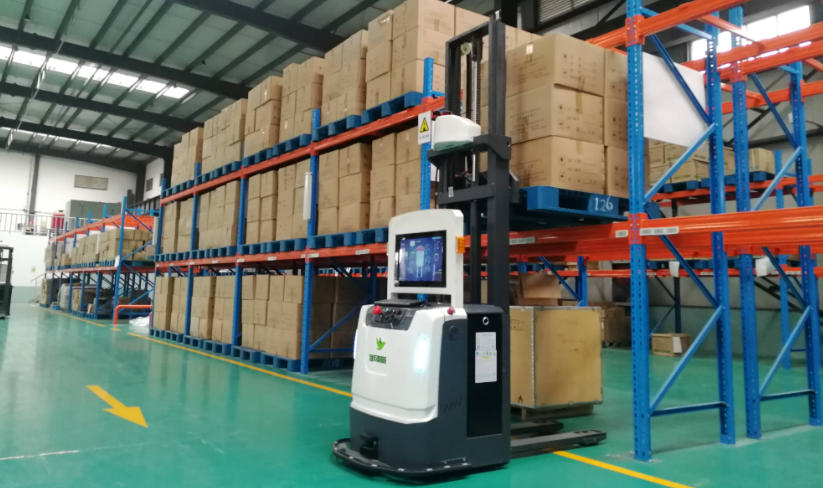
An ACR (Autonomous Case-handling Robot) is an intelligent mobile robot designed primarily for warehouse and logistics automation, specializing in the autonomous transport of cartons, totes, and bins. It uses sensors such as LiDAR, ToF depth cameras, RGB cameras, and IMUs to achieve markerless autonomous navigation, precise localization, and dynamic obstacle avoidance, operating freely without magnetic strips or QR codes. Compared with traditional AGVs, ACRs offer faster deployment, higher flexibility, and scalable multi-robot coordination, enabling 24/7 stable operation. They are widely used in e-commerce fulfillment centers, third-party logistics (3PL), pharmaceutical cold chains, and internal manufacturing logistics, making them a core robot type in modern smart warehousing systems.

1. Market Background and Development Trends of ACR Case-Handling Robots
Global Market: Explosive Growth in ACR Demand
Driven by smart warehousing, intelligent logistics, and unmanned warehouse solutions, the global ACR market is entering a period of rapid growth.
As warehouse robotics and AMR/AGV automation systems mature, ACRs are increasingly becoming core equipment in automated storage facilities due to their strengths in high-density storage, fast inbound/outbound handling, and flexible transport.
China Market: Technology Innovation Driving Global Leadership
China is not only a major application market for ACRs, but also a global innovation hub for ToF 3D vision, robot navigation, and intelligent perception technologies.
With continued growth in new retail, intelligent manufacturing, consumer electronics, and pharmaceutical logistics, both the scale and technical maturity of ACR deployments in China are rapidly increasing.
Chinese manufacturers are building globally competitive smart warehousing solutions by combining ToF depth cameras + AI algorithms + SLAM.
2. Why ToF 3D Vision Has Become the Core Technology for ACR Case Recognition
In smart warehousing and automated logistics environments, the case recognition capability of ACRs directly determines system efficiency, stability, and automation level. As warehouse operations shift from “standardized and rule-based” to “flexible and highly diverse,” traditional case recognition solutions are increasingly unable to meet real-world demands. Against this backdrop, ToF 3D vision technology has become the core component of ACR perception systems.
Limitations of Traditional Case Recognition Methods
Many current ACR systems still rely on the following approaches for case recognition and localization:
-
Barcode / QR code scanning
Reading barcodes or QR codes on case surfaces to obtain identification and location data. -
Fixed rule-based size matching
Identifying cases based on predefined dimensions and templates. -
2D camera-based vision recognition
Using 2D images for edge detection, contour extraction, or object classification.
While effective in standardized, low-complexity scenarios, these methods reveal clear limitations in real warehouse environments.
1. High Sensitivity to Lighting Conditions
Traditional 2D vision and scanning solutions are highly dependent on lighting:
-
Strong light, shadows, or reflective packaging can cause recognition failures
-
Nighttime or uneven lighting requires additional illumination
-
Worn, dirty, or damaged labels reduce barcode readability
This makes it difficult to maintain stability in 24/7 unmanned operations.
2. Inability to Capture True Height and Volume Information
Barcodes and 2D images provide only planar information and cannot directly obtain:
-
Actual case height
-
Stack layers
-
True occupied volume
In high-density vertical storage and dynamic stacking scenarios, the lack of 3D data can lead to:
-
Reduced storage utilization
-
Incorrect pick-and-place path planning
-
Increased risk of grasp failures or collisions

3. High Requirements on Case Orientation and Low Flexibility
Traditional methods often assume that cases are:
-
Properly aligned
-
Not tilted or occluded
-
Uniform in size
In real-world operations, cases frequently exhibit:
-
Rotation or tilt
-
Misaligned stacking
-
Edge occlusion or overlap
These conditions pose major challenges for 2D vision and rule-based systems, severely limiting the operational flexibility of ACRs.
4. Poor Adaptability to Multi-Size and Multi-SKU Scenarios
With the growth of e-commerce and new retail, warehouses now handle an exponential increase in SKU count and case variety:
-
Mixed storage of different sizes and materials
-
Increased use of temporary or irregular packaging
Rule-based and template-driven recognition methods are costly to maintain and difficult to scale, making them ill-suited to rapidly changing business needs.
5. Limited Automation and Intelligence
Traditional solutions are largely passive “recognize + execute” systems and lack deep spatial understanding:
-
Unable to assess graspability
-
Unable to make intelligent decisions based on spatial relationships
-
Difficult to deeply integrate with AI algorithms, SLAM, and path planning
This has become a major barrier to upgrading ACRs into truly intelligent warehouse robots.
As multi-size cases, high-density storage, dynamic environments, and unmanned operation become the norm, traditional case recognition solutions can no longer meet requirements for stability, accuracy, flexibility, and intelligence.
Driven by these challenges, ToF-based 3D vision technology with true spatial perception is increasingly becoming the core sensing solution for ACR case recognition and localization—laying a solid foundation for high-precision grasping, intelligent scheduling, and 3D warehouse optimization.
Advantages of ToF 3D Vision Technology
ToF (Time-of-Flight) 3D vision technology emits modulated infrared light and measures its return time to directly obtain true-scale depth information and 3D point cloud data, providing ACRs with perception capabilities closer to human stereoscopic vision.
Key advantages of ToF depth cameras in ACR applications include:
-
High-precision 3D case recognition and localization
-
Markerless recognition without relying on barcodes or artificial labels
-
Real-time acquisition of case height, volume, and orientation
-
Strong resistance to ambient light interference, suitable for complex warehouse environments
-
Low latency, ideal for high-speed operation scenarios

3. ToF + Deep Learning: Technical Implementation Path for ACR Case Recognition
1. 3D Data Acquisition
ACRs equipped with ToF 3D cameras perform real-time scanning of cases, generating high-density 3D point cloud data that accurately reconstruct the true spatial structure of cartons and totes.
2. Deep Learning–Based Feature Extraction
By integrating deep learning algorithms (such as CNNs and PointNet-based models), the system automatically extracts key features from point clouds, including:
-
Case edges
-
Dimensional contours
-
Placement angles
-
Surface structure features
This enables robust recognition of cases with varying sizes and placement poses.
3. Precise Localization and Dimension Calculation
Leveraging the true depth data provided by ToF, the system can accurately calculate:
-
Case center coordinates
-
Height and volume
-
Graspable regions
These high-precision spatial parameters are directly supplied to the ACR’s robotic arm or handling mechanism for reliable execution.
4. Automatic Correction and Intelligent Optimization
In dynamic warehouse environments, the system continuously detects deviations and performs:
-
Pose correction
-
Fine path adjustment
-
Storage location optimization
This significantly improves overall task success rates and operational stability.
5. Execution Output and System Coordination
Finally, recognition results from the ToF + AI pipeline are transmitted to:
-
ACR control systems
-
Warehouse Management Systems (WMS)
-
Warehouse Control Systems (WCS)
Enabling full automation across inbound, storage, and outbound workflows.
4. Typical Application Scenarios Enabled by ToF for ACRs
As smart warehousing and intelligent logistics evolve toward higher density, greater flexibility, and deeper automation, ACRs (Autonomous Case-handling Robots) are transitioning from rule-based handling devices to intelligent robots with true spatial understanding. ToF 3D vision provides stable, real-time depth perception, enabling efficient and reliable operation across complex scenarios.
Automated High-Bay Warehouses
In automated high-bay warehouses, storage locations are densely packed and vertically distributed, with diverse case sizes and stacking methods. ToF 3D vision delivers accurate spatial information, allowing ACRs to precisely determine case height, volume, and spatial occupancy. This ensures correct placement decisions and safe motion planning during automated put-away and retrieval.
By generating real-time 3D point clouds and voxel maps, ACRs can dynamically manage storage locations and adjust strategies based on warehouse conditions, significantly improving space utilization and throughput. Even in unmanned or low-light environments, ToF maintains stable performance, ensuring continuous operation.
E-commerce and Retail Logistics
E-commerce and retail logistics environments are characterized by high SKU counts, diverse case dimensions, and fluctuating order volumes, placing heavy demands on sorting and outbound efficiency. ToF 3D vision enables ACRs to rapidly recognize cases of different sizes and orientations without relying on barcodes or rigid templates.
With true 3D perception, robots can achieve precise localization and handling at high speeds, reducing manual intervention and significantly shortening order fulfillment cycles. ToF also ensures reliable recognition under complex stacking and occlusion conditions, enhancing system robustness during peak demand periods.
Intralogistics in Manufacturing Facilities
In manufacturing intralogistics scenarios—such as 3C electronics, pharmaceuticals, and automotive parts—materials are diverse, workstation layouts are complex, and production rhythms change frequently. ToF-powered ACRs can continuously perceive their surroundings and case conditions, enabling flexible line-side feeding and automated replenishment.
Through close integration of 3D vision and scheduling systems, ACRs dynamically adjust pick-and-place paths based on production tempo, accurately completing docking, loading/unloading, and transfer tasks. This spatially aware logistics approach reduces manual handling costs while improving production stability and overall efficiency.
Intelligent Logistics Centers
Large-scale intelligent logistics centers operate in highly complex environments with long operating hours and strict requirements for stability and safety. ToF 3D vision enables ACRs to operate 24/7 in unmanned conditions, maintaining reliable perception even at night, in low-light areas, or amid frequent environmental changes.
With real-time 3D mapping and obstacle detection, ACRs can safely avoid collisions in multi-robot collaborative environments, optimize route planning, and reduce congestion and waiting times. This ToF-based spatial perception capability provides critical technical support for scalable deployment and high-reliability operation in modern logistics hubs.
5. Future Trends: ToF as the 'Spatial Eye' of ACRs
As ToF sensor costs decrease while resolution improves and power consumption drops, adoption in ACRs and smart warehousing will continue to rise. Key future trends include:
-
Deep integration of ToF + AI + SLAM
-
Multi-sensor fusion (ToF + LiDAR + RGB)
-
A shift from rule-driven systems to intelligent decision-making
-
Evolution from 2D warehousing to fully 3D intelligent storage
Conclusion
ToF 3D vision technology is redefining the perception capabilities of ACR case-handling robots.
By providing robots with true, real-time, and stable 3D spatial understanding, ToF not only improves case recognition and localization accuracy but also drives the evolution of warehousing and logistics from basic automation toward genuine intelligence.
In the future ecosystem of smart warehousing, intelligent logistics, and unmanned warehouses,
ACR + ToF 3D Vision + AI will form an indispensable core technology stack.
Synexens Industrial Outdoor 4m TOF Sensor Depth 3D Camera Rangefinder_CS40p

After-sales Support:
Our professional technical team specializing in 3D camera ranging is ready to assist you at any time. Whether you encounter any issues with your TOF camera after purchase or need clarification on TOF technology, feel free to contact us anytime. We are committed to providing high-quality technical after-sales service and user experience, ensuring your peace of mind in both shopping and using our products.
