

What Is a ToF Sensor? Principles, Benefits & Applications
What Is a ToF Sensor and How Does Time-of-Flight Technology Work?
With the rapid development of artificial intelligence (AI), robotics, smart manufacturing, autonomous driving, and 3D vision technology, accurately obtaining spatial distance and depth information has become an important requirement for modern intelligent devices. Traditional RGB cameras mainly provide two-dimensional images, while robots, smart terminals, industrial equipment, and automation systems also need to understand the position, distance, depth, and spatial structure of objects. As a result, the time-of-flight sensor has become one of the important 3D sensing technologies for modern applications.
So, what is a time of flight sensor? Simply put, a ToF sensor is a depth sensor that calculates the distance to an object by measuring the time required for a light signal to travel from the emitter to the target and return to the receiver. Based on the constant speed of light, Time-of-Flight technology calculates spatial depth information and can generate distance data, depth maps, and even 3D point clouds. Unlike a conventional camera, a ToF sensor can directly obtain the distance between the sensor and an object, making it valuable for robot vision, 3D vision, smart devices, industrial automation, and other applications.
Today, time-of-flight sensors are widely used in smartphones, facial recognition, AR/VR, robot navigation, industrial automation, logistics and warehousing, smart manufacturing, and automotive driver-assistance systems. As AI vision and 3D sensing continue to evolve, ToF technology is moving beyond simple distance measurement toward real-time 3D perception and intelligent spatial understanding.
How Does a ToF Sensor Work?
To understand what is time of flight sensor, it is first important to understand the basic operating principle of ToF technology. A complete time of flight sensor system typically consists of a light source or emitter, receiver, ToF image sensor, signal processing circuit, and control algorithms.
During operation, the ToF sensor actively emits modulated infrared light. Common light sources include 940nm VCSEL lasers and LEDs. The infrared light travels toward an object, reflects from its surface, and returns to the receiver. The system then calculates the distance according to the time difference or phase difference between the emitted and returned signals.
The basic formula is:
Distance = Speed of Light × Time of Flight ÷ 2
Because the light travels from the sensor to the target and then back to the receiver, the total travel distance is divided by two.
This active ranging method distinguishes a ToF sensor from a conventional RGB camera. In addition to capturing visual information, a ToF system can provide a corresponding depth distance for each effective pixel, creating a Depth Map. When large amounts of depth data are combined, the system can also generate a 3D point cloud. Therefore, the 3D ToF sensor has become an important component of modern 3D sensing systems.

What Are the Main Types of ToF Technology?
The current ToF technology market can generally be divided into two major approaches: Direct ToF and Indirect ToF. Both are based on the Time-of-Flight principle, but they use different methods to calculate distance.
1. Direct ToF (dToF Sensor)
A dToF sensor (direct time of flight sensor) calculates distance by directly measuring the time required for a light pulse to travel from the emitter to the target and return to the receiver. It commonly uses SPAD (Single Photon Avalanche Diode) technology, VCSEL lasers, and high-speed timing circuits to measure the arrival time of photons and determine distance.
Compared with conventional approaches, dToF offers strong long-range measurement capabilities and fast response, making it particularly suitable for applications that require rapid detection of moving targets. For example, a dToF sensor can be used in LiDAR, robot navigation, long-range distance measurement, drone perception, and high-performance 3D sensing systems. Some ToF chips using SPAD arrays can also capture depth information across multiple areas simultaneously, providing richer data for robot vision and spatial perception.
2. Indirect ToF Sensor (iToF)
An indirect time of flight sensor (iToF) primarily calculates distance by detecting the phase difference between emitted and reflected light. An iToF system generally emits continuously modulated infrared light and analyzes the phase shift of the returning signal to determine the distance to the target.
This approach typically offers high spatial resolution and strong large-area depth imaging capabilities, making it widely used in smartphone TOF cameras, AR/VR devices, robot vision, industrial 3D inspection, and consumer electronics.
For applications that need to capture a large number of depth pixels simultaneously, an iToF camera can provide real-time Depth Map output within a compact module. As a result, iToF technology has become an important solution for many 3D vision and machine vision systems.
What Is a Time-of-Flight Camera?
A time-of-flight camera (ToF camera) is a 3D imaging device based on ToF sensor technology. Unlike a conventional RGB camera, which mainly captures color and texture, a ToF camera can obtain both spatial distance and depth information from objects.
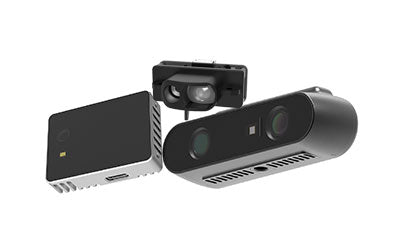
A complete camera tof system typically includes a ToF camera sensor, infrared emitter module, optical lens, image processing chip, and communication interface. During operation, the ToF camera actively emits infrared light and analyzes the returning signal to generate a Depth Map, distance data, and 3D spatial information.
Today, time of flight cameras have become an important component of robot vision and 3D vision systems. For example, AMR autonomous mobile robots can use a ToF camera for obstacle detection and avoidance. Industrial robots can use a 3D time of flight camera for object positioning, robotic picking, and spatial measurement. Smart warehousing systems can use ToF 3D sensing to obtain the dimensions, position, and height of packages.
Compared with a conventional 2D camera, a ToF camera allows machines not only to “see” an object but also to understand how far away it is and where it is located in three-dimensional space.
How Does a ToF 3D Sensor Enable 3D Perception?
A traditional 2D camera mainly answers the question, “What is the object?” A ToF 3D sensor can provide an additional answer: “Where is the object?”
By collecting distance information from a large number of pixels, a ToF camera sensor can build a three-dimensional representation of the target environment.
For example, a 640 × 480 ToF camera module can theoretically capture depth information from more than 300,000 pixel positions simultaneously. After image processing and AI analysis, this Depth Data can be used for 3D object recognition, people detection, gesture recognition, SLAM navigation, spatial modeling, and robot positioning.
In industrial environments, industrial ToF 3D image sensors can be combined with AI vision and machine vision algorithms to perform object dimension measurement, target classification, defect inspection, robotic picking, and automated positioning. For AGVs, AMRs, and intelligent logistics equipment, this real-time spatial perception capability helps robots understand their surrounding environment more accurately.
What Are the Advantages of ToF Sensors?
1. Real-Time 3D Measurement
One of the biggest advantages of a ToF sensor is its ability to directly acquire depth data. Compared with stereo vision, which relies on texture matching, or structured light, which projects specific patterns onto a target, ToF technology actively emits infrared light to obtain distance information and can quickly build three-dimensional spatial data.
This makes ToF sensors suitable for fast-moving targets, dynamic environments, robot navigation, industrial robotics, and real-time 3D measurement. In applications requiring low-latency Depth Data, ToF technology can continuously provide spatial information for control systems.
2. Compact Design and Easy Integration
As VCSEL, SPAD, and ToF image sensor technologies continue to advance, modern tof camera modules are becoming increasingly compact. They can be integrated into smartphones, drones, robots, smart access-control systems, industrial equipment, and portable 3D scanning devices.
This miniaturization allows ToF technology to be used not only in large industrial systems but also in consumer electronics and mobile devices. For example, TOF sensing in smartphones can support facial recognition, AR spatial measurement, autofocus, and depth perception.
3. Low Dependence on Surface Texture
Stereo vision typically relies on differences between images captured by two cameras. When an object's surface has little visible texture, depth matching can become more difficult.
A ToF sensor actively emits light, so it can obtain distance information from objects without relying heavily on surface texture. In low-texture environments, indoor applications, and other challenging visual conditions, a ToF depth sensor can provide independent depth information.
4. Fast Response
A ToF sensor is a fast 3D sensing device capable of continuously outputting distance and depth data. This makes it suitable for robotics, automated equipment, and dynamic object detection.
In robot navigation, a ToF camera can continuously detect obstacles in front of the robot. In industrial automation, a 3D ToF sensor can help robots determine the position of objects. In human-machine interaction applications, ToF technology can also support gesture recognition and motion tracking.
What Are the Limitations of ToF Sensors?
Although ToF technology provides significant advantages, it also has several technical challenges in practical applications. Understanding these limitations helps engineers select the appropriate depth sensor or 3D vision solution for a specific application.
1. Ambient Light Interference
Strong sunlight and other infrared light sources can interfere with ToF reception signals, particularly in outdoor environments, highly reflective scenes, and industrial environments with strong lighting.
To improve reliability, ToF sensors may use optical filters, signal processing, algorithmic compensation, and system calibration to reduce the impact of ambient light.
2. Multipath Reflection
When infrared light reflects multiple times from different surfaces before reaching the receiver, it can create Multipath Interference and affect the accuracy of the resulting depth data.
Materials such as glass, mirrors, and highly reflective metals can be particularly challenging. Therefore, industrial 3D inspection and precision measurement applications may require optimized sensor designs and advanced algorithms to improve measurement reliability.
3. Resolution Limitations
Compared with conventional RGB cameras, many ToF cameras still offer relatively limited image resolution. Therefore, applications that require highly detailed texture information and high-resolution visual data may combine a ToF sensor with an RGB camera, stereo camera, or AI vision system.
The RGB camera provides color and texture information, while the ToF sensor provides depth information. Together, they can create a more complete RGB-D vision system.
4. Different Measurement Ranges
Different ToF sensors offer different measurement ranges, fields of view, resolutions, and accuracy levels. Short-range ToF sensors are commonly suitable for smartphones, gesture recognition, people detection, and short-distance spatial perception, while long-range time of flight laser distance sensors are better suited to industrial measurement, robot navigation, and long-distance target detection.
When selecting a ToF sensor, engineers should therefore consider measurement range, ambient light, target material, resolution, frame rate, power consumption, and other specifications rather than simply comparing sensor models.

How Does ToF Compare with Other Distance Sensors?
ToF Sensor vs Ultrasonic Sensor
An ultrasonic sensor uses the propagation time of sound waves to measure distance, while a ToF sensor primarily uses the travel time of light.
A ToF sensor generally provides faster response and richer spatial information and can generate depth maps or even 3D data through a ToF camera. This makes it particularly suitable for 3D vision and robot vision applications.
Ultrasonic sensors, on the other hand, offer low cost and are relatively insensitive to lighting conditions, making them suitable for simple distance measurement, liquid-level detection, and basic obstacle detection.
ToF Sensor vs LiDAR
From a fundamental perspective, many LiDAR systems also use the Time-of-Flight principle to measure the travel distance of light, so the two technologies are closely related.
However, LiDAR typically focuses on long-range measurement, high accuracy, and large-scale spatial scanning, while a ToF camera focuses more on short-range 3D imaging and pixel-level depth information.
For robotics, industrial automation, and indoor 3D vision, a ToF camera can provide an intuitive Depth Map. For autonomous driving, surveying, mapping, and long-range environmental modeling, LiDAR can serve different sensing requirements.
What Are the Applications of ToF Technology?
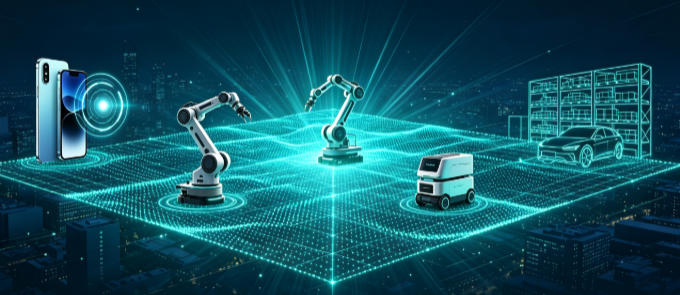
As 3D sensing technology continues to mature, ToF sensors are being adopted across an increasingly broad range of applications. In consumer electronics, a ToF camera can support facial recognition, AR measurement, gesture recognition, and spatial perception. In robotics, it can be used for obstacle detection, navigation, SLAM, and object positioning. In industrial automation, ToF technology can support dimension measurement, object detection, robotic picking, and 3D inspection.
In logistics and warehousing, a ToF 3D sensor can capture the length, width, height, and spatial position of packages, boxes, and other objects. This depth information can support package volume measurement, automated sorting, warehouse automation, and intelligent logistics systems. For AGVs and AMRs, a ToF camera can also detect surrounding obstacles and help enable more intelligent autonomous movement.
ToF technology is also expanding into smart homes, drones, medical devices, smart access control, industrial safety, and human-machine interaction. As AI and 3D vision become increasingly integrated, ToF sensors will not simply measure distance. They will increasingly serve as an important source of spatial data that enables machines to understand the real world.
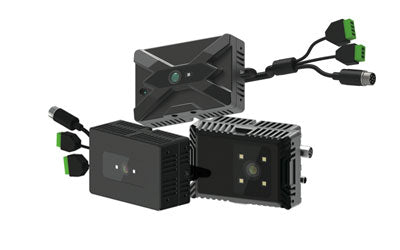
Synexens Industrial Outdoor 4m TOF Sensor Depth 3D Camera Rangefinder_CS40p

Future Trends in ToF Technology
With continued advances in AI chips, SPAD arrays, VCSEL light sources, edge computing, and 3D vision algorithms, ToF sensors are moving toward higher resolution, longer measurement ranges, lower power consumption, greater accuracy, and stronger environmental adaptability.
Future AI ToF cameras will not only output basic distance information but can also combine AI algorithms for object recognition, human detection, pose estimation, spatial analysis, and behavior understanding. At the same time, 3D ToF sensing will increasingly work together with RGB cameras, LiDAR, radar, and other depth sensors to create multi-sensor fusion systems that provide robots and intelligent devices with more comprehensive environmental perception.
Especially in smart manufacturing and industrial automation, industrial ToF 3D image sensors are expected to become an important component of robot vision and machine vision systems. From camera tof technology in smartphones to 3D time of flight cameras in industrial robots, AGVs, AMRs, and intelligent logistics systems, ToF technology is becoming an important sensing technology connecting digital information with real-world three-dimensional space.
For developers, engineers, and businesses looking to understand what is a time of flight sensor, ToF is more than a distance measurement technology. It is evolving from simple point-to-point ranging into an intelligent sensing solution that integrates depth perception, 3D vision, AI recognition, and spatial computing. As this technology continues to mature, it will play an increasingly important role in robotics, smart manufacturing, autonomous driving, and next-generation 3D vision applications.
