

Smart Fitness with ToF Tech: Non-Contact Motion Capture & Analysis
How Does ToF Technology Enable Smart Fitness and Non-Contact Motion Analysis?
Smart Fitness and Motion Analysis: ToF Empowers Non-Contact Motion Recognition
With the rapid development of fitness, sports training, and rehabilitation medicine, the demand for non-contact motion monitoring is increasing significantly. Traditional methods that rely on cameras or wearable sensors often suffer from lighting interference, occlusion, and discomfort, as well as privacy concerns. With the adoption of TOF (Time-of-Flight)sensor technology, smart fitness and motion analysis have entered a new era — enabling high-precision, contactless motion capture and posture analysis, and providing scientific data support for both training and rehabilitation applications.
What is the Meaning of SMART Fitness?
Smart and Connected Fitness
In this context, “SMART” stands for the application of Smart Technology, referring to the integration of Artificial Intelligence (AI), sensors, ToF depth cameras, big data, and cloud computing to achieve real-time monitoring and analysis of movement posture, heart rate, energy expenditure, and training performance.
-
Smart fitness mirrors, treadmills, and wristbands can analyze users’ movements, posture, and training intensity in real time.
-
The system automatically generates personalized training plans and provides audio or visual feedback to help users correct movements and improve exercise efficiency.
Therefore, SMART Fitness represents a data-driven, personalized, and interactive approach to training and health management.

Applications of ToF in Motion Capture and Posture Analysis
ToF (Time of Flight) technology measures the time it takes for emitted light to travel to an object and return, generating high-precision depth images and spatial data. Compared with traditional RGB cameras or stereo vision systems, ToF sensors can quickly capture 3D human structure and motion trajectories even under complex lighting conditions. As a result, ToF has been widely used in smart fitness equipment, posture analysis systems, and rehabilitation training platforms. The following are typical application scenarios:
1. Fitness Training Motion Monitoring
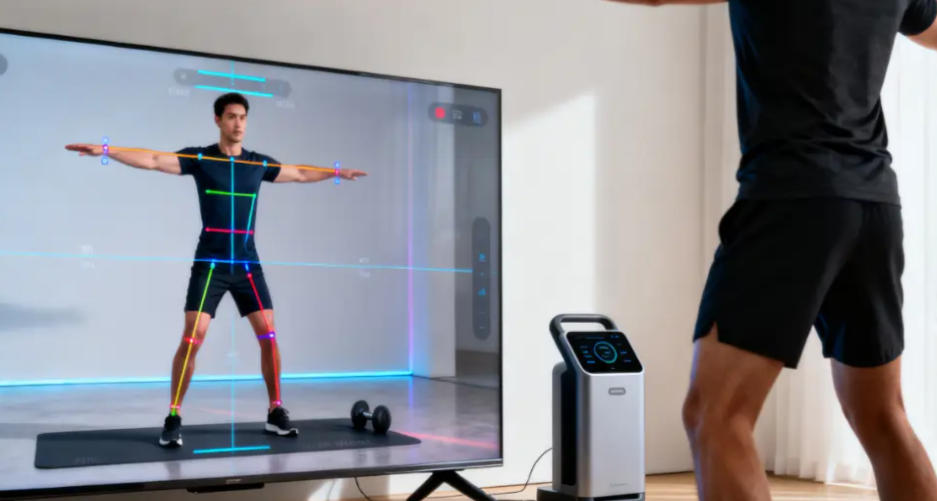
In the field of smart fitness, ToF cameras can capture fine motion details and trajectories in real time, achieving accurate pose recognition and analysis.
-
Real-Time Motion Capture and Tracking
ToF depth sensors can generate a 3D skeletal model of the user within milliseconds, dynamically tracking common exercises such as squats, push-ups, and dumbbell curls. Combined with AI algorithms, it identifies motion angles, speed, and rhythm for high-precision motion detection. -
Form Recognition and Error Correction
The system automatically compares movements to standard posture models to detect inaccuracies. For example, during squats, if the user’s knees move forward excessively or the back bends, the ToF sensor can instantly detect the error and provide voice or visual reminders, reducing the risk of injury. -
Smart Scoring and Training Guidance
By integrating ToF depth data with AI analysis, the system can score each movement and provide personalized improvement suggestions. Users can review performance and receive targeted recommendations through smart mirrors or fitness apps, achieving measurable and scientific progress.
2. Motion Posture Analysis and Rehabilitation Training
In rehabilitation and medical recovery scenarios, ToF technology serves as an ideal tool for high-precision, safe, and non-contact motion monitoring.
-
3D Posture Modeling and Joint Analysis
ToF cameras generate real-time 3D data of patients’ movements, identifying key joint positions and measuring Range of Motion (ROM) and trajectory. This provides clinicians or therapists with objective and data-based assessments. -
Symmetry and Quality Evaluation
By comparing motion curves of both limbs, the system can assess symmetry, coordination, and recovery progress, assisting in the evaluation of balance and rehabilitation effectiveness. -
Non-Contact Rehabilitation Monitoring
ToF technology eliminates the need for wearable sensors, reducing discomfort and interference. Patients simply move within the camera’s field of view, and the system accurately records posture changes, enhancing safety and convenience.
3. Real-Time Feedback and Long-Term Motion Analysis
By integrating ToF technology with AI algorithms, motion tracking systems can deliver instant feedback and continuous progress tracking, supporting scientific and personalized training.
-
AI-Based Recognition and Performance Evaluation
The depth data captured by ToF sensors is processed by AI models to analyze movement accuracy, speed, and balance. For instance, AI can calculate joint angle variations and body center shifts, offering real-time feedback and optimization suggestions. -
Interconnection Across Smart Devices
ToF depth-sensing technology has been widely applied in smart fitness mirrors, treadmills, and AI personal trainer systems. Combined with motion sensors, it enables more precise and interactive training experiences. -
Cloud-Based Data Management and Personalized Optimization
All motion data can be uploaded to the cloud for long-term tracking. The system automatically generates training curves and health reports, and AI algorithms adjust future plans based on trends, enabling truly personalized fitness guidance and adaptive optimization.
With its high accuracy, low latency, and contactless characteristics, ToF technology is becoming one of the key enablers in smart fitness and rehabilitation systems. From real-time motion monitoring to long-term performance tracking, ToF empowers intelligent health management and human–machine interaction with greater precision and convenience.

Technical Advantages: Real-Time Depth Sensing and Safe Contactless Monitoring
ToF (Time of Flight) technology, with its ability to provide high-precision depth measurement and non-contact sensing, has become a core component in smart fitness equipment, posture analysis systems, and rehabilitation platforms. Compared with traditional 2D vision or motion sensors, ToF excels in real-time responsiveness, accuracy, and safety.
1. Real-Time 3D Depth Perception — Millisecond-Level Precision
ToF sensors emit near-infrared light and measure the return time to create millisecond-level 3D depth maps. This spatial data accurately depicts human body structure and movement, even during fast motion.
-
High Frame Rate Capture: ToF cameras achieve 30–60 fps depth sampling, maintaining stability even in fast, dynamic activities such as jumping or running.
-
Robust Under Complex Lighting: Unlike RGB cameras that rely on visible light, ToF sensors use active infrared light, ensuring accuracy under low light or bright sunlight.
-
Multi-Angle Pose Analysis: Integrated with AI pose estimation, the system outputs joint angles, skeletal mapping, and motion trajectories in real time for full-body analysis.
This millisecond-level precision makes ToF ideal for accurate motion capture and real-time posture analysis.
2. Low Power Consumption — Extending Device Battery Life
Power efficiency is essential in smart fitness and wearable devices. Optimized ToF modules achieve low power, high performance depth sensing through both hardware and algorithm improvements.
-
Energy-Efficient Design: Advanced infrared emitters and adaptive exposure control reduce energy usage without compromising range or accuracy.
-
Dynamic Power Management: Sampling rate and frame density adjust automatically based on activity level to save power during low-motion states.
-
Versatile Integration: ToF modules function effectively in fitness mirrors, treadmills, or portable wearables, ensuring continuous monitoring with minimal battery drain.
This balance of power efficiency and performance ensures ToF-enabled devices deliver a more stable and enduring fitness experience.
3. Safe Contactless Monitoring — Comfort and Privacy Protection
Unlike wearable or contact-based sensors, ToF technology enables fully non-contact detection. Users can perform exercises or rehabilitation routines naturally without physical devices attached.
-
Enhanced Comfort: No skin contact or discomfort, ideal for long sessions or sensitive users.
-
Higher Privacy Security: ToF captures only depth data, not color or facial details, significantly reducing privacy risks.
-
Multi-Person and Public Use: Suitable for gyms or rehabilitation centers, ToF can monitor multiple users simultaneously without interference.
This non-invasive approach improves both comfort and safety, making ToF technology a preferred solution in smart fitness, telemedicine, and behavioral analytics applications.
With its three key advantages — real-time depth perception, low power operation, and safe non-contact sensing — ToF technology has become a cornerstone of modern smart fitness systems and posture analysis platforms. It enables more accurate data collection, more natural interaction, and stronger privacy protection, opening new possibilities for intelligent motion tracking and personalized health management.

Technical Challenges: Occlusion, Ambient Light, and High-Speed Motion Adaptation
Although ToF (Time-of-Flight) technology has shown great potential in smart fitness, posture analysis, and rehabilitation training, practical applications still face several technical challenges. The main issues focus on body occlusion, ambient light interference, and high-speed motion adaptation. To address these challenges, the industry continues to improve system stability and reliability through hardware optimization and algorithm upgrades.
1. Occlusion — Multi-View Fusion and Skeletal Model Compensation
In multi-user training or complex motion scenarios, certain body parts (such as arms, legs, or joints) may be blocked by other objects or the user’s own body, preventing the ToF sensor from capturing complete depth data. Such occlusion directly affects continuous motion recognition and complete posture reconstruction.
Common solutions include:
-
Multi-view ToF sensor systems: Deploy multiple ToF cameras to capture depth data from different angles, enabling 3D data fusion and reducing occlusion-induced data loss.
-
AI compensation based on skeletal models: Utilize human biomechanics and deep learning algorithms to intelligently predict and interpolate missing joint positions, restoring complete human posture.
-
Adaptive occlusion detection mechanisms: Identify occluded regions and dynamically adjust data sampling strategies to minimize recognition errors.
These methods significantly enhance the accuracy of motion recognition in complex environments and multi-user scenarios.
2. Ambient Light Interference — Filtering and Signal Enhancement
ToF sensors measure distance by emitting near-infrared light and calculating the return time. In conditions with strong lighting, reflective surfaces, or shadows, external light can interfere, causing depth fluctuations, measurement errors, or signal loss.
Solutions typically involve both hardware and algorithm improvements:
-
Narrowband filtering and optical optimization: Optimize the infrared emission spectrum and receiving filters to enhance interference resistance and maintain high signal-to-noise ratio in bright environments.
-
Multi-frame fusion and temporal filtering: Average, interpolate, and denoise multiple frames of depth data to remove transient disturbances caused by ambient light, improving measurement stability.
-
Dynamic exposure and illumination control: Automatically adjust infrared emission power and exposure time according to environmental brightness to avoid overexposure or underexposure.
These enhancements allow ToF sensors to maintain high-precision depth measurements even in outdoor workouts, glass reflections, or complex lighting conditions.
3. High-Speed Motion Adaptation — High Frame Rate Sampling and AI Interpolation
In motion capture or fitness training scenarios, users often perform high-speed movements such as jumping, punching, or rapid rotations. If the ToF sensor’s frame rate or sampling speed is insufficient, it may result in data latency, motion blur, or missing key frames.
To ensure accurate tracking of high-speed motions, common technical measures include:
-
High-frame-rate depth sampling: Increase sensor frame rates (e.g., 60 fps or higher) to reduce time gaps between movements and maintain capture continuity.
-
AI interpolation and motion prediction algorithms: Use neural network models to dynamically interpolate missing or blurred frames and predict motion trends, ensuring consistent and accurate posture analysis.
-
Time synchronization and latency compensation: In multi-sensor setups, synchronize clocks to minimize cumulative delays and ensure consistent temporal alignment of all sensor data.
These optimizations allow ToF systems to maintain precise posture recognition and motion tracking even in fast, dynamic exercise scenarios.
ToF technology in motion capture and posture analysis is relatively mature, but occlusion, ambient light interference, and high-speed motion adaptation remain key areas for improvement. In the future, combining multi-modal sensor fusion (e.g., ToF + RGB + IMU), AI deep learning optimization, and hardware computing power upgrades will enable ToF systems to achieve higher robustness and real-time performance, further advancing their application in smart fitness, rehabilitation, virtual reality, and human-computer interaction.
Manufacturer Recommendations: AI-Enhanced Motion Recognition and Data Analysis
-
Integrate AI algorithms: Use deep learning models for skeletal reconstruction and motion classification from ToF point cloud data.
-
Multi-sensor fusion: Combine IMU, heart rate sensors, or RGB camera data for more comprehensive motion analysis.
-
Edge computing deployment: Process data locally on the device for low-latency feedback and improved user experience.
Future Outlook: ToF + AI + Wearables Driving Smart Fitness Evolution
With the development of ToF + AI + wearable devices, smart fitness and rehabilitation training are entering a stage of higher efficiency, safety, and personalization:
-
Smart fitness mirrors and training equipment: Enable full-body motion capture, standardized training guidance, and real-time correction.
-
Digital rehabilitation training: Provide scientific, quantifiable data to rehabilitation centers, guiding the optimization of training plans.
-
Cloud-based motion data analysis: Long-term tracking of user movement patterns to deliver personalized training and health management.
Synexens 3D Of RGBD ToF Depth Sensor_CS30

Our professional technical team specializing in 3D camera ranging is ready to assist you at any time. Whether you encounter any issues with your TOF camera after purchase or need clarification on TOF technology, feel free to contact us anytime. We are committed to providing high-quality technical after-sales service and user experience, ensuring your peace of mind in both shopping and using our products.
-
で掲示されます
CS30
