

Visual SLAM & Camera Odometry for Mobile Robot Navigation
How Do Mobile Robots Use Visual SLAM and Camera Odometry for Precise Navigation?
In the field of mobile robotics, Visual Odometry (Camera Odometry) and Visual SLAM (Simultaneous Localization and Mapping) technologies have become key research areas. As the demand for autonomous robot navigation continues to grow, achieving high-precision localization and mapping has become a major focus for both academia and industry. This article explores the principles, applications, and future development trends of robot SLAM, VIO SLAM, and camera odometry.
1. What is Visual Odometry (Camera Odometry)?
Visual Odometry (VO) is a technique that uses cameras as the primary sensor to estimate the motion of a robot or device through continuous image sequences. By performing feature extraction, feature matching, and motion estimation on environmental images, the system calculates pose changes between consecutive frames, enabling continuous updates of the robot's position and orientation.
Unlike traditional wheel encoder-based odometry, camera odometry does not rely on contact-based measurements. This makes it highly adaptable to complex and uneven terrains, serving as a critical component of modern robot SLAM systems.
Core Workflow of Visual Odometry
Visual odometry typically consists of the following steps:
-
Image Acquisition: Capturing visual information using monocular, stereo, or RGB-D cameras.
-
Feature Extraction: Detecting key points such as corners, edges, or ORB features.
-
Feature Matching: Establishing correspondences between features in consecutive frames.
-
Motion Estimation: Calculating camera pose changes using geometric methods such as PnP, triangulation, or optical flow.
-
Pose Update: Accumulating relative motion to estimate the robot's trajectory.
Through these processes, the system continuously estimates the robot's movement in 3D space, providing foundational data for SLAM-based mapping.
Advantages of Visual Odometry
Compared with traditional wheel odometry or purely inertial navigation systems, visual odometry offers several advantages:
-
Non-Contact Measurement and Strong Environmental Adaptability
Since it does not depend on wheel traction, visual odometry can operate reliably on sand, slopes, and complex indoor environments. -
High Accuracy and Rich Information Content
Images contain abundant environmental texture information. Through multi-frame fusion, positioning accuracy can reach centimeter-level precision, making it an essential component of high-performance robot SLAM systems. -
Low Cost and Lightweight Deployment
Cameras are significantly more affordable and compact than sensors such as LiDAR, making them ideal for embedded robotic platforms and mobile devices. -
Semantic Environmental Perception
In addition to pose estimation, visual data can be used to identify obstacles and scene structures, enabling more intelligent navigation capabilities.

Integration of Camera Odometry and VIO SLAM
In practical applications, standalone visual odometry can be affected by lighting changes, motion blur, and texture-poor environments. To overcome these limitations, it is often combined with an Inertial Measurement Unit (IMU) to form a VIO SLAM (Visual-Inertial Odometry SLAM) system.
Within a VIO SLAM framework:
-
Camera Odometry provides accurate visual constraints.
-
IMU sensors provide high-frequency acceleration and angular velocity measurements.
-
Sensor fusion significantly reduces drift and improves both short-term and long-term localization stability.
This approach has become one of the most widely adopted SLAM solutions and is extensively used in drones, autonomous vehicles, AR/VR devices, and indoor mobile robots.
The Role of Camera Odometry in Robot SLAM
As the front-end component of a robot SLAM system, visual odometry provides real-time motion estimation and serves as the perception layer of the localization and mapping pipeline. Its performance directly influences map quality, loop closure accuracy, and overall system reliability.
Therefore, advanced camera odometry algorithms such as ORB-SLAM, DSO, and VINS play a critical role in modern robotic navigation systems.
2. Principles and Categories of Visual SLAM
Visual SLAM is a fundamental technology for autonomous robot navigation. By using cameras to perceive the environment in real time, robots can perform simultaneous localization and mapping.
A typical Visual SLAM pipeline includes:
-
Feature Extraction and Matching: Detecting and matching visual features across consecutive frames.
-
Motion Estimation (Camera Odometry): Estimating robot movement based on matched features.
-
Map Updating: Updating the global map using estimated poses and feature information.
-
Loop Closure Detection and Optimization: Recognizing previously visited locations to correct accumulated errors.
Types of Visual SLAM
Monocular SLAM
Uses a single camera for localization and mapping. It is cost-effective but cannot directly estimate scale without additional information.
Stereo SLAM
Utilizes stereo cameras to obtain depth information, providing higher accuracy and better performance in outdoor and dynamic environments.
VIO SLAM (Visual-Inertial SLAM)
Combines camera data with IMU measurements, significantly improving robustness in challenging lighting conditions and high-speed motion scenarios.
3. Applications of Robot SLAM in Mobile Robotics
With rapid advancements in artificial intelligence and robotics, robot SLAM has become a core technology for autonomous navigation and intelligent robotic operations. By integrating camera odometry and VIO SLAM, robots can achieve high-precision localization, real-time mapping, and intelligent decision-making across a wide range of applications.
Autonomous Vehicles
In autonomous driving, robot SLAM enables real-time environmental perception, path planning, and autonomous navigation. Camera odometry continuously tracks vehicle movement on city roads, highways, and complex intersections. Combined with VIO SLAM, vehicles can maintain accurate positioning even in GPS-denied environments such as tunnels.
Applications include autonomous taxis, self-driving trucks, and unmanned patrol vehicles.
Warehouse and Logistics Robots
In warehouse environments, robots must navigate among dense shelving systems and dynamic obstacles. Robot SLAM enables robots to identify storage locations, optimize routes, and avoid collisions.
-
Camera Odometry ensures accurate pose tracking.
-
VIO SLAM provides motion prediction and dynamic compensation.
These capabilities are widely deployed in e-commerce fulfillment centers, smart factories, and distribution hubs.
Service Robots
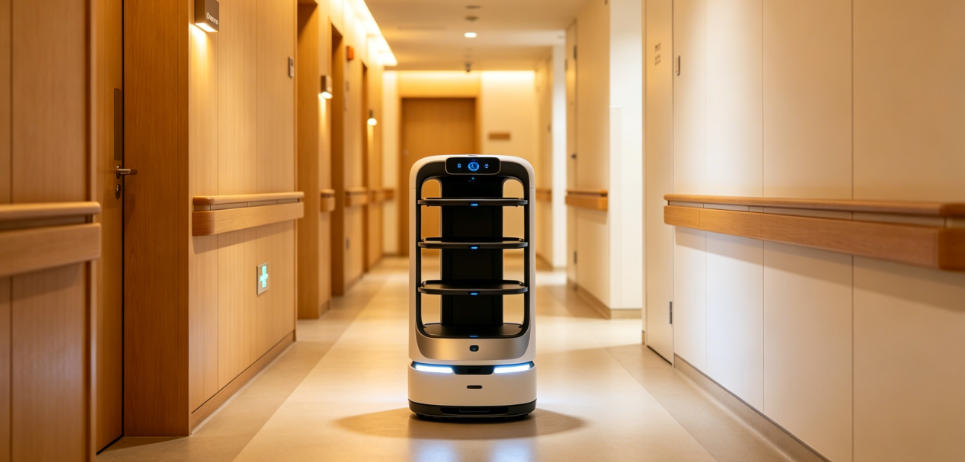
Service robots operating in homes, hotels, hospitals, and commercial spaces require safe and reliable navigation.
Through VIO SLAM, robots can automatically build maps, plan routes, and perform tasks such as cleaning, food delivery, and visitor guidance. Combined with camera odometry, robots can accurately detect furniture, walls, and moving obstacles, resulting in more intelligent navigation.
Industrial Inspection Robots
In industrial environments such as power plants, chemical facilities, and warehouses, robot SLAM empowers robots to perform autonomous inspection and monitoring tasks.
Using camera odometry, robots can track their movement and monitor environmental changes in real time. The integration of VIO SLAM ensures reliable positioning even in low-light or confined environments.
Typical applications include power line inspection, pipeline monitoring, and industrial safety inspections.

Adaptability Across Multiple Scenarios
By combining camera odometry and VIO SLAM, modern robot SLAM systems can operate effectively in both static and dynamic environments. Whether navigating crowded public spaces, busy logistics centers, or industrial facilities with moving machinery, robots can continuously update maps, predict trajectories, and adjust routes in real time.
4. Future Trends of Visual Odometry and VIO SLAM
As mobile robotics and intelligent systems continue to evolve, camera odometry and VIO SLAM technologies are advancing rapidly in terms of accuracy, computational efficiency, environmental adaptability, and application diversity.
Deep Learning Integration
Traditional visual odometry relies on handcrafted features and matching algorithms, which are vulnerable to lighting changes and low-texture environments.
Recent advances include:
-
CNN and Transformer-based feature extraction.
-
Deep-learning-based image matching and motion estimation.
-
End-to-end learning frameworks that directly predict camera motion from image sequences.
These innovations enhance the robustness and intelligence of modern robot SLAM systems.
Multi-Sensor Fusion
To overcome the limitations of single-sensor systems, modern robot SLAM increasingly integrates multiple sensing modalities:
-
IMU: Provides high-frequency motion measurements.
-
LiDAR: Delivers highly accurate distance measurements and map construction.
-
Ultrasonic Sensors and Depth Cameras: Improve obstacle avoidance and local mapping performance.
Multi-sensor fusion enables robots to achieve reliable localization and navigation in complex environments.
Lightweight and Real-Time Algorithms
As robotic applications expand to embedded and edge-computing platforms, computational efficiency has become a key focus.
Current trends include:
-
Lightweight neural networks and feature extraction methods.
-
Incremental optimization and sparse mapping techniques.
-
GPU acceleration and edge-computing optimization.
These developments allow camera odometry and VIO SLAM to run efficiently on drones, autonomous vehicles, and consumer robots.
Large-Scale Environment Adaptation
Future robot SLAM systems must operate reliably in large-scale environments such as cities, factories, airports, and warehouses.
Key research directions include:
-
Global consistency optimization using loop closure and graph optimization.
-
Dynamic object detection and semantic segmentation.
-
Multi-floor and multi-building navigation.
These capabilities will enable VIO SLAM systems to maintain high accuracy and stability across large and complex environments.
3D Safe Guarding Privacy RGBD Camera Synexens CS30

5. Conclusion
Visual odometry and Visual SLAM technologies are fundamental to autonomous navigation in mobile robotics. By integrating camera odometry and VIO SLAM, robots can achieve accurate localization, reliable navigation, and intelligent mapping.
With continuous advancements in deep learning, multi-sensor fusion, and real-time computing, robot SLAM will play an increasingly important role in autonomous vehicles, logistics automation, service robotics, and industrial inspection. For robotics engineers and researchers, mastering Visual SLAM technologies is becoming an essential skill for developing the next generation of intelligent robotic systems.
