
website From Compass to ToF: How Humans Learned to Navigate & Understand Space– Tofsensors
(852)56489966
7*12 Hours Professional Technical Support

From Compass to ToF: How Humans Learned to Navigate & Understand Space
From Compass to ToF: How Humans Learned to Navigate & Understand Space

How Did Humans Navigate Before GPS and Evolve to Using ToF Technology?

Throughout the development of human civilization, 'how to determine direction and position' has always been one of the core drivers of technological progress. From the earliest compass and oldest maps to today’s 3D perception and autonomous navigation systems based on TOF (Time-of-Flight) technology, humanity’s understanding of space has undergone one revolutionary leap after another.

This article starts with the highly searched question 'when was the compass invented', systematically reviews the origin and history of the compass, and further extends to modern ToF technology, revealing the evolution of navigation from 'direction sensing' to 'spatial understanding.'


What is the formula for Time of Flight?

The core formula of Time of Flight (ToF) is used to calculate distance based on the signal’s travel time, as follows:

Basic ToF Formula

Distance=Propagation Speed×Time of Flight2\text{Distance} = \frac{\text{Propagation Speed} \times \text{Time of Flight}}{2}

or written as:

d=v×t2d = \frac{v \times t}{2}

Explanation of Symbols:

  • d: Distance between the target and the sensor

  • v: Signal propagation speed

    • Optical ToF: speed of light c3×108m/sc \approx 3 \times 10^8\, \text{m/s}

    • Ultrasonic ToF: speed of sound ≈343 m/s (in air)

  • t: Round-trip time from signal emission to reflection and return

  • Division by 2: Because the measured time is the round-trip, but the distance is only for a one-way path

From Compass to ToF How Humans Learned to Navigate & Understand Space

1. The Origin of the Compass: What Was the Oldest Compass in the World?

Where was the compass invented?

Historical and archaeological research generally recognizes China as the origin of the compass.
As early as the 4th–3rd century BCE, ancient Chinese people had discovered that natural magnets (magnetite) possess directional properties.

The earliest directional device was called:

  • Sinan

  • Shaped like a spoon, placed on a smooth bronze plate

  • The handle of the spoon always pointed south

This is widely considered the world’s oldest compass / earliest compass.


2. When Was the Compass Invented?

The question 'when was the compass invented?' has very high search volume globally. People often phrase it in different ways, such as when was compass invented, when were compasses invented, when was a compass made, or more specific long-tail queries like when was the first compass invented and when was the first compass made.

Historians generally agree that the earliest compass originated in ancient China during the Warring States period, when people used the natural properties of magnetite to indicate direction for navigation and other purposes. Over time, the compass spread worldwide, providing reliable directional reference for navigation, exploration, and early mapmaking. No matter how people search, the answer is basically the same: the compass was invented in ancient China and represents a major milestone in human navigation history.

Key Historical Milestones:

  • 3rd century BCE (Warring States period):
    Magnetic directional tools (prototype of Sinan) appear

  • Northern Song Dynasty (~11th century CE):
    Magnetic needle compasses are officially used in navigation

  • 12th–13th century CE:
    Compass technology spreads to Europe via the Arab world

👉 Therefore, we can answer:

The compass was invented in ancient China more than 2,000 years ago.

What is the formula for Time of Flight?

3. Who Invented the Compass?

Unlike modern engineering inventions, the compass does not have a single inventor.

  • It was the result of long-term observation of natural magnetic phenomena

  • Gradually improved by ancient Chinese craftsmen, astronomers, and geomancers

  • Represents civilizational-level technological accumulation

Thus, the authoritative answer to who is the inventor of the compass is:

The compass has no single inventor; it is the collective wisdom of ancient China.


4. The Earliest Maps and the Compass: The Prototype of Early Human Navigation Systems

Before the compass appeared, humans had already begun creating maps:

  • The oldest maps:
    Can be traced back to clay tablet maps from Mesopotamia around 2300 BCE

  • The earliest maps in China:
    Terrain and administrative maps existed from the Warring States to the Qin and Han periods

📌 Compass + Maps = Humanity’s earliest “navigation system”

However, navigation at this stage still had clear limitations:

  • Could only provide direction, not distance

  • Unable to perceive environmental changes in real time

  • Strongly reliant on experience and static information


5. From Compass to ToF: The Fundamental Change in Navigation Technology

What Problem Did the Compass Solve?

In early times, the most basic navigation need was “Which direction should I go?” The invention of the compass provided a simple and reliable solution to this question. By utilizing the magnetic properties of natural magnets, the compass could indicate geographic north, allowing people to travel over land, explore the seas, or draw early maps without relying entirely on the sun, stars, or landmarks. This significantly improved directional awareness and travel safety.

Core Function: Direction
Application Scenarios: Navigation, long-distance travel, surveying, geographic exploration

Although the compass could tell people which way to go, it could not provide detailed information about spatial structure, obstacle locations, or surrounding terrain. This meant that in complex environments, people still had to rely on experience or other auxiliary tools.


What Problem Does ToF Technology Solve?

In modern times, fields like mobile robotics, autonomous driving, and smart warehousing have navigation demands far beyond simple direction. People not only need to know which way to go, but also want to understand the precise structure of their surroundings. This is the core value of ToF (Time-of-Flight) technology.

ToF works by emitting light pulses (e.g., infrared or laser) and measuring the time it takes for the light to travel to an object and return, allowing precise calculation of object distance and depth and the generation of real-time 3D spatial structures. Compared to traditional vision sensors or standalone LiDAR, ToF offers several advantages:

  • High real-time performance: Millisecond-level depth updates, suitable for dynamic environments

  • High accuracy: Millimeter-level depth data, supporting precise navigation

  • Strong light adaptability: Reliable measurement in low light, backlight, or strong sunlight

  • Low dependency on environment features: Works even without complex textures

Core Function: Distance + Depth + 3D Spatial Structure
Application Scenarios: Autonomous driving, warehouse logistics robots, indoor navigation, dynamic obstacle avoidance, robotic manipulation

In short, from the compass to ToF, the fundamental change in navigation technology is: evolving from 'just telling you the direction' to 'allowing you to perceive the environment and understand spatial structures', laying the foundation for autonomous decision-making and dynamic navigation in intelligent systems.

What is the formula for Time of Flight?

6. What is ToF (Time-of-Flight)? The “Spatial Compass” of Modern Navigation

ToF (Time-of-Flight) measures the time it takes for light or laser to travel to an object and back, allowing the calculation of the object’s distance.

Modern applications of ToF include:

  • Mobile robot navigation

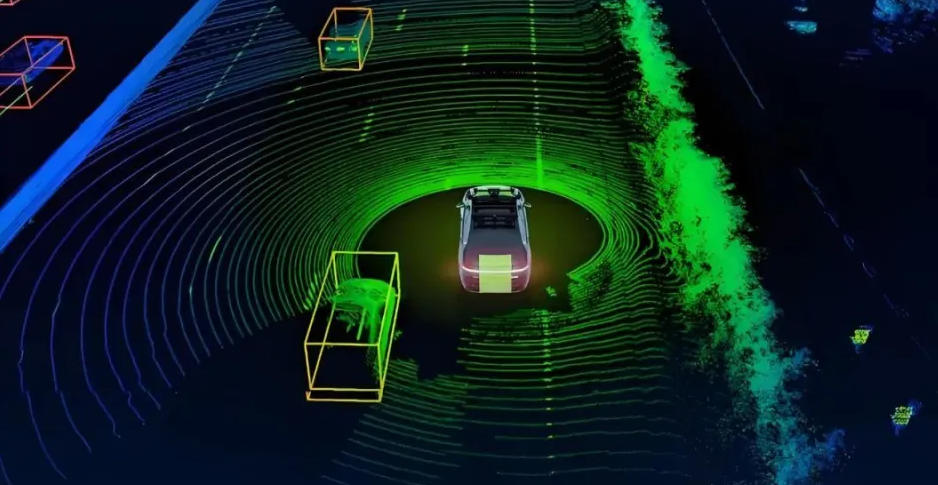
  • Near-field perception in autonomous driving

  • 3D point cloud modeling

  • Mapless navigation


7. Compass vs. ToF: Two Eras of Navigation Technology

Dimension Compass ToF Technology
Navigation Capability Direction sensing 3D spatial perception
Real-time No Yes
Obstacle detection No Yes
Supports autonomous decision-making No Yes
Typical Applications Navigation, exploration Robotics, autonomous driving

👉 If the compass represents humanity’s first 'sense of direction',
then ToF represents the first 'sense of space' for machines.


8. From the 'Earliest Compass' to 'Mapless Navigation': The Common Logic of Technological Evolution

Whether it is:

  • earliest compass

  • first compass invented

  • history of the compass

or today’s:

  • ToF + SLAM

  • mapless navigation

  • autonomous robots

they all address the same core question:

'In an unknown world, how do I know where I am and how to move safely?'


9. Conclusion: The Compass Has Not Disappeared; It Evolved into ToF

The compass has not been eliminated by history; instead, it continues to exist in a new form:

  • From magnet → sensor

  • From direction guidance → spatial modeling

  • From human use → machine autonomous understanding

Today, ToF is becoming the 'new compass' of the intelligent era, providing robots, autonomous vehicles, and smart systems with capabilities beyond direction—a three-dimensional understanding of the real world.


Synexens 3D Camera Of ToF Sensor Soild-State Lidar_CS20


Synexens 3D Camera Of ToF Sensor Soild-State Lidar_CS20_tofsensors


After-sales Support:
Our professional technical team specializing in 3D camera ranging is ready to assist you at any time. Whether you encounter any issues with your TOF camera after purchase or need clarification on TOF technology, feel free to contact us anytime. We are committed to providing high-quality technical after-sales service and user experience, ensuring your peace of mind in both shopping and using our products


Laissez un commentaire

Veuillez noter que les commentaires doivent être approvés avant d'être affichés

Effectuez une recherche