

ToF Technology Powering Markerless Navigation for Autonomous Robots
- par TofSensor
How Does ToF Technology Enable Reliable Markerless Navigation for Robots?
With the rapid development of robotics, autonomous driving, and smart logistics, markerless navigation is gradually replacing traditional navigation methods that rely on QR codes, reflective markers, or high-precision maps. In this technological shift, TOF (Time-of-Flight) depth sensing technology has become a key sensor enabling high-precision and robust markerless navigation.
This article explores ToF depth cameras + markerless navigation, analyzing the technical principles, core advantages, application scenarios, and future trends to systematically explain how ToF enhances robots’ autonomous navigation in complex and dynamic environments.
What Is Markerless Navigation?
Markerless navigation refers to the ability of robots to navigate autonomously without relying on any external artificial markers such as QR codes, reflective strips, magnetic tapes, or pre-installed reference points. Instead, the robot perceives the environment, builds maps, localizes itself, and plans paths using only onboard sensors.
The core of markerless navigation lies in:
👉 real-time perception + real-time decision-making + autonomous adaptation to environmental changes
What Is ToF Technology and Why Is It Critical for Markerless Navigation?
In fields such as robotic mobility, AGV/AMR navigation, smart logistics, and autonomous driving, markerless navigation is gradually replacing traditional methods based on QR codes, magnetic strips, or reflective markers. To achieve true markerless navigation, devices must have reliable, real-time, and environment-independent 3D spatial perception, and ToF (Time-of-Flight) depth sensing technology is one of the key enablers.
Introduction to ToF (Time-of-Flight) Depth Sensing Technology
ToF technology is an active 3D depth sensing method. Its working principle is:
It emits modulated near-infrared light (NIR) into the environment and precisely measures the time it takes for the light to travel to the target and back. Using the speed of light, the sensor can calculate the exact distance to the object.
Unlike traditional 2D vision or passive sensing, ToF can directly acquire high-precision, real-scale depth maps and 3D point cloud data without relying on environmental markers, enabling machines to 'understand' the spatial structure of their surroundings.
Core Advantages of ToF Sensors / ToF Depth Cameras
Compared with stereo vision, structured light, or ultrasonic solutions, ToF depth cameras offer clear advantages for markerless navigation:
1. Real-Time High-Precision Depth Maps
ToF sensors can continuously output pixel-level depth data at high frame rates (30–60 fps or higher), enabling real-time 3D modeling to support high-speed robot navigation.
2. Strong Resistance to Ambient Light Interference
Thanks to modulated light sources and phase/flight time calculation, ToF works reliably under strong, weak, or low-light conditions, making it suitable for indoor + outdoor mixed environments.
3. Low System Latency
Depth computation is highly integrated in hardware, avoiding complex stereo matching or feature extraction. End-to-end latency is minimal, ideal for real-time markerless navigation and obstacle avoidance.
4. Robustness in Dynamic Environments
ToF measures distances directly and does not rely on environmental textures or static features. It performs stably in dynamic crowds, moving objects, and changing environments, significantly outperforming traditional vision systems.

Why ToF Is Crucial for Markerless Navigation
In markerless navigation systems, robots must perform key tasks:
-
Real-time perception of surrounding 3D environment
-
Construction of high-precision maps (SLAM)
-
Accurate self-localization
-
Reliable obstacle avoidance and path planning
ToF depth sensing technology provides a solid data foundation for these tasks:
🔹 Provides Real-Scale Spatial Information
ToF outputs absolute distances rather than relative features, allowing robots to determine obstacle size, position, and safe distance without artificial markers.
🔹 Enhances SLAM Stability and Robustness
In vision-based or multi-sensor SLAM systems, ToF depth data reduces feature loss and scale drift, significantly improving mapping and localization accuracy.
🔹 Supports Autonomous Decision-Making in Complex Environments
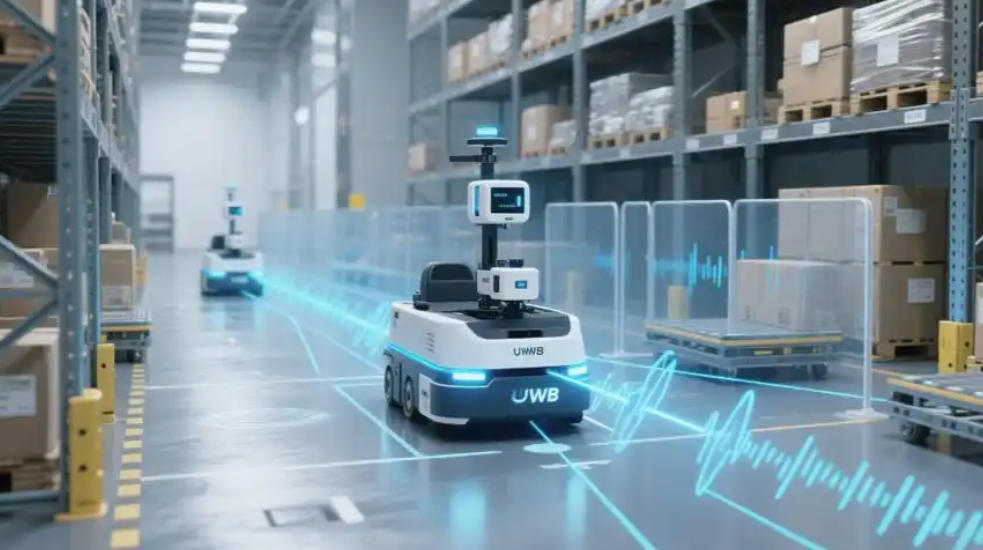
Whether navigating narrow corridors, reflective floors, or low-texture environments (white walls, warehouse shelves), ToF consistently provides reliable depth input for path planning and motion control.
Typical Applications of ToF Technology
Due to its critical value in markerless navigation, ToF is widely applied in:
-
RGBD Camera Systems
Combining RGB images with depth data for environmental understanding and target recognition. -
Robot Obstacle Avoidance and Autonomous Navigation
Core perception modules for AMRs, AGVs, service robots, and inspection robots. -
SLAM Mapping and Localization Systems
Supporting visual SLAM, RGB-D SLAM, and multi-sensor fusion SLAM. -
Autonomous Driving and Vehicle Perception
Short-range obstacle detection, parking assistance, low-speed autonomous driving. -
Smart Logistics and Warehouse Robots
Enabling flexible deployment and efficient operation without tracks or markers.
ToF depth sensing is one of the core technologies for true markerless navigation. Its low-latency, high-precision, and robust 3D perception allows robots and automated equipment to operate safely and efficiently in complex, dynamic, and unmarked environments.
With improvements in ToF chip performance, reduced cost, and deep AI integration, ToF is becoming an indispensable 'eye in space' for markerless navigation systems, smart robots, and autonomous driving perception architectures.
ToF + Markerless Navigation: Key Technology Integration
1. High-Precision Real-Time Localization Based on ToF (Markerless Localization)
In markerless navigation, robots cannot rely on fixed reference points, which demands extremely high localization accuracy and stability.
ToF depth cameras provide centimeter-level depth measurements, which can be combined with:
-
Visual SLAM
-
ToF SLAM
-
LiDAR + ToF fusion SLAM
Robots can map and localize simultaneously in unknown environments, without high-precision maps or artificial markers, achieving true mapless navigation.
High-search-volume keywords naturally included:
-
ToF SLAM
-
Markerless localization
-
Robot autonomous localization
-
SLAM without markers
2. Real-Time Obstacle Avoidance and Dynamic Environment Perception with ToF
Traditional 2D cameras often fail under strong light, shadows, or low-texture environments, whereas ToF depth sensing directly provides real distance information, significantly improving obstacle avoidance reliability.
In markerless navigation, ToF enables:
-
Real-time detection of static and dynamic obstacles
-
Accurate measurement of obstacle distance and volume
-
Support for high-speed navigation and avoidance decisions
This is particularly critical for applications such as:
-
Warehouse AMR robots
-
Indoor/outdoor delivery robots
-
Service robots navigating through crowds
3. 3D Path Planning and Spatial Understanding Enabled by ToF
Compared to 2D LiDAR-based planar perception, ToF (Time-of-Flight) depth sensing technology provides complete 3D spatial information, giving robots true 'stereoscopic perception.'
By outputting high-density 3D point clouds and depth maps in real time, ToF allows robots not only to 'see if an obstacle is ahead' but also to 'understand what the obstacle is, whether it can be crossed, and how to bypass it.'

Key Capabilities ToF Provides for 3D Path Planning
Using ToF 3D depth data, robots can achieve advanced spatial understanding and decision-making in markerless environments:
-
Assess obstacle height and volume
Accurately identify low obstacles, overhanging objects, or traversable items (e.g., cables, pallet edges), avoiding misclassification by 2D LiDAR. -
Understand slopes, steps, and uneven surfaces
Depth continuity analysis allows identification of incline angles, step heights, and surface irregularities, supporting climbing, slowing, or rerouting strategies. -
Build 3D point cloud maps
Generate real-time 3D maps with height information to support 3D SLAM, voxel mapping, and semantic mapping. -
Support multi-level and 3D environment navigation
In environments with multiple height channels, layered structures, or uneven terrain, ToF significantly enhances map representation and path planning accuracy.
From 'Planar Obstacle Avoidance' to '3D Path Planning'
Traditional 2D LiDAR navigation systems operate mainly on a flat plane, performing only planar obstacle detection and avoidance, which faces limitations:
-
Cannot determine whether an obstacle is passable (lacks height info)
-
Weak recognition of slopes, steps, and ground irregularities
-
Susceptible to misjudgment from overhanging or low obstacles
With ToF-based 3D path planning, navigation systems can search paths and evaluate costs in three-dimensional space, enabling:
-
Safer path selection
-
Higher navigation success rates
-
More natural human-robot coexistence
This marks a transition from 2D geometric avoidance to 3D spatial understanding and intelligent decision-making in markerless navigation.
Advantages of ToF in Complex Environments
In complex real-world scenarios, ToF’s 3D perception is especially valuable:
Factories and Multi-Level Warehouses
-
Multi-tier shelving and stacked pallets
-
Overhead pipes and forklift forks
-
Sloped and uneven floors
ToF helps robots distinguish passable space from danger zones, reducing false stops and collisions.
Malls, Hospitals, and Public Spaces
-
Crowded and dynamic environments
-
Varied heights of carts, wheelchairs, and temporary obstacles
-
Mixed ramps, steps, and elevator entrances
3D perception significantly improves safety, passage success, and human-robot collaboration.
Agriculture and Outdoor Unstructured Environments
-
Large terrain variations and soft ground
-
Varying plant heights
-
Irregularly shaped obstacles
ToF helps robots understand true terrain structure, avoiding getting stuck, tipping over, or misjudging navigable paths.

ToF + Algorithms: Building True 3D Spatial Intelligence
In real systems, ToF is often deeply integrated with algorithms such as:
-
3D SLAM / RGB-D SLAM
-
Voxel maps and OctoMap
-
3D cost maps
-
Depth-based semantic understanding via AI
Through hardware-software integration, robots can perform the full loop in milliseconds:
Perception → Spatial modeling → Path planning → Action decision
Summary
ToF technology provides a critical leap from 2D to 3D for markerless navigation.
It not only enhances obstacle detection but also gives robots the ability to understand height, slope, and spatial structure, enabling truly 3D intelligent path planning.
In multi-level warehouses, public service environments, agricultural robots, and outdoor autonomous systems, ToF has become a core sensing technology for achieving high safety, high passage success, and high reliability.
4. Multi-Sensor Fusion: ToF + LiDAR + IMU
In advanced markerless navigation systems, ToF depth cameras often serve as key supplementary sensors, fused with:
-
LiDAR (long-range, structurally stable)
-
IMU (attitude and motion estimation)
-
RGB cameras (semantic recognition)
This multi-sensor fusion navigation can:
-
Improve stability in low-texture and strong-light environments
-
Reduce risk of single-sensor failure
-
Enhance robustness in complex scenarios
Typical Applications of ToF Markerless Navigation
1. Smart Logistics and Warehouse Robots
Rapid deployment without QR codes or magnetic strips, adaptable to changing warehouse layouts.
2. Autonomous Delivery and Service Robots
Operate safely in dynamic environments such as sidewalks, campuses, and malls.
3. Industrial Mobile Robots (AMR)
Achieve high-precision navigation and obstacle avoidance in complex factory settings.
4. Outdoor and Agricultural Robots
Perform inspection, data collection, and operational tasks in unstructured environments.
Future Trends: ToF Will Accelerate Markerless Navigation Adoption
With ongoing improvements in cost, resolution, and power consumption of ToF sensors, their role in markerless navigation will become increasingly important:
-
Expanding from indoor to outdoor applications
-
From low-speed to high-speed movement
-
From single-robot operation to multi-robot collaboration
ToF + SLAM + AI decision-making will become the standard configuration for next-generation autonomous navigation systems.
Conclusion: Why ToF Is a Key Technology for Markerless Navigation
ToF technology provides “real, real-time, and stable” depth sensing for markerless navigation, effectively addressing traditional navigation challenges in dynamic, low-feature, and highly variable environments.
With ToF, robots can achieve:
-
Markerless autonomous localization
-
High-precision real-time obstacle avoidance
-
3D spatial understanding
-
Stable and reliable mapless navigation
In the future of robotics, autonomous driving, smart logistics, and smart cities, ToF-enabled markerless navigation solutions will become an indispensable core technology.
Synexens 3D Camera Of ToF Sensor Soild-State Lidar_CS20

After-sales Support:
Our professional technical team specializing in 3D camera ranging is ready to assist you at any time. Whether you encounter any issues with your TOF camera after purchase or need clarification on TOF technology, feel free to contact us anytime. We are committed to providing high-quality technical after-sales service and user experience, ensuring your peace of mind in both shopping and using our products
