

Mobile Robot Navigation in Factories with AI Best Practices for AMRs
- par TofSensor
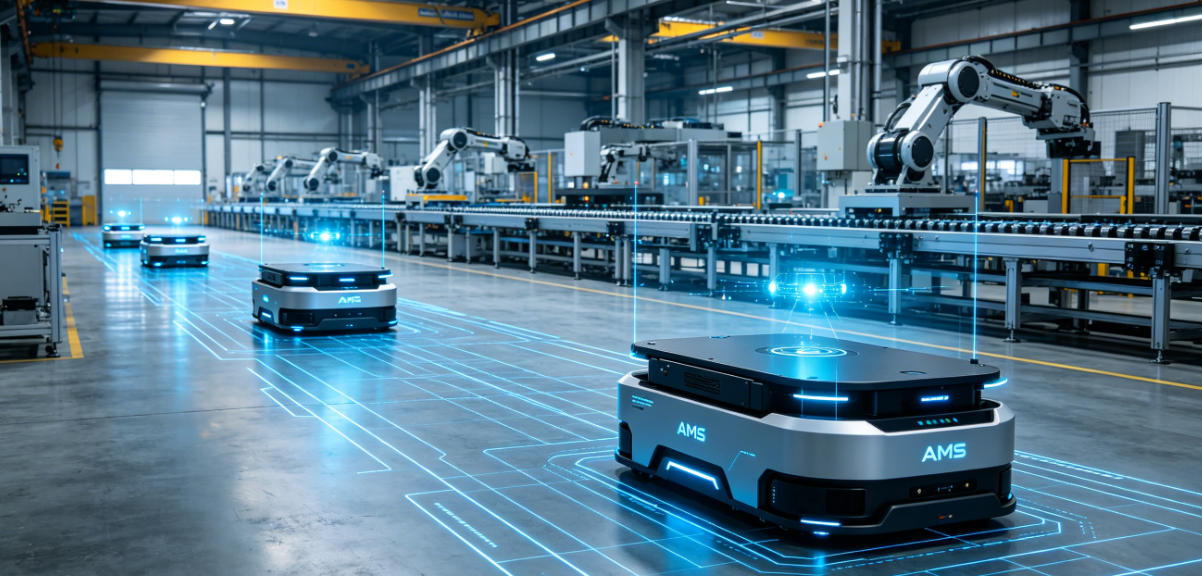
Why is mobile robot navigation so important in factories and how do AI best practices improve AMR performance?
In modern smart manufacturing and industrial automation systems, mobile robot navigation has become one of the core technologies for factory logistics and production coordination. With the widespread adoption of Autonomous Mobile Robots (AMRs), factories are shifting from traditional fixed conveyor systems toward more flexible, scalable, and intelligent logistics architectures.
The core capability of mobile robot navigation is enabling robots to perform autonomous localization, path planning, and obstacle avoidance in complex dynamic environments, allowing them to complete material transport, warehouse scheduling, and production coordination without human intervention. This capability directly determines the level of automation and overall operational efficiency of smart factories.
1 Why Mobile Robot Navigation Is So Important in Factories
In modern industrial environments, robot navigation is no longer just about mobility. It is a fundamental capability of the entire smart logistics system. A stable, high-precision, and real-time responsive navigation system directly defines the upper limit of a factory’s production efficiency, cost control, and flexible manufacturing capabilities. Especially under the continuous development of smart manufacturing and Industry 4.0, mobile robot navigation has become a key hub connecting production equipment, warehouse systems, and logistics scheduling.
In terms of production efficiency, AMRs can build a 24 7 automated material flow network, enabling continuous transportation of raw materials, semi-finished products, and finished goods between workstations. Compared with manual handling or fixed conveyor systems, AMRs provide higher scheduling flexibility and route adaptability. They can dynamically adjust transport frequency based on production rhythm, reducing waiting time and minimizing production interruptions. With SLAM-based navigation and real-time path planning algorithms, robots can also autonomously avoid obstacles and replan routes, significantly improving overall logistics throughput.
In terms of safety, modern mobile robots integrate multiple high-precision sensors including LiDAR, 3D cameras, and IMU units, enabling real-time environmental perception through multi-sensor fusion. This allows robots to detect workers, forklifts, equipment, and temporary obstacles, making collision avoidance decisions within milliseconds. In human robot collaborative environments, this safety mechanism is essential for building sustainable production systems.
In addition, mobile robot navigation greatly enhances flexible manufacturing capabilities. In traditional production systems, changes in layout or logistics routes often require extensive infrastructure modifications. However, AMRs with autonomous navigation can quickly adapt through software-based path reconfiguration without altering physical environments. This enables factories to respond more effectively to order fluctuations, multi-product production, and small batch customization, significantly improving scalability and responsiveness.
Furthermore, in large manufacturing systems, mobile robot navigation serves as a system level execution unit. Through integration with MES and WMS systems, AMRs enable a closed loop of task reception, execution, and status feedback, transforming factory logistics from a reactive system into an autonomous, real time optimized intelligent network.

2 Core Technology Architecture of Mobile Robot Navigation
Modern industrial grade mobile robot navigation systems consist of multiple tightly coordinated technical modules that enable AMRs to operate autonomously in complex and dynamic environments. A mature navigation system must address not only movement, but also environmental understanding, decision making, and stable execution, forming a closed loop intelligent system that integrates perception, computation, and control.
1 Environmental Perception
Environmental perception acts as the sensory system of mobile robot navigation, responsible for capturing real time environmental data. Modern AMRs rely on multi sensor fusion, including LiDAR, RGB D cameras, and IMU units, to collect spatial information from different dimensions.
LiDAR builds high precision point cloud maps for obstacle detection. Vision sensors provide semantic information such as identifying people, forklifts, or shelves. IMU data improves short term motion estimation stability. Through sensor fusion algorithms, the system constructs real time environmental models that handle both static and dynamic obstacles, including moving personnel or temporary equipment placement.
2 SLAM Localization and Mapping
SLAM is one of the most critical technologies in mobile robot navigation. It enables robots to simultaneously build maps and localize themselves in unknown environments.
In industrial applications, SLAM continuously updates environmental maps while computing precise robot positions. This is crucial because factory environments are highly dynamic, with frequent layout changes and temporary obstacles.
Industrial SLAM often combines LiDAR SLAM and visual SLAM, and may also incorporate deep learning methods to improve robustness under challenging lighting, repetitive structures, or occlusions. This capability forms the foundation of autonomous navigation and intelligent logistics scheduling.
3 Path Planning
The path planning module calculates optimal movement routes within a known map and serves as the decision making core between perception and execution.
Common algorithms include A star, Dijkstra, and RRT, which compute optimal or feasible paths under different constraints.
In industrial environments, path planning must consider not only distance but also real world factors such as dynamic obstacle avoidance, multi robot traffic congestion, task priority scheduling, energy optimization, and production cycle synchronization. Modern systems often combine AI based optimization algorithms with real time feedback mechanisms to continuously adjust routes during operation.
4 Motion Control
Motion control is the execution layer of mobile robot navigation, responsible for translating planned paths into real movement.
It includes speed control, direction control, and trajectory tracking algorithms to ensure smooth and accurate navigation. Industrial systems must balance stability, responsiveness, and safety.
Advanced motion control systems use closed loop control to continuously correct errors based on sensor feedback, adjusting speed and steering when floor conditions or payload changes occur. In human robot environments, motion control also integrates safety mechanisms such as automatic deceleration or stopping when people are detected nearby.
Overall, these four core modules form a complete navigation closed loop:
Environmental Perception → SLAM Mapping and Localization → Path Planning → Motion Control
This architecture enables AMRs to operate efficiently, safely, and flexibly in modern smart factories.
3 AI Driven Robot Navigation Best Practices
With the deep integration of artificial intelligence and industrial automation, traditional rule based navigation is being replaced by AI driven navigation. In complex industrial environments such as smart factories and warehousing systems, AI navigation demonstrates higher adaptability, better decision making efficiency, and improved scalability.
1 Multi Sensor Fusion
Multi sensor fusion enhances environmental perception by combining data from LiDAR, RGB D cameras, and IMU units. Compared with single sensor systems, it significantly improves robustness under lighting changes, occlusions, and reflections, enabling stable operation in complex environments.
2 AI Path Optimization
AI path optimization transforms robot navigation from rule based decision making to intelligent optimization. Using machine learning and reinforcement learning, robots can dynamically adjust routes based on real time traffic conditions rather than relying on fixed algorithms.
This enables consideration of congestion, multi robot coordination, task priority changes, energy efficiency, and production rhythm alignment, significantly improving logistics efficiency.
3 Semantic Environment Understanding
Semantic understanding enables robots not only to see the environment but also to interpret it. Through computer vision and deep learning, systems can recognize people, forklifts, shelves, and packages, assigning semantic labels to each object.
This allows robots to make intelligent avoidance decisions based on object type rather than simple geometric distance, improving both safety and efficiency.
4 Multi Robot Coordination
In large factories and warehouses, single robot systems are insufficient. Multi robot coordination allows multiple AMRs to share map data, task states, and path planning results through centralized or cloud based systems.
This enables dynamic task allocation, traffic optimization, and congestion avoidance, forming a swarm intelligence like system.
5 Digital Twin Simulation
Digital twin technology is becoming a key tool for AI navigation development. By building virtual factory environments, navigation strategies can be tested and optimized before deployment.
It reduces testing costs, identifies potential risks early, optimizes parameters, and accelerates deployment, making it a critical infrastructure for industrial scale systems.
Overall, these five best practices define modern AI robot navigation methodology:
Multi Sensor Fusion → AI Path Optimization → Semantic Understanding → Multi Robot Coordination → Digital Twin Simulation
This evolution is transforming mobile robot navigation from an automated execution system into an intelligent decision making system.

4 Real World Industrial Applications
Mobile robot navigation is widely used in smart warehouses, production line material supply, cross factory logistics, semiconductor manufacturing, and pharmaceutical clean room transport.
AMRs enable end to end logistics automation through intelligent navigation systems, significantly reducing labor costs while improving operational efficiency.
5 Future Trends From Rule Based Navigation to AI Autonomous Decision Making
Future mobile robot navigation will evolve toward fully autonomous AI decision making systems.
Reinforcement learning and deep learning based navigation methods allow robots to continuously optimize behavior strategies in dynamic environments and adapt to different factory layouts and task requirements.
Key future directions include stronger environmental understanding, higher precision localization, cloud based coordination, deep integration with MES and ERP systems, and fully autonomous factory logistics networks.
6 Conclusion
Mobile robot navigation has become a core capability of smart factories. From SLAM mapping and path planning to AI driven navigation optimization, this technology stack is continuously advancing industrial automation.
By applying best practices for robot navigation with AI, companies can significantly improve logistics efficiency, safety, and system flexibility, making AMRs a foundational infrastructure of smart manufacturing.
With continuous advancements in AI and robotics, future factories will increasingly move toward fully autonomous intelligent logistics systems.
3D Safe Guarding Privacy RGBD Camera Synexens CS30

After-sales Support:
Our professional technical team specializing in 3D camera ranging is ready to assist you at any time. Whether you encounter any issues with your TOF camera after purchase or need clarification on TOF technology, feel free to contact us anytime. We are committed to providing high-quality technical after-sales service and user experience, ensuring your peace of mind in both shopping and using our products.
