

Vision-Guided Robotics Explained: Systems, Robots & Applications
- par TofSensor
What is vision-guided robotics and how do vision guided robot systems work in industrial automation?
In modern smart manufacturing, warehouse automation, and industrial robotics, vision-guided robotics has become one of the core technologies for improving production efficiency and enabling flexible automation.
With the development of artificial intelligence, machine vision, and robotic control systems, traditional industrial robots that rely on fixed paths are gradually evolving into intelligent systems with visual perception capabilities.
Mainstream applications include:
- vision guided robot
- vision guided depalletizing
- robot guided system
- intelligent picking, handling, and sorting systems
These technologies together form the 'visual brain' of modern industrial automation.
1. What is Vision-Guided Robotics?
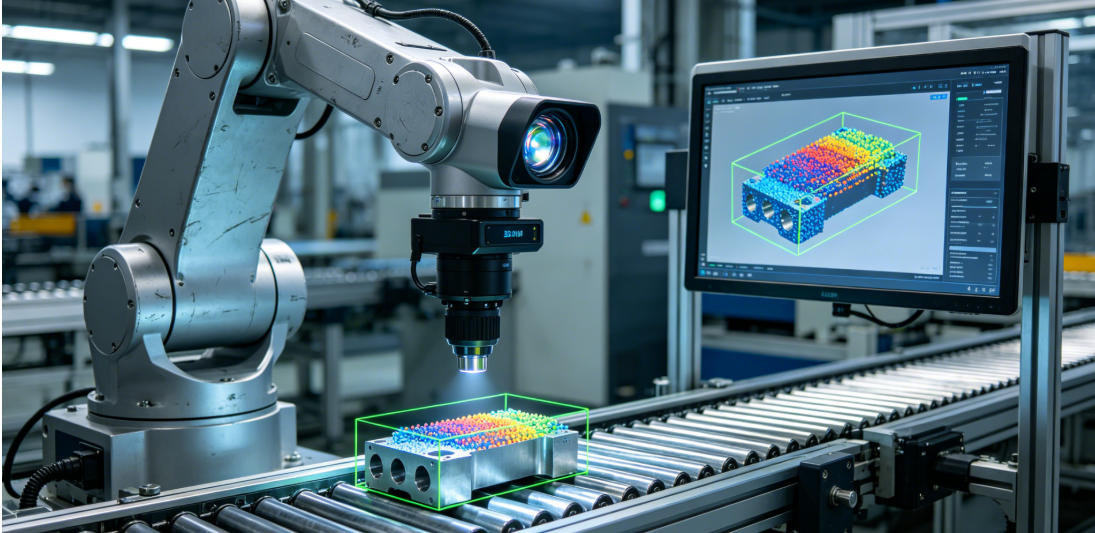
Vision-guided robotics (VGR) is an automation system that deeply integrates machine vision with industrial robots. It enables robots to “see and understand the environment” using industrial cameras, 3D vision sensors, or AI-based vision algorithms. As a result, robots are no longer limited to fixed coordinates or pre-programmed paths but can dynamically adjust their actions based on real-time visual input, enabling tasks such as positioning, picking, assembly, and material handling.
Unlike traditional industrial robots, which rely on teach programming or fixed trajectories, vision-guided systems are driven by perception. Instead of blindly executing commands, robots follow a real-time loop of “observe → compute → decide → act.”
In a typical workflow, vision guided robotics operates through several key steps: industrial cameras or 3D vision systems capture images of the workspace; AI vision algorithms detect and locate target objects, extracting position, orientation, size, and even pose information; this visual data is then converted into 3D coordinates or robot motion instructions; finally, the robotic controller executes precise movements based on this real-time feedback.
This approach significantly improves environmental adaptability. In complex production environments where objects may be randomly placed, stacked at different angles, or slightly misaligned, traditional robots often fail, whereas vision guided robotics can automatically detect changes and correct the picking path in real time, ensuring stable operation.
From a system perspective, vision-guided robotics consists of three core modules:
- Vision Perception: capturing environmental data via 2D/3D cameras
- AI Interpretation: recognizing objects and understanding spatial structure
- Robot Motion Control: converting vision results into mechanical actions
👉 In essence:
vision-guided robotics = machine vision + artificial intelligence + robotic control system

In industrial applications, vision-guided robotics has become a foundational technology for smart manufacturing. It is widely used in automated loading/unloading, component assembly, quality inspection, material handling, and intelligent sorting. In logistics and warehousing, it integrates with conveyor systems to identify and handle objects of different sizes and positions. In precision manufacturing, it enables high-accuracy assembly and visual alignment, improving consistency and yield.
The core value of vision-guided robotics is transforming robots from 'fixed-function machines' into adaptive intelligent systems capable of environmental perception and autonomous adjustment, laying the foundation for fully automated smart factories.
2. How Does a Vision Guided Robot Work?
A typical vision guided robot system consists of three main components:
- Industrial vision system (2D / 3D / RGB-D camera)
- Vision processing algorithms (AI + image recognition)
- Robot control system (robot controller)
Workflow:
- Cameras capture images of the workspace
- AI vision system detects target objects
- Position, orientation, and spatial coordinates are calculated
- Data is sent to the robot controller
- Robot adjusts motion path based on feedback
- Task such as picking, handling, or placement is completed
This allows robots to operate dynamically instead of following fixed paths.
👉 This is the core capability of a vision guided robot.
3. Vision Guided Depalletizing
In logistics and warehouse automation, vision guided depalletizing is one of the most widely used applications.
Traditional depalletizing relies on manual labor or fixed mechanical structures, while vision-guided systems automatically detect stacked boxes on pallets and remove them layer by layer.
Key advantages include:
- Automatic box position and orientation detection
- Support for randomly stacked cargo
- Dynamic path planning for picking
- Adaptation to different package sizes and shapes
In real-world applications such as e-commerce warehouses, vision guided depalletizing systems significantly reduce labor costs, improve sorting efficiency, and enable 24/7 continuous operation.
4. What is a Robot Guided System?
A robot guided system is a broader concept referring to a complete solution that uses vision, sensors, or AI systems to guide robotic operations in real time.
It includes not only vision recognition but also:
- Path planning systems
- Motion control systems
- Object detection modules
- Real-time feedback loops
In the context of Industry 4.0, robot guided systems have become a core infrastructure of smart factories.
5. Core Advantages of Vision-Guided Robotics
Compared with traditional fixed-path industrial robots, vision-guided robotics introduces real-time perception, upgrading robots into intelligent systems capable of environmental understanding.
Key advantages include:
High flexibility in production
No need for fixed fixtures or precise positioning; supports multi-product manufacturing.
Automatic recognition and positioning
Detects object position, orientation, and geometry in real time.
Reduced labor dependency
Minimizes manual handling and intervention.
Improved production efficiency
Optimizes motion paths and supports continuous high-speed operation.
Adaptability to complex environments
Handles randomly stacked, mixed, and irregular objects.

6. Typical Application Scenarios
Vision-guided robotics is now widely deployed across multiple industries.
Warehousing and logistics automation
- vision guided depalletizing
- automated sorting systems
- intelligent mobile robots
Smart manufacturing
- component assembly
- welding guidance
- machine tending
Industrial robot vision applications
- vision guided robot picking on production lines
- automatic inspection and quality control
E-commerce and logistics
- automatic depalletizing
- parcel recognition and sorting
7. Future Trends
With advances in AI and 3D vision, vision-guided robotics is evolving toward:
- 3D point cloud recognition
- deep learning-based vision guidance
- multi-robot collaboration systems
- fully autonomous smart warehouses
Future robot guided systems will not only 'see,' but also understand, decide, and execute autonomously.
8. Conclusion
Vision-guided robotics is driving industrial automation from fixed programming to intelligent perception-based execution.
Core technologies include:
- vision guided robot
- vision guided depalletizing
- robot guided system
Together, they form the foundation of next-generation smart factories.
👉 In simple terms:
Vision-guided robotics = giving robots 'eyes + brain + action capability' in one integrated intelligent system
Synexens Industrial Outdoor 4m TOF Sensor Depth 3D Camera Rangefinder_CS40p

After-sales Support:
Our professional technical team specializing in 3D camera ranging is ready to assist you at any time. Whether you encounter any issues with your TOF camera after purchase or need clarification on TOF technology, feel free to contact us anytime. We are committed to providing high-quality technical after-sales service and user experience, ensuring your peace of mind in both shopping and using our products.
