

Overhead Camera AMR Navigation for Autonomous Robot Systems
How Does an Overhead Camera System Enable Autonomous Robot Navigation in Smart Factories?
In the era of Industry 4.0, smart manufacturing, and intelligent warehousing, AMR (Autonomous Mobile Robot) has become a core execution unit in modern logistics and factory automation. One of the most critical challenges in deploying AMR systems is achieving high-precision, low-cost, and scalable navigation.
Overhead camera-based navigation is emerging as a powerful approach for robot autonomous navigation, forming advanced autonomous robot navigation solutions widely used in smart factories, warehouses, and flexible production environments.
What Is an Overhead Camera-Based Robot Navigation System?
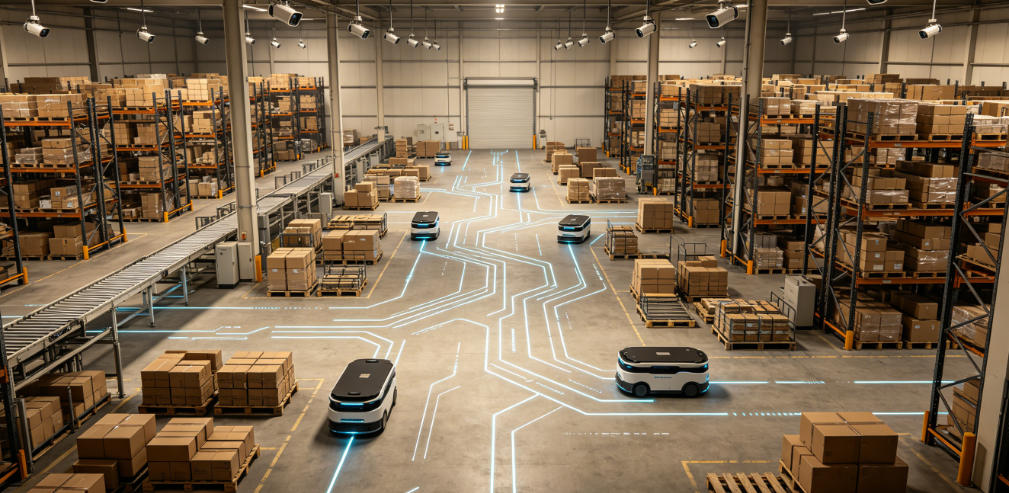
An overhead camera-based navigation system is an innovative autonomous robot navigation solution that installs industrial cameras on ceilings or elevated structures to provide full-area visual coverage of the workspace.
By combining computer vision, AI-based detection, and path planning algorithms, the system tracks AMRs and AGVs in real time, enabling centralized monitoring, positioning, and coordination.
Core capabilities include:
- Multi-robot localization and tracking
- Global path planning and task scheduling
- Dynamic obstacle detection
- Real-time traffic management
- Reduced reliance on onboard sensors
This architecture is typically known as a Centralized Vision-Based Navigation System, where all robots operate under a unified global coordinate system instead of independent onboard navigation.

Why Choose Overhead Camera Navigation?
1. Global View for Higher Positioning Accuracy
Unlike LiDAR-based or onboard SLAM systems, overhead cameras provide a true “bird’s-eye view” of the entire workspace.
Key advantages:
- No visual occlusion from obstacles
- Unified global coordinate system
- Simultaneous multi-robot tracking
- Reduced cumulative drift errors
This makes it especially valuable in large warehouses and dense production environments where multiple robots operate simultaneously.
2. Lower Hardware Cost per Robot
Traditional AMR systems rely heavily on onboard hardware such as:
- LiDAR sensors
- Depth cameras
- IMU modules
- Multi-sensor fusion systems
With overhead camera-based systems, most intelligence is shifted to the infrastructure layer:
- Fewer onboard sensors required
- Lower per-robot BOM cost
- Simplified robot design
- Easier maintenance and deployment
This is particularly beneficial for large-scale AMR deployments in logistics centers and smart factories.
3. Strong Multi-Robot Coordination Capability
In high-density logistics environments, AMRs often face:
- Route conflicts
- Traffic congestion
- Complex scheduling constraints
Overhead vision systems solve these issues through centralized intelligence:
- Real-time traffic flow management
- Dynamic path optimization
- Collision avoidance control
- Coordinated fleet scheduling
This enables efficient operation of tens or even hundreds of robots simultaneously.
4. Scalable autonomous robot navigation solutions
As factories expand, scalability becomes essential. Vision-based autonomous robot navigation solutions offer strong expansion advantages:
- Easy camera network expansion for larger coverage
- Software upgrades improve system intelligence
- Multi-floor and multi-zone deployment support
- Seamless MES/WMS integration
- Compatibility with digital twin and industrial IoT systems
This makes overhead vision a foundational technology for future flexible manufacturing systems.
How Robot Autonomous Navigation Works
Modern robot autonomous navigation systems using overhead cameras typically follow this workflow:
- Overhead cameras capture global workspace images
- AI detects and identifies AMR/AGV positions
- A real-time map of the environment is constructed
- Path planning algorithms compute optimal routes
- Movement commands are sent to robots
- Continuous feedback adjusts navigation dynamically
This closed-loop system enables safe, efficient, and fully autonomous robot operations.
Core System Components
1. Overhead Industrial Camera Network
- High-resolution industrial cameras
- Wide-angle or fisheye lenses
- High-frame-rate real-time capture
- Factory-grade stable deployment
2. AI Vision Recognition System
- AMR/AGV detection
- Human presence recognition
- Dynamic obstacle tracking
- Trajectory prediction models
3. Real-Time Path Planning Engine
- A* / Dijkstra algorithms
- Dynamic rerouting
- Multi-robot scheduling optimization
- Collision avoidance logic
4. Communication & Control System
- Low-latency industrial Ethernet / 5G
- ROS or middleware integration
- Real-time command execution
- Edge + cloud hybrid computing

Application Scenarios
Smart Warehousing & Logistics
- Automated material handling
- Inventory management
- Order fulfillment
- Multi-robot transport systems
Smart Factory Production Lines
- Inter-station material delivery
- Flexible manufacturing support
- Dynamic task allocation
Electronics Manufacturing
- PCB transport
- Precision component handling
- High-accuracy logistics coordination
Healthcare & Special Environments
- Autonomous delivery systems
- Sterile environment transport
- Safe routing in sensitive areas
Comparison: Overhead Vision vs Traditional AMR Navigation
| Dimension | Overhead Camera Navigation | Onboard SLAM Navigation |
|---|---|---|
| Positioning method | Global vision-based | Local sensor-based |
| Cost | Lower system-level cost | Higher per-robot cost |
| Accuracy | High (unified coordinate system) | Medium (drift possible) |
| Scalability | Strong | Limited |
| Multi-robot coordination | Excellent | Complex |
Future Trends
The evolution of robot autonomous navigation is moving toward:
- AI-driven centralized fleet orchestration
- Real-time digital twin synchronization
- 5G ultra-low-latency control
- Cross-factory unified logistics platforms
- Deep integration with AMR/AGV ecosystems
These systems will become the 'central nervous system' of future smart factories.
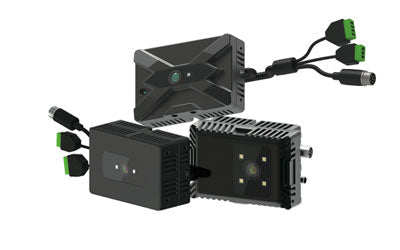
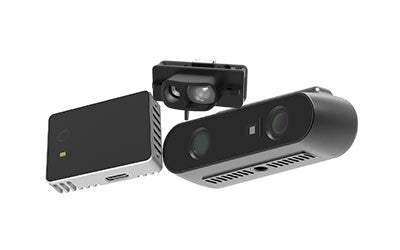
Synexens Industrial Outdoor 4m TOF Sensor Depth 3D Camera Rangefinder_CS40p

Conclusion
Overhead camera-based AMR navigation is accelerating the evolution of autonomous robot navigation solutions, enabling higher efficiency, lower costs, and stronger coordination capabilities.
By combining global visual perception with AI-driven path planning, it significantly enhances robot autonomous navigation performance, allowing AMRs to operate truly autonomously in complex industrial environments.
As smart manufacturing continues to advance, this vision-based navigation approach is becoming a foundational technology for next-generation intelligent logistics systems.
