

TOF Sensor Technology Explained: dTOF, Robotics, and 3D Sensing
What Is a TOF Sensor and Why Do Robots Use It for 3D Vision?
With the rapid development of artificial intelligence (AI), robotics, automation, and smart manufacturing, robots are becoming increasingly capable of understanding and interacting with their surrounding environments. However, for robots to perform complex tasks autonomously, they need more than mechanical movement—they need advanced perception technologies that allow them to accurately detect objects, measure distances, and understand 3D space.
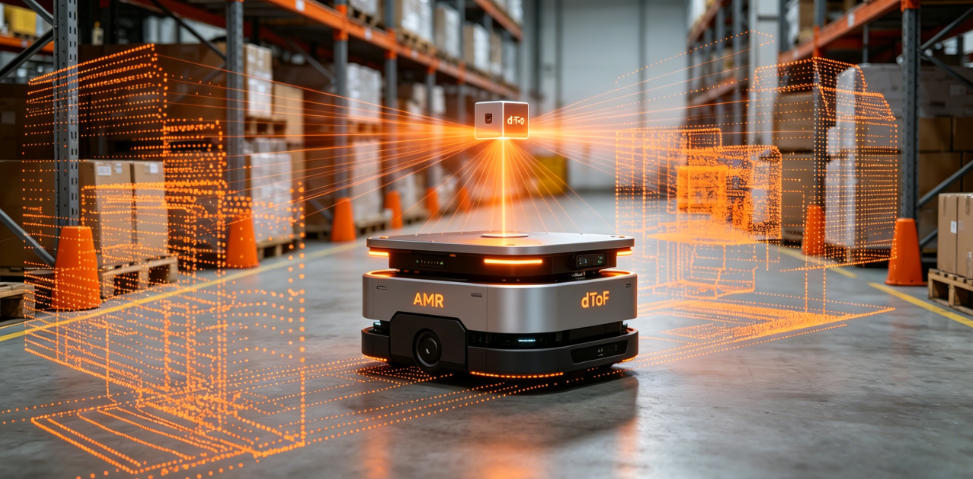
Among various sensing technologies, the TOF sensor (Time-of-Flight sensor) has become one of the most important solutions for modern robotic vision systems. By measuring the time required for light signals to travel from the sensor to an object and return, a time of flight sensor can generate accurate depth information and create a detailed 3D view of the environment.
Today, TOF sensors are widely used in:
- Autonomous mobile robots (AMR)
- Industrial robots
- Autonomous navigation systems
- Smart warehouses
- Robot vacuum cleaners
- Service robots
- Humanoid robots
- AI vision systems
As the demand for intelligent automation continues to grow, TOF sensor technology for robots is becoming a key component in enabling machines to achieve human-like perception capabilities.
What Is a TOF Sensor?
A TOF sensor (Time-of-Flight sensor) is a distance measurement device that calculates the distance between the sensor and an object by measuring the travel time of emitted light.
Unlike traditional cameras that only capture 2D images, a TOF depth sensor provides additional depth information, allowing machines to understand:
- How far an object is located
- The shape and size of objects
- The spatial relationship between different objects
- The structure of the surrounding environment
The basic working principle of a TOF sensor is simple:
- The sensor emits infrared light toward the target area.
- The light reflects from surrounding objects.
- The sensor detects the returned light signal.
- The system calculates the flight time.
- A depth map is generated based on distance information.
Because light travels at a constant speed, TOF sensors can achieve fast and accurate distance measurement, making them ideal for real-time robotic perception.

How Does a dTOF Sensor Work?
dTOF (Direct Time-of-Flight) is an advanced TOF measurement technology that directly measures the arrival time of individual photons reflected from objects.
Compared with traditional indirect TOF methods, dTOF technology provides several advantages:
- Higher measurement accuracy
- Longer detection range
- Better performance in complex environments
- Strong resistance to ambient light interference
A dTOF sensor typically includes:
- Infrared laser emitter
- Single Photon Avalanche Diode (SPAD) or advanced photon detection unit
- Time measurement circuit
- Signal processing system
The sensor calculates the exact distance by measuring the difference between the emitted and received light pulses.
This makes Direct TOF sensors especially suitable for applications requiring precise 3D perception, such as:
- Autonomous robots
- Industrial inspection robots
- Warehouse automation systems
- Robot navigation
- Obstacle detection
TOF Sensor vs Traditional Camera: Why Do Robots Need Depth Sensors?
Traditional RGB cameras provide valuable visual information, but they have limitations.
A normal camera can recognize:
- Color
- Texture
- Shape
However, it cannot directly measure real-world distance.
For robots operating in dynamic environments, knowing distance is critical.
For example, an autonomous robot in a warehouse needs to determine:
- How far obstacles are located
- Whether objects are moving
- Where paths are available
- How to avoid collisions
A 3D depth sensor for robotics solves these challenges by providing accurate spatial information.
Compared with conventional cameras, TOF sensors offer:
| Technology | Information Provided |
|---|---|
| RGB Camera | 2D color images |
| Ultrasonic Sensor | Basic distance measurement |
| LiDAR Sensor | Long-range 3D scanning |
| TOF Sensor | Real-time 3D depth information |
Because TOF sensors combine compact size, high speed, and accurate depth measurement, they have become an important choice for modern robot vision systems.
Why Do Robots Use TOF Sensors?
1. Accurate Obstacle Detection and Collision Avoidance
One of the most important applications of TOF sensors in robots is obstacle detection.
Autonomous robots must continuously analyze their environment to avoid collisions.
TOF sensors provide real-time depth maps that allow robots to detect:
- Walls
- Furniture
- Humans
- Equipment
- Moving objects
This capability improves safety and navigation reliability.
For example, autonomous mobile robots (AMRs) in smart factories use TOF cameras to identify obstacles and dynamically adjust their movement paths.
2. Robot Navigation and SLAM Applications
Modern autonomous robots rely on technologies such as:
- SLAM (Simultaneous Localization and Mapping)
- AI vision
- Sensor fusion
- Autonomous navigation algorithms
A TOF camera for SLAM navigation provides accurate depth information that helps robots understand their surroundings and build environmental maps.
By combining TOF sensors with:
- LiDAR
- IMU sensors
- RGB cameras
- AI processors
robots can achieve more accurate positioning and navigation.
Applications include:
- Warehouse robots
- Delivery robots
- Inspection robots
- Agricultural robots
- Service robots
3. Smart Manufacturing and Industrial Automation
In smart factories, robots need reliable perception systems to perform complex operations.
TOF sensors are used in industrial automation for:
- Object detection
- Robot picking
- Product measurement
- Machine vision inspection
- Automated assembly
A TOF sensor for industrial robots allows robotic arms and automation systems to accurately identify objects and adjust their movements.
This improves:
- Production efficiency
- Manufacturing accuracy
- Workplace safety
4. Human-Robot Interaction
As robots become more common in homes, offices, and public environments, they need to understand human behavior.
TOF sensors enable robots to detect:
- Human position
- Body movement
- Hand gestures
- Distance from users
This supports applications such as:
- Service robots
- Humanoid robots
- Healthcare robots
- Interactive AI robots
With the combination of TOF technology and artificial intelligence, robots can interact with people in a more natural way.

5. Better Performance in Low-Light Environments
Many traditional vision systems depend heavily on lighting conditions.
However, robots often operate in environments where lighting changes frequently.
TOF sensors use infrared light, allowing them to work effectively in:
- Dark warehouses
- Night environments
- Indoor spaces
- Complex lighting conditions
This makes TOF depth sensors highly reliable for autonomous systems that require 24/7 operation.
dTOF vs iTOF: What Is the Difference?
There are two major types of TOF technologies:
Direct TOF (dTOF)
dTOF directly measures photon arrival time.
Advantages:
- Higher accuracy
- Longer measurement range
- Better for outdoor applications
- Excellent distance resolution
Common applications:
- LiDAR systems
- Autonomous vehicles
- Industrial robots
Indirect TOF (iTOF)
iTOF measures phase differences between emitted and received light signals.
Advantages:
- Compact design
- Lower cost
- Suitable for consumer electronics
Common applications:
- Smartphones
- AR devices
- Indoor depth cameras
Both technologies play important roles depending on application requirements.
Future Trends of TOF Sensors in Robotics
With the growth of AI robotics and embodied intelligence, TOF sensors will continue evolving.
Future TOF sensor development will focus on:
Higher Resolution 3D Vision
Future robots require more detailed environmental understanding.
Advanced TOF cameras will provide:
- Higher depth resolution
- Faster frame rates
- More accurate measurements
AI-Based Sensor Fusion
TOF sensors will increasingly work together with:
- AI algorithms
- LiDAR
- RGB cameras
- Edge computing processors
This combination will create smarter robot perception systems.
Smaller and More Efficient Sensors
As technology improves, TOF sensors will become:
- Smaller
- Lower power consumption
- More affordable
This will accelerate adoption in:
- Consumer robots
- Smart devices
- Industrial automation equipment
Synexens 3D Camera Of ToF Sensor Soild-State Lidar_CS20

Conclusion: TOF Sensors Are Enabling the Future of Intelligent Robots
A TOF sensor is one of the most important technologies helping robots understand the physical world.
By providing accurate 3D depth sensing, TOF technology enables robots to detect obstacles, navigate environments, interact with humans, and perform complex automated tasks.
From autonomous mobile robots (AMRs) and industrial automation to AI-powered humanoid robots, time of flight sensors are becoming a fundamental component of modern robotic vision systems.
As robotics continues moving toward greater intelligence and autonomy, TOF sensors, dTOF technology, and 3D vision solutions will play an increasingly important role in building the future of intelligent machines.
