

AMRs in Manufacturing:Applications, Integration & Key Trends Explained
- par TofSensor
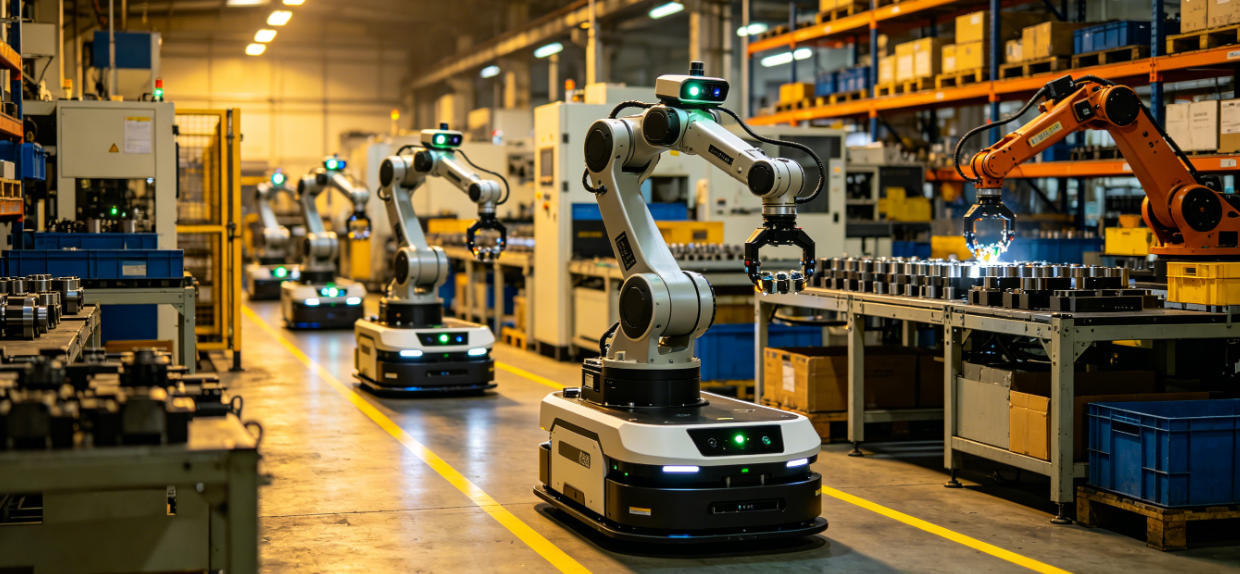
What are AMRs in Manufacturing, and how are they transforming smart factories and industrial logistics?
With the rapid development of industrial automation and smart factories, AMRs in manufacturing (autonomous mobile robots in manufacturing) have become one of the core technologies in modern production systems. By combining AI-based navigation, real-time data processing, and flexible scheduling systems, industrial mobile robots are fundamentally transforming traditional production and logistics models.
Globally, leading AMR companies are accelerating large-scale deployments across industries such as warehousing, manufacturing, pharmaceuticals, and biotechnology (biotech).
1. What Are Industrial Mobile Robots?
Industrial Mobile Robots (IMRs), which often include Autonomous Mobile Robots (AMRs), refer to intelligent robotic systems designed to handle autonomous transportation and decision-making tasks in industrial environments. Unlike traditional systems, they do not rely on fixed tracks or predefined routes. Instead, they function like intelligent “mobile workers” capable of independently navigating factories, warehouses, and logistics centers to execute tasks.
Compared with AGVs (Automated Guided Vehicles), the key difference lies in autonomy and environmental understanding. AGVs rely on physical infrastructure such as magnetic strips, QR codes, or reflective markers for navigation, which limits flexibility when the environment changes (e.g., blocked pathways). In contrast, AMRs rely on SLAM (Simultaneous Localization and Mapping) technology to build real-time maps of their environment. Combined with sensors such as LiDAR, depth cameras, and IMUs, they achieve high-precision real-time mapping and localization, enabling dynamic path planning and obstacle avoidance in complex environments shared with humans, forklifts, and other equipment.
In real-world applications, AMRs have evolved from simple transport tools into key nodes of intelligent logistics systems. They can automatically perform material delivery between production lines, handle warehouse picking and sorting, and dynamically adjust task priorities based on production demand. Integration with MES (Manufacturing Execution Systems) or WMS (Warehouse Management Systems) enables automated task allocation. For example, when a production line runs low on materials, the system can automatically dispatch an AMR to retrieve and deliver them, reducing human intervention and downtime.
From a technical architecture perspective, industrial mobile robots rely on three core capabilities: perception, which fuses multi-sensor data to understand the environment; decision-making, which uses path planning algorithms (such as A, Dijkstra, or RRT) for real-time optimization and obstacle avoidance; and execution, which ensures precise and stable movement through advanced motion control systems. Together, these capabilities enable reliable performance in dynamic industrial environments.
Overall, industrial AMRs are driving manufacturing and logistics from traditional 'fixed-path, human-dispatch' models toward more flexible 'on-demand, autonomous decision-making' systems, becoming a foundational element of Industry 4.0 and smart factories.

2. Key Application Scenarios of AMRs in Manufacturing
In manufacturing, AMRs in manufacturing are rapidly evolving from single-task automation tools into system-wide logistics orchestration nodes. Their applications now span warehousing, production lines, and cross-facility coordination, reshaping internal factory logistics.
In material handling and production line replenishment, AMRs act as mobile supply chain units. They autonomously transport raw materials, components, and semi-finished goods between workstations based on production demand. When inventory levels drop below a threshold, the system automatically triggers an AMR to retrieve materials from warehouses or supermarket zones and deliver them directly to production lines. This reduces manual handling and minimizes production stoppages.
In automated inventory management, AMRs integrate tightly with WMS (Warehouse Management Systems) and serve as mobile execution nodes for inventory data. Equipped with barcode scanners, vision systems, or RFID modules, they can identify goods and update inventory in real time while moving. Compared to traditional manual inventory checks, this approach significantly improves accuracy and transforms inventory management from periodic updates into continuous real-time tracking.
In flexible production line collaboration, AMRs are particularly valuable. Modern manufacturing increasingly relies on multi-product, small-batch, and customized production models, requiring high logistics flexibility. AMRs can dynamically adjust transport tasks based on schedules issued by MES systems, switching between production lines as needed. For example, the same AMR can supply an electronics assembly line in the morning and transport tools or semi-finished parts in a machining area in the afternoon, enabling truly on-demand logistics.
In factory-wide internal logistics automation, AMRs connect previously isolated workshop areas. In large factories, different production zones are often physically separated, making traditional forklift or conveyor-based systems inefficient. AMRs can autonomously navigate between zones, enabling end-to-end logistics from warehouses to production, assembly, and packaging areas. With centralized fleet management, multiple AMRs can also coordinate dynamically, optimizing routes and task allocation in real time to improve overall efficiency.
Overall, AMRs are no longer just transportation tools; they have become dynamic logistics infrastructure supporting intelligent manufacturing systems.
3. Integration of AMRs in Factory Floors
With the advancement of Industry 4.0, the integration of AMRs in factory floors has become a critical trend in smart manufacturing transformation.
Modern AMR systems are typically integrated with:
- MES (Manufacturing Execution Systems)
- ERP (Enterprise Resource Planning)
- WMS (Warehouse Management Systems)
Through this integration, factories can achieve:
- Automated task scheduling
- Real-time production data synchronization
- Dynamic path optimization
- Coordinated multi-system production
This highly integrated ecosystem enables factories to move toward unmanned logistics and intelligent manufacturing.
4. AMR Applications in Warehousing and Biotech
AMRs demonstrate strong adaptability across industries, especially in:
1. Warehousing
In large-scale warehouses, AMRs are used for:
- Automated picking and transportation
- Shelf replenishment
- Sorting system collaboration
- High-density storage optimization
2. Biotech and Pharmaceutical Industry
In biotech and pharmaceutical environments, AMRs are used for:
- Laboratory sample transport
- Sterile environment material handling
- Cold chain logistics management
- Precision production support
These scenarios require high navigation accuracy and strict environmental compliance.
5. Real-Time Mapping and Localization
Core AMR technologies include:
✔ Real-time Mapping
AMRs build dynamic environmental maps using LiDAR, 3D vision, and AI algorithms.
✔ High-Precision Localization
They achieve centimeter-level positioning accuracy in complex factory environments.
✔ AI Path Planning
Real-time data is used to optimize routes, avoid congestion, and prevent collisions.
Together, these technologies form the “brain” of modern AMR systems.

6. Key Features to Compare in Autonomous Inventory Robots
When selecting autonomous inventory robots, the key is not simply mobility, but whether the system can operate reliably, intelligently, and at scale in complex industrial environments.
The first critical factor is navigation and localization capability, which represents the robot’s spatial intelligence. Advanced systems combine SLAM, 3D vision, and multi-sensor fusion (LiDAR + IMU + vision). High-performance AMRs must not only navigate static environments but also dynamically avoid obstacles such as workers, forklifts, or temporary storage changes. They should also support dynamic re-routing when paths are blocked.
The second factor is system integration capability, which determines whether the robot can connect to enterprise digital systems. Industrial AMRs must integrate with ERP, WMS, and MES systems to enable seamless task execution from digital instructions to physical actions. Without strong integration, AMRs remain isolated devices rather than system-level assets.
The third factor is payload capacity and battery endurance, which defines application scope. Different factories require different load capacities, so both payload rating and runtime performance must match production demand. Charging strategies such as automatic docking or opportunity charging are also critical for continuous operation.
The fourth factor is AI scheduling and fleet coordination capability, which transforms AMRs from single machines into coordinated systems. Advanced platforms use centralized fleet management to dynamically assign tasks based on workload, congestion, and priority. Some systems also use machine learning or reinforcement learning to optimize long-term efficiency.
The final factor is safety systems, which are essential in human-robot shared environments. AMRs must include multi-layer safety mechanisms such as LiDAR safety zones, vision-based obstacle detection, and emergency stop systems. Advanced systems also support adaptive speed control based on environmental density.
Together, these factors determine operational stability, scalability, and ROI in real factory deployments.
7. Leading AMR Companies and Industry Trends
Leading AMR companies are focusing on:
- AI-driven autonomous navigation
- Multi-robot fleet management systems
- Digital twin factory integration
- Cloud-based real-time monitoring
- Edge computing for low-latency control
AMRs are also expanding beyond manufacturing into:
- Automotive production
- Electronics manufacturing
- Healthcare and biotech
- E-commerce warehousing
8. Future Trends: AMR-Driven Smart Factories
Future smart factories will be centered around AMRs as core infrastructure nodes:
- Fully automated logistics systems
- Real-time data-driven decision-making
- AI-optimized production workflows
- Multi-robot collaborative factory networks
As technology matures, AMRs will become foundational infrastructure for smart manufacturing ecosystems.
Conclusion
Overall, AMRs in manufacturing are driving the next wave of industrial automation. From industrial mobile robots to real-time mapping and localization, and from factory integration systems to full-scale smart manufacturing networks, AMRs are reshaping modern production.
With continued innovation from leading AMR companies, these systems will play an increasingly critical role across warehousing, manufacturing, and biotech industries, becoming a core driver of future smart factories.
Synexens 3D Camera Of ToF Sensor Soild-State Lidar_CS20

After-sales Support:
Our professional technical team specializing in 3D camera ranging is ready to assist you at any time. Whether you encounter any issues with your TOF camera after purchase or need clarification on TOF technology, feel free to contact us anytime. We are committed to providing high-quality technical after-sales service and user experience, ensuring your peace of mind in both shopping and using our products
