

How Are Autonomous Mobile Robots Transforming Smart Manufacturing?
- por LidarSensor

How Are AMR Robots Changing the Future of Smart Manufacturing?
With the rapid development of artificial intelligence (AI), robotics, Industrial Internet of Things (IIoT), and smart manufacturing technologies, the global manufacturing industry is undergoing a major transformation from traditional automation toward intelligent and flexible production models. In the past, industrial robots were mainly responsible for repetitive tasks in fixed locations, such as welding, assembly, and material handling. Today, a new generation of robots is breaking beyond fixed work areas, enabling autonomous movement, environmental perception, and dynamic task execution in complex industrial environments.
Among these emerging technologies, Autonomous Mobile Robots (AMR) are becoming one of the most important trends in smart manufacturing and industrial automation. From internal factory logistics and warehouse management to production line delivery and human-robot collaboration, AMR robots are helping enterprises improve production efficiency, reduce operational costs, and accelerate the development of Industry 4.0.
In European and global manufacturing markets, the keyword robots mobiles autonomes (autonomous mobile robots) is also gaining increasing attention. Compared with traditional automated transportation systems, autonomous mobile robots offer stronger environmental adaptability and higher levels of intelligence. By combining artificial intelligence, SLAM navigation, 3D vision, and multi-sensor fusion technologies, AMR robots can achieve truly autonomous operation.
What Is an Autonomous Mobile Robot (AMR)?
An Autonomous Mobile Robot (AMR) is a new generation of intelligent robotic systems that combines robotics, artificial intelligence (AI), sensor fusion, and autonomous navigation algorithms. It is designed to operate in complex and dynamic environments, allowing robots to independently perceive surrounding spaces, determine their own position, plan movement paths according to tasks, and complete operations such as material transportation, warehouse handling, equipment inspection, and production assistance.
Unlike traditional fixed industrial robots, AMR robots are not restricted to a specific working area. They can freely move throughout factories, warehouses, logistics centers, and smart manufacturing environments. Traditional industrial robots are usually installed in fixed positions and execute repetitive operations based on predefined programs. In contrast, AMR robots have stronger environmental adaptability and can automatically adjust movement strategies according to real-time changes.
For example, when an AMR robot encounters workers, equipment, or temporary obstacles along its route, it can quickly recognize environmental changes and recalculate a safer and more efficient path without requiring human intervention.
A complete Autonomous Mobile Robot system usually consists of multiple core technology modules, including:
- High-precision mobile platform: Responsible for robot movement control, stable operation, and accurate positioning;
- LiDAR sensor: Uses laser scanning technology to collect high-precision distance information for mapping and obstacle detection;
- RGB camera: Provides visual information to help robots recognize environmental features and target objects;
- ToF depth camera (Time of Flight Camera): Obtains 3D depth data by measuring the flight time of light signals, improving spatial perception capabilities;
- IMU inertial sensor (Inertial Measurement Unit): Detects robot motion status and improves positioning stability;
- AI computing module: Processes sensor data to achieve environmental understanding and intelligent decision-making;
- SLAM localization algorithm (Simultaneous Localization and Mapping): Enables autonomous mapping, real-time positioning, and navigation planning;
- Robot fleet management system: Controls multiple robots working together and improves overall production efficiency.
Through the integration of these technologies, AMR robots can perform advanced functions including autonomous map creation, centimeter-level positioning, dynamic obstacle avoidance, automatic task allocation, multi-robot collaboration, and real-time route optimization. This makes AMR more than just a mobile device—it has become a critical component of smart factories and industrial automation systems.
Simply put, traditional automation equipment requires engineers to define routes and operating logic in advance, telling the machine 'where to work' and 'how to move.' However, AMR robots can understand their surroundings through sensors and AI algorithms, determine their own location, select the optimal path, and decide what action to take next. This autonomous capability makes AMR one of the key technologies driving smart manufacturing, Industry 4.0, and future flexible production systems.

Why Is Manufacturing Rapidly Adopting AMR Robots?
Modern manufacturing is facing increasingly complex production requirements. As consumer demand for customized products continues to grow, companies need to adjust production processes faster while improving efficiency and reducing costs.
Traditional manual handling and fixed-route transportation systems are gradually showing limitations.
First, manual material handling has limited efficiency and is affected by workforce availability, physical workload, and safety risks.
Second, traditional AGV systems usually depend on magnetic strips, QR codes, or fixed tracks. When production environments change, companies often need to redesign routes and modify infrastructure.
AMR robots use a more flexible autonomous navigation approach. They can be deployed quickly and automatically adjust routes according to real-world conditions. As a result, they have become an important technology for upgrading smart manufacturing systems.
For example, in an automotive manufacturing plant, thousands of components may need to be transported every day. Manual transportation is not only inefficient but can also result in delivery errors. AMR robots can automatically transport components to designated workstations according to production system instructions while selecting optimal routes based on real-time traffic conditions.
What Is the Difference Between AMR Robots and Traditional AGVs?
Many companies compare AGV and AMR technologies when selecting industrial mobile robots.
Traditional AGVs (Automated Guided Vehicles) mainly operate through predefined routes, such as:
- Magnetic navigation;
- Floor QR codes;
- Rail systems;
- Fixed path planning.
This approach offers reliability and maturity, making it suitable for environments with limited changes.
However, modern smart factories require greater flexibility. For example:
- Production equipment may be relocated;
- Product models may frequently change;
- Logistics routes may need dynamic optimization.
In these situations, traditional AGVs have limited adaptability.
AMR robots use SLAM (Simultaneous Localization and Mapping) technology to understand surrounding environments. They can autonomously create maps, determine their position in real time, and recalculate routes when obstacles appear.
For example, when an AMR robot is transporting materials and encounters workers or temporarily placed equipment, it does not simply stop and wait. Instead, it can automatically avoid the obstacle and continue completing the assigned task.
This is one of the key characteristics that differentiates Autonomous Mobile Robots from traditional automated guided systems.
How Does SLAM Technology Enable Autonomous Navigation for AMR Robots?
One of the core technologies that allows AMR robots to move intelligently is SLAM.
SLAM mainly solves two fundamental questions:
Where is the robot?
What does the surrounding environment look like?
By using cameras, LiDAR sensors, ToF depth cameras, and IMU sensors, robots continuously collect environmental data and use algorithms to create maps.
For example, when an AMR robot enters a warehouse for the first time, it can scan the surrounding environment and identify:
- Shelf locations;
- Wall structures;
- Corridor layouts;
- Working areas.
The robot then creates a digital map and uses it for autonomous navigation.
During operation, if the environment changes, such as moved goods or blocked pathways, the robot can analyze the updated conditions and adjust its route automatically.
Therefore, SLAM does not simply allow robots to “move”; it gives robots the ability to 'understand space.'
Main Applications of Autonomous Mobile Robots in Manufacturing
1. Internal Factory Material Transportation
Material transportation is one of the most mature applications of AMR robots.
In manufacturing plants, a significant amount of time is spent on:
- Raw material delivery;
- Component transportation;
- Semi-finished product movement;
- Finished product handling.
AMR robots can automatically complete transportation tasks according to production schedules and deliver materials accurately to designated locations.
This reduces manual handling pressure and improves production line continuity.

2. Smart Warehouse Logistics
With the growth of e-commerce, manufacturing, and global supply chains, smart warehouse solutions are becoming increasingly important.
AMR robots can perform tasks such as:
- Automatic shelf transportation;
- Order picking;
- Inventory movement;
- Warehouse transportation.
When integrated with a WMS (Warehouse Management System), robots can automatically execute tasks based on order requirements and create a more intelligent logistics management system.
3. Automated Production Line Delivery
Modern manufacturing companies need continuous supply of components to production lines.
AMR robots can automatically deliver parts to different workstations based on production status.
For example, in automotive manufacturing, robots can transport:
- Battery components;
- Engine parts;
- Electronic modules;
- Assembly components.
Compared with manual delivery, robots provide more stable and accurate logistics support.
4. Human-Robot Collaborative Manufacturing
Future smart factories will not completely replace humans but will focus on collaboration between workers and robots.
AMR robots can:
- Follow workers;
- Automatically provide tools;
- Deliver production materials;
- Assist with assembly tasks.
This human-robot collaboration model is becoming an important direction of Industry 5.0.
5. Intelligent Inspection and Monitoring
With AI vision technology, AMR robots are no longer limited to material transportation and can also perform inspection tasks.
For example, they can:
- Carry industrial cameras to monitor equipment conditions;
- Collect production environment data;
- Detect abnormal situations.
This allows mobile robots to evolve from simple logistics devices into intelligent manufacturing assistants.
6. Precision Manufacturing and Cleanroom Applications
In semiconductor, electronics, and medical device manufacturing environments, production stability and contamination control are critical.
AMR robots can reduce human contact, improve production consistency, and lower contamination risks.
Future Development Trends of Robots Mobiles Autonomes
With the development of AI, large-scale models, robot vision, and smart manufacturing technologies, robots mobiles autonomes will continue evolving toward higher levels of intelligence.
First, AI technology will further improve robot environmental understanding. Future AMR robots will not only know “where they can move” but also understand “what objects are around them” and “what actions should be performed.”
Second, multi-robot collaboration will become a major trend. In large factories, hundreds of AMR robots may operate simultaneously, using intelligent scheduling systems to optimize task distribution and navigation routes.
In addition, 3D vision and advanced sensing technologies will continue improving AMR capabilities. By combining:
- LiDAR sensors;
- ToF depth cameras;
- AI Vision;
- SLAM algorithms;
robots will achieve more accurate spatial perception.
In the future, AMR robots may also integrate with humanoid robots, enabling more advanced mobility and manipulation capabilities.
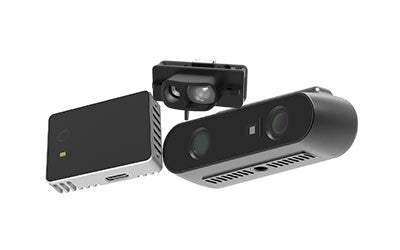
Synexens 3D Camera Of ToF Sensor Soild-State Lidar_CS20

Conclusion: AMR Robots Are Driving the Next Stage of Smart Manufacturing
Autonomous mobile robots are redefining modern manufacturing processes. From traditional automation equipment that follows fixed routes to intelligent AMR robots capable of autonomous navigation, decision-making, and dynamic collaboration, industrial automation is entering a more flexible and intelligent era.
By combining:
- SLAM navigation technology;
- AI vision systems;
- LiDAR sensors;
- ToF depth cameras;
- Industrial Internet of Things platforms;
Autonomous Mobile Robots (AMR) help companies improve production efficiency, reduce operational costs, and achieve more flexible smart manufacturing.
In the future, with the continuous development of robots mobiles autonomes, autonomous mobile robots, and industrial AI technologies, AMR robots will play an increasingly important role in smart factories, intelligent logistics, automotive manufacturing, electronics production, and global industrial digital transformation.
