

Qianjue Robotics Raises Funding: The Future of Robot Tactile AI
Qianjue Robotics Raises Hundreds of Millions in Funding: How Vision-Based Tactile Sensors Are Driving Embodied AI into the 'Tactile Era'
With the rapid development of artificial intelligence, large AI models, and robotics, Embodied AI has become one of the most competitive areas in the global technology industry. Future robots will need more than visual recognition, language understanding, and autonomous planning capabilities. They will also need the ability to sense and interact with the physical world like humans. Among these technologies, robot tactile sensing, tactile sensors, and vision-based tactile sensors are becoming key technologies driving the next generation of intelligent robots.
Recently, Shanghai-based robotics company Qianjue Robotics Technology (Shanghai) Co., Ltd. announced the completion of a hundreds-of-millions RMB financing round. The investment was jointly led by embodied intelligence industry investors, Jiade Electric Appliance as a strategic investor, and Tianji Capital. The new funding will focus on three major areas: accelerating the commercialization of high-precision tricolor vision-based tactile sensors, developing large-scale tactile data collection systems, and advancing physical intelligence models that support tactile and contact-based interaction.
The goal is to help robots evolve from simply 'seeing, hearing, and planning' to being able to touch, manipulate, and complete complex tasks in real-world environments.
Qianjue Robotics: A Company Focused on Robot Tactile Perception Technology
Founded in May 2024, Qianjue Robotics is an innovative robotics company specializing in robot tactile perception technology. The company provides comprehensive solutions covering tactile sensors, robotic end-effectors, simulation systems, and intelligent software platforms.
Unlike traditional robots that mainly rely on cameras, LiDAR, and other visual sensing technologies, Qianjue Robotics focuses on how robots perceive information during physical contact with objects.
Through advanced Vision-Based Tactile Sensors, robots can obtain detailed information including:
- Object surface changes
- Contact pressure distribution
- Three-dimensional deformation
- Friction and slip detection
- Force feedback information
For future intelligent robots, simply 'seeing' objects is not enough. Humans can naturally adjust their grip strength based on an object’s weight, texture, and friction. Robots, however, require advanced tactile sensing technologies to achieve similar abilities.
This makes tactile perception one of the most important foundations for advanced robotic manipulation.
Hundreds-of-Millions Funding Accelerates Tactile Technology Commercialization
After completing this funding round, Qianjue Robotics will focus on three key development directions.
1. Commercialization of High-Precision Vision-Based Tactile Sensors
Traditional robot sensors mainly focus on visual recognition and position detection. However, vision-based tactile sensors provide much richer contact information.
By using optical imaging technology, these sensors can capture subtle changes during interaction between robots and objects, allowing robots to understand:
- Whether an object is securely grasped
- How much force should be applied
- Whether slipping occurs
- How the object surface changes during contact
This technology gives robots a more human-like sense of touch.

2. Building Large-Scale Robot Tactile Data Systems
The rapid development of AI has shown that high-quality data determines intelligence capability.
For embodied AI robots, visual and language data alone are not sufficient. Robots also need massive amounts of real-world tactile data, including:
- Grasping data
- Contact information
- Force feedback data
- Manipulation experience
Qianjue Robotics is developing tactile data collection devices and large-scale tactile datasets to provide training resources for future intelligent robots.
3. Developing Physical Intelligence Models with Tactile Understanding
Current AI models mainly process:
- Text
- Images
- Videos
- Speech
However, robots operating in the real world need to understand physical interactions, including:
- Spatial relationships
- Material properties
- Force changes
- Object manipulation rules
Qianjue Robotics is exploring a new generation of intelligent systems that combine:
Vision + Tactile Sensing + Motion Control + AI Models
to enable robots to better understand and interact with the physical world.
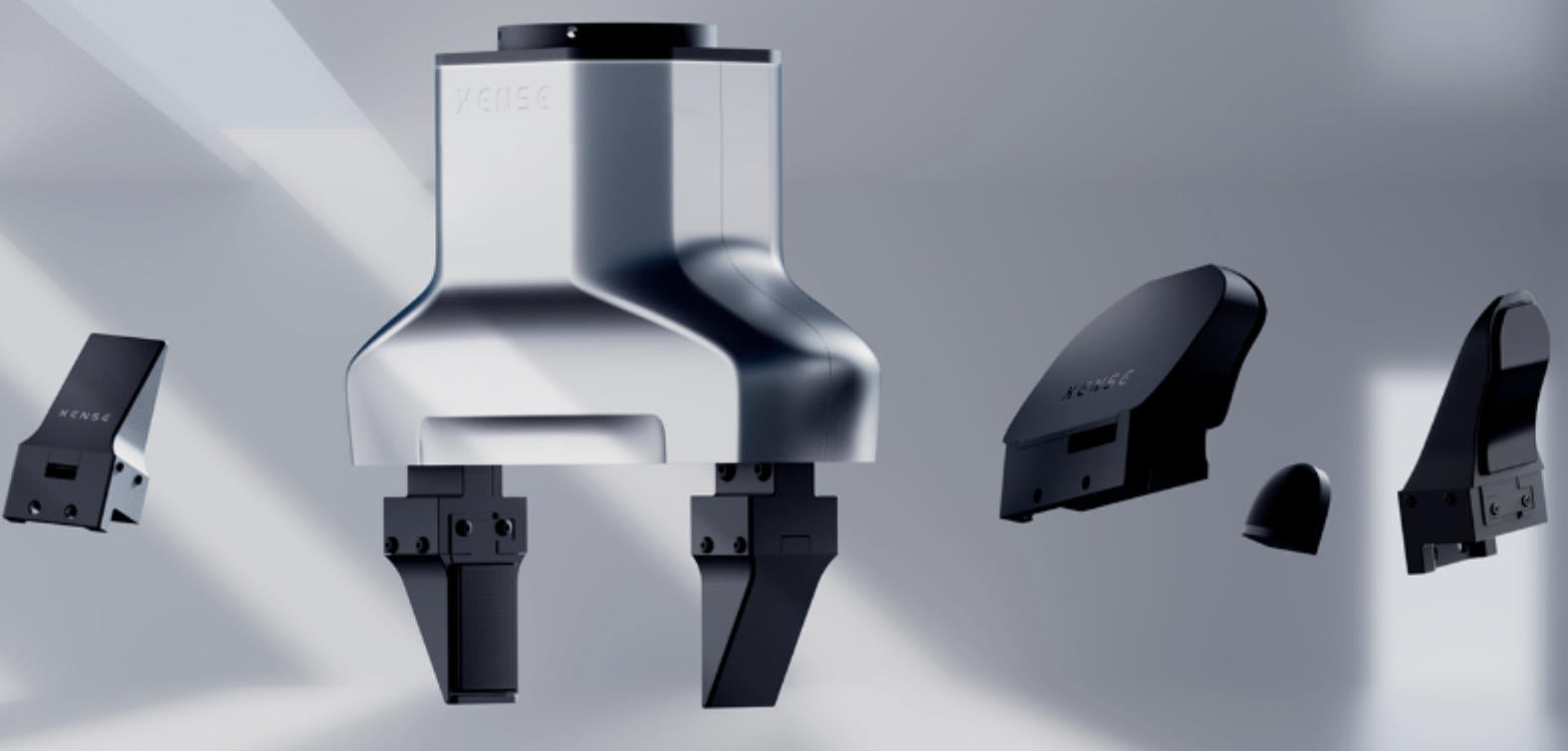
GS-PS Vision-Based Tactile Sensor: Giving Robots a 'Sense of Touch'
In July 2025, Qianjue Robotics launched its new GS-PS Vision-Based Tactile Sensor, designed specifically for UMI robot data collection scenarios.
The product supports multiple UMI grippers and robotic data acquisition systems while providing multi-dimensional sensing capabilities, including:
- 3D deformation detection
- Six-axis force measurement
- 3D force distribution analysis
- Slip detection
- Motion tracking
Compared with traditional force sensors that only measure basic force information, vision-based tactile sensors provide more comprehensive feedback, allowing robots to perform more precise operations.
For example:
- Industrial robots can detect whether components are properly assembled.
- Humanoid robots can adjust gripping force when handling different objects.
- Home robots can interact safely with fragile and soft items.
From Machine Vision to Robot Tactile Perception: The Next Stage of Embodied AI
For decades, robots have mainly relied on vision systems to complete recognition tasks. However, many real-world operations cannot be solved through vision alone.
A robot may recognize an apple visually, but it cannot accurately determine its softness. It may identify a glass cup, but it does not know how much force is needed to hold it safely.
This is why future embodied intelligence requires multimodal perception.
The development path of intelligent robots can be summarized as:
Vision helps robots see the world.
Language helps robots understand instructions.
Tactile sensing helps robots physically interact with the world.
By combining tactile sensors, AI models, and robotic control systems, robots will gradually achieve more human-like perception and manipulation abilities.
Qianjue Robotics Team: Academic Research Power Behind Technology Innovation
The founder of Qianjue Robotics is a researcher specializing in robot tactile perception.
Founder Ma Daolin received his PhD from Peking University and previously studied under robotics manipulation expert Alberto Rodriguez. His research focuses on:
- Robot manipulation
- Vision-based tactile perception
- Intelligent robot control
He also received the Best Paper Award at the prestigious robotics conference ICRA.
Currently, Ma Daolin serves as an Associate Professor at Shanghai Jiao Tong University and proposed the robotic manipulation approach of:
'Building spatial perception through tactile sensing.'
The company’s core team members come from leading institutions including:
- MIT
- Tsinghua University
- Peking University
The team has developed three major technical capabilities:
- Tactile sensor technology
- Tactile perception algorithms
- Tactile control algorithms
Application Scenarios: From Industrial Robots to Humanoid Robots
Qianjue Robotics is currently promoting tactile technology across multiple industries.
1. Embodied AI Robots
Future humanoid robots need to perform complex tasks such as:
- Picking up objects
- Using tools
- Interacting with environments
- Performing household tasks
Tactile sensing is essential for achieving these capabilities.
2. Industrial Precision Assembly
In automotive, battery manufacturing, and advanced manufacturing industries, robots require highly accurate operations.
Tactile technology can help robots:
- Improve assembly precision
- Detect installation quality
- Adjust operating force automatically
3. Flexible Logistics
Modern warehouses require robots to handle products with different shapes, materials, and sizes.
Tactile perception can improve:
- Object grasping accuracy
- Sorting efficiency
- Adaptability in complex environments
4. Home Intelligent Robots
Household environments are much more unpredictable than factories.
Robots need to handle:
- Irregular objects
- Soft materials
- Human interaction scenarios
Tactile sensing will become a critical technology for future home robots.
Robot Competition Is Entering the 'Tactile Era'
As humanoid robots and embodied AI continue to develop worldwide, the future competition will not only focus on AI model capabilities but also on perception and physical interaction abilities.
If vision allows robots to see the world, tactile sensing allows robots to truly understand and manipulate the world.
Through the development of vision-based tactile sensors, tactile datasets, and physical intelligence models, Qianjue Robotics is helping robots evolve from simple automation machines into intelligent agents capable of sensing, learning, and performing complex tasks.
In the future, robots combining vision, language, and tactile intelligence may become a fundamental technology in smart manufacturing, household services, and human-robot interaction.
