

3D ToF Accuracy vs Precision: Improve Depth Camera Stability
What’s the Difference Between 3D ToF Precision and Accuracy, and How Can You Improve Depth Sensor Stability?
In 3D ToF (Time of Flight) technology, depth cameras, and high-precision ranging systems, 'precision' and 'accuracy' are two core performance indicators that are often confused but fundamentally different. Whether in smartphone 3D sensing, robotics vision, industrial measurement, or autonomous driving perception systems, understanding these differences is essential for improving overall system performance.
This article focuses on the difference between Precision and Accuracy, and explains how to improve ToF measurement precision and system reliability in real-world applications, while covering key SEO keywords related to 3D ToF sensing and depth measurement.
1. What Is Precision? What Is Accuracy?
In sensor measurement, 3D vision systems, and industrial inspection, 'precision' and 'accuracy' are two of the most fundamental yet commonly misunderstood concepts, especially in 3D ToF (Time of Flight) depth sensing technology.
Although they are often used together, they describe completely different types of errors:
- Precision = stability and repeatability
- Accuracy = correctness and closeness to the true value
1. Precision: Consistency of repeated measurements
Precision refers to how consistent multiple measurements are under the same conditions. It describes the degree of dispersion or stability in the data.
In simple terms, precision answers the question:
“How stable are the measurement results?”
- If repeated measurements are very close → high precision
- If measurements vary significantly → low precision
High precision means the data is tightly clustered, stable, and smooth. Low precision leads to scattered results, noticeable jitter, and noisy depth maps.
In 3D ToF systems, high precision ensures that even when the object is stationary, the measured distance remains stable without obvious fluctuations, maintaining consistent point cloud structure and depth map integrity.
In engineering terms, precision is related to:
repeatability, stability, and depth consistency.

2. Accuracy: Closeness to the true value
Accuracy refers to how close the measured value is to the actual physical distance. It indicates whether the measurement is correct or not.
In simple terms, accuracy answers the question:
'Is the measurement correct?'
- Measurements close to the true value → high accuracy
- Measurements significantly offset from the true value → low accuracy
High accuracy means systematic errors are small, often achieved through calibration and correction algorithms in ToF systems.
For example, if the true distance is 1.00m and measurements are 0.98m, 1.01m, and 0.99m, the system has high accuracy. However, if measurements consistently stay around 1.20m, the system has low accuracy even if the values are stable, due to a systematic offset.
Engineering Summary
From an engineering perspective:
- Precision = random error
- Accuracy = systematic error
Therefore, in 3D ToF or machine vision systems, optimization is usually done in two steps:
- Improve precision using filtering and multi-frame fusion
- Improve accuracy using calibration and compensation algorithms
2. Precision vs Accuracy: Key Differences
A simple way to understand:
- Precision = how stable the results are
- Accuracy = how correct the results are
| Case | Precision | Accuracy |
|---|---|---|
| Measurements are tightly clustered but off the true value | High | Low |
| Measurements are scattered but average is close to true value | Low | High |
| Measurements are both stable and close to true value | High | High |
In 3D ToF systems, the ideal state is: high precision + high accuracy.
3. Importance of Precision in 3D ToF Technology
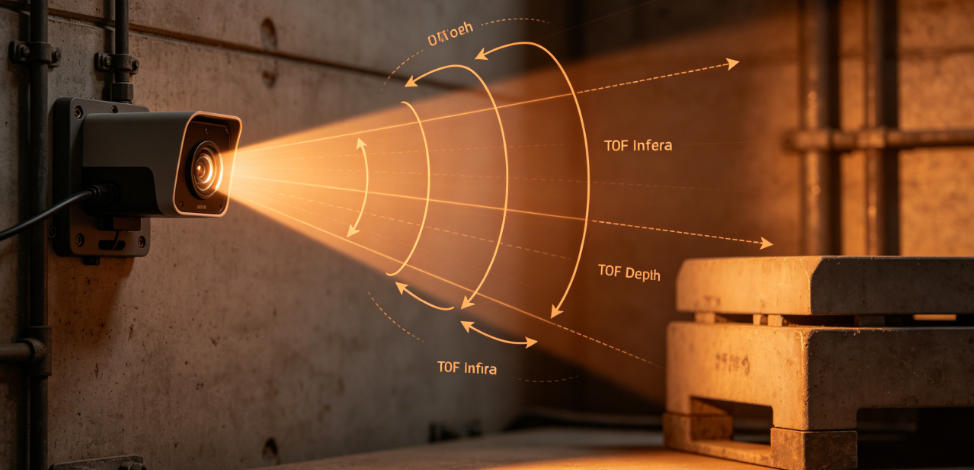
In ToF depth sensing, the system emits light pulses and calculates distance based on the time of flight of the reflected signal.
Why precision is critical
In real-world applications such as:
- Smartphone facial recognition
- AR/VR spatial mapping
- Robot obstacle avoidance
- Industrial inspection
- Autonomous driving perception
Low precision can cause:
- Depth map jitter
- Unstable object edges
- Distorted 3D reconstruction
- Incorrect obstacle detection
4. Key Factors Affecting ToF Measurement Precision
In 3D ToF depth sensing systems, measurement precision and depth stability are influenced by multiple physical and hardware conditions. Any variation in these factors may increase measurement error, noise, and instability in 3D vision systems.
1. Optical noise and ambient light interference
Ambient light interference is one of the most common factors affecting ToF measurement precision and depth camera stability, especially in outdoor strong-light environments or complex indoor lighting conditions.
Strong ambient light reduces the signal-to-noise ratio (SNR) of the ToF sensor, weakening the active infrared signal and causing unstable depth calculations. This may result in noisy depth maps, edge jitter, and increased local measurement errors.
Higher resistance to ambient light interference leads to better measurement precision and depth consistency in ToF systems.
2. Sensor resolution
ToF sensor resolution determines the spatial sampling capability of depth maps and is a key hardware factor affecting 3D vision precision.
Higher-resolution ToF sensors provide more pixel-level depth information, improving edge clarity, point cloud density, and overall measurement precision.
Lower-resolution depth cameras may suffer from insufficient spatial detail, reduced small-object recognition capability, and depth aliasing at object boundaries.

3. Reflective material differences
Different surface materials significantly affect reflected ToF signals and thus measurement precision.
- Dark surfaces absorb light, weakening the return signal
- Metallic or mirror-like surfaces cause strong specular reflection
- Glass or transparent materials introduce transmission and multiple reflections
These effects lead to unstable signal strength and increased depth errors, especially in complex scenes.
4. Multipath effect
Multipath reflection is a typical physical issue in ToF systems, especially in indoor environments.
Light emitted from the sensor may reflect multiple times on walls, tables, or objects before returning to the receiver.
This causes incorrect time-of-flight estimation, leading to:
- Depth distortion
- Point cloud deformation
- Incorrect object boundaries
Multipath suppression is a key research direction in high-precision ToF systems.
5. Temperature drift
Temperature changes significantly affect the long-term stability of ToF sensors.
When device temperature changes, it can cause:
- Variation in laser power
- Changes in receiver sensitivity
- Timing circuit drift
- Calibration parameter shifts
Without compensation, this leads to measurement drift over time and reduced accuracy and precision.
High-end ToF systems often use temperature compensation algorithms and real-time calibration to maintain stable performance.
5. How to Improve ToF System Precision
In engineering practice, improving precision usually involves both hardware and algorithm optimization:
- Filtering algorithms (Kalman filter, median filter, averaging)
- Multi-frame fusion techniques
- System calibration
- Signal-to-noise ratio (SNR) enhancement
- AI-based depth correction models
6. Application Scenarios of Precision in 3D Systems
- Smartphone 3D sensing and face recognition → stable unlocking and anti-jitter performance
- Robotics vision and obstacle avoidance → safer navigation and better path planning
- Autonomous driving perception → accurate obstacle detection and braking decisions
- Industrial inspection → consistent measurement and defect detection
3D Safe Guarding Privacy RGBD Camera Synexens CS30

7. Conclusion: Precision Is the Core of 3D Sensing Optimization
In 3D ToF and depth measurement systems:
- Accuracy determines correctness
- Precision determines stability
High-performance systems require both high accuracy and high precision.
With the rapid development of smartphone 3D sensing, robotics vision, and autonomous driving, the demand for high-precision ToF measurement will continue to increase. Future improvements will rely on:
- Advanced ToF sensor hardware
- Stronger AI algorithms
- Better adaptation to complex environments
