


AGV vs AMR: Key Differences, Navigation & Use Cases Explained
- Posted by TofSensor
What is the difference between AGV and AMR? Which type of automation robot should businesses choose?
In today’s rapidly evolving world of industrial automation and intelligent logistics, agv vs amr has become one of the most searched topics across manufacturing, warehousing, and robotics industries. More and more companies evaluating automation solutions are deeply analyzing the difference between agv and amr to maximize return on investment and operational efficiency.
This article provides a comprehensive breakdown of AGV and AMR technologies, covering navigation systems, core differences, applications, and future trends, while naturally integrating high-search-volume keywords such as agv navigation system, what does agv stand for, amr robot vs agv, and more.
1. What is AGV? what does agv stand for explained
One of the most common questions in industrial automation is: what does agv stand for. AGV stands for Automated Guided Vehicle, which is why you often see terms like agv stands for / agv stand for in the industry.
An AGV is essentially a driverless material handling system that follows predefined routes. It is widely used in factories and warehouses to enable standardized and unmanned material transportation.
The core of AGV operation relies on a complete agv navigation system, also known as agv navigation systems. These systems guide vehicles using technologies such as magnetic strips, QR codes, or laser reflectors, enabling them to follow fixed paths with high stability. This type of agv navigation is fundamentally based on 'predefined routes + environmental markers' rather than real-time decision-making.
In practice, AGVs require infrastructure preparation, such as floor-embedded magnetic strips or navigation markers. Once deployed, they repeatedly perform tasks like warehouse transport, production line delivery, and material handling. This makes AGVs highly reliable and suitable for structured and stable industrial environments.
However, AGVs are relatively limited in flexibility, since route changes often require physical modifications or system reconfiguration. Although technologies like agv lidar and vision systems are increasingly being integrated to improve accuracy and safety, the core logic still depends on fixed-path navigation.
Overall, AGV represents a mature early-stage solution in industrial automation. It relies on stable agv navigation systems to ensure consistent operation and serves as a foundational technology for modern logistics automation.

2. What is AMR? amr agv difference core explanation
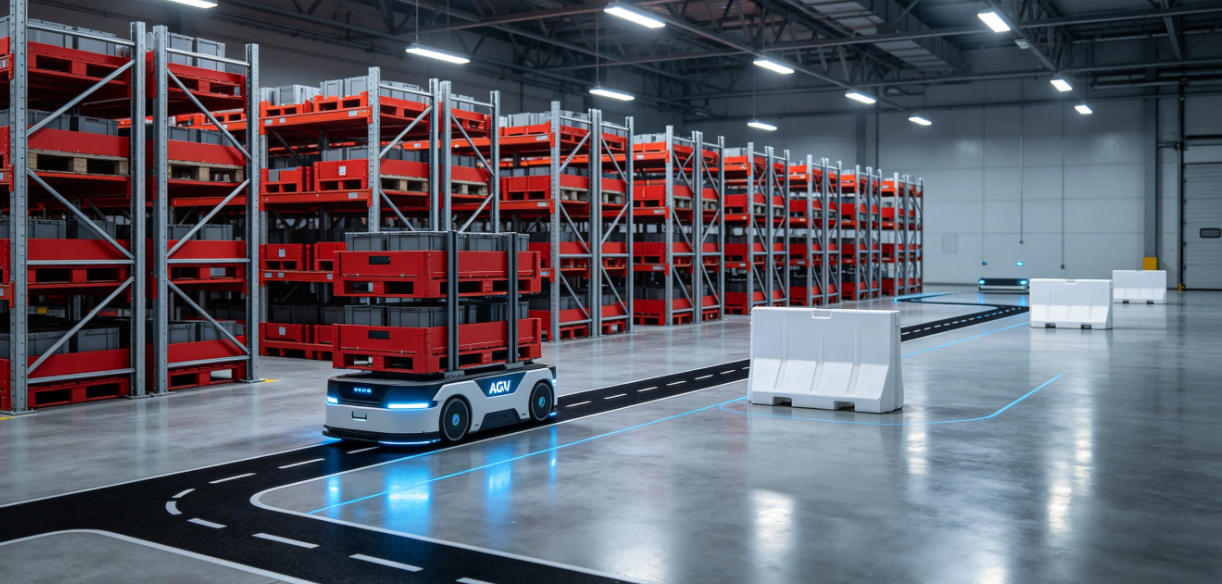
AMR (Autonomous Mobile Robot) is one of the fastest-growing technologies in intelligent warehousing and flexible manufacturing. When analyzing the amr agv difference, AMR can be defined as a mobile robot system that uses AI algorithms, sensor fusion, and real-time mapping to achieve autonomous decision-making and path planning.
Unlike traditional AGVs, AMRs do not rely on fixed tracks or predefined routes. Instead, they use SLAM (Simultaneous Localization and Mapping) technology to continuously understand and map their environment. This allows AMRs to dynamically adapt to changes such as obstacles, human movement, or warehouse layout adjustments.
Key capabilities of AMR include:
- Autonomous path planning, calculating optimal routes in real time
- Real-time environment perception using LiDAR, depth cameras, and sensor fusion
- Dynamic obstacle avoidance, enabling rerouting without human intervention
- No infrastructure dependency, allowing fast deployment and scalability
Because of these capabilities, AMRs behave more like intelligent decision-making systems rather than fixed-route execution machines.
In industry comparisons, AMRs are often discussed alongside amr and agv, highlighting the fundamental shift from rigid automation to intelligent autonomy.
3. agv vs amr: Key differences in detail
When searching agv vs amr or agv vs. amr - what's the difference, the core comparison focuses on navigation logic, flexibility, and system intelligence.
1. Navigation differences
Understanding difference between agv and amr starts with navigation logic.
AGV:
- Operates on fixed routes
- Relies on agv navigation technology
- Common agv navigation types include magnetic navigation, laser navigation, and vision navigation
- Requires environmental markers or floor modifications
- Functions as an execution-based system following predefined rules
AMR:
- Uses SLAM-based real-time mapping
- Continuously updates environmental maps
- Autonomously selects optimal routes
- Does not require fixed infrastructure
- Functions as a decision-based intelligent system
2. Flexibility comparison
In the amrs vs agvs flexibility comparison, flexibility is the most critical differentiator.
-
AGV: Low flexibility
- Requires physical reconfiguration when layouts change
- Best suited for stable production environments
- Ideal for long-term fixed-route operations
-
AMR: High flexibility
- Can be deployed without modifying existing infrastructure
- Automatically avoids obstacles and adjusts routes
- Supports dynamic task scheduling and real-time adaptation
As a result, autonomous guided vehicles amrs trends are increasingly shifting toward AMRs in modern automation systems.
3. Application differences
The difference in applications reflects two distinct automation philosophies: stability vs flexibility.
AGV is suitable for:
- Automotive manufacturing lines
- Fixed-cycle production logistics
- Repetitive material transportation tasks
- Highly structured environments with minimal changes
AGVs excel in stable environments due to reliable agv navigation system performance and low operational error rates.
AMR is suitable for:
- E-commerce and logistics fulfillment centers
- Dynamic warehousing with changing inventory layouts
- Flexible manufacturing environments
- Complex multi-robot collaborative systems
AMRs perform better in dynamic environments, such as warehouses where layouts, orders, and traffic patterns constantly change.
4. agv navigation system and technical structure
The agv navigation system is the core of AGV operation.
Common agv navigation systems include:
- Magnetic strip navigation (low cost, low flexibility)
- Laser navigation (high precision, widely used)
- Vision navigation (camera-based recognition)
- agv lidar systems for improved accuracy and safety

5. amr robot vs agv: which is more advanced?
The comparison of amr robot vs agv is a key industry debate.
| Dimension | AGV | AMR |
|---|---|---|
| Navigation | Fixed path | Autonomous |
| Flexibility | Low | High |
| Deployment cost | Lower | Higher |
| Scalability | Limited | Strong |
In modern intelligent logistics, AMR is gradually becoming the dominant technology.
6. Collaboration of agvs and amrs
In real-world industrial environments, AGVs and AMRs are not always competitors but often work together as agvs and amrs:
- AGVs handle stable, repetitive transport tasks
- AMRs manage dynamic routing and flexible operations
This hybrid model maximizes efficiency and enables smarter logistics systems.
7. Future trends of agv navigation types
Research into agv navigation types shows future trends such as:
- Transition from magnetic to vision-based navigation
- Shift from fixed routes to intelligent path planning
- Integration with AI-based scheduling systems
The convergence of agv navigation and AMR technology is forming hybrid automation ecosystems.
8. amr agv definition standardization
The industry definition of amr agv definition is becoming more standardized:
- AGV: A guided vehicle relying on predefined paths
- AMR: A mobile robot with autonomous decision-making capabilities
This distinction directly influences system design and investment decisions.
9. Conclusion: future of agv vs amr
The core of agv vs amr lies in 'fixed vs autonomous.'
With advances in AI, SLAM algorithms, and sensor technology:
- AGVs will continue serving stable industrial environments
- AMRs will rapidly expand in smart warehousing and flexible manufacturing
Ultimately, companies must evaluate the difference between agv and amr based on real application scenarios rather than simply choosing one over the other.
Final Thoughts
Whether it is the maturity of the agv navigation system or the intelligence of AMR technology, the future of smart logistics will revolve around automation and intelligent decision-making.
Understanding agv vs amr enables businesses to make more informed automation decisions and achieve the optimal balance between efficiency, flexibility, and cost.
Synexens Industrial Outdoor 4m TOF Sensor Depth 3D Camera Rangefinder_CS40p

After-sales Support:
Our professional technical team specializing in 3D camera ranging is ready to assist you at any time. Whether you encounter any issues with your TOF camera after purchase or need clarification on TOF technology, feel free to contact us anytime. We are committed to providing high-quality technical after-sales service and user experience, ensuring your peace of mind in both shopping and using our products.
