

Autonomous Security Camera Systems: AI Robot Surveillance Explained
What Is an Autonomous Security Camera System and How Does Robot Surveillance Work?
In the context of rapid development in intelligent security and industrial automation, robot surveillance is becoming a critical component of modern safety systems. By integrating AI vision, mobile robotics platforms, and multi-sensor systems, the autonomous security camera is redefining traditional surveillance methods, enabling a shift from 'fixed monitoring' to 'mobile intelligent patrol.'
In recent years, with the maturity of robot with camera for security and AMR camera technologies, mobile security systems have been widely deployed in factories, warehouses, industrial parks, and urban public safety environments.
1. What is an Autonomous Security Camera?
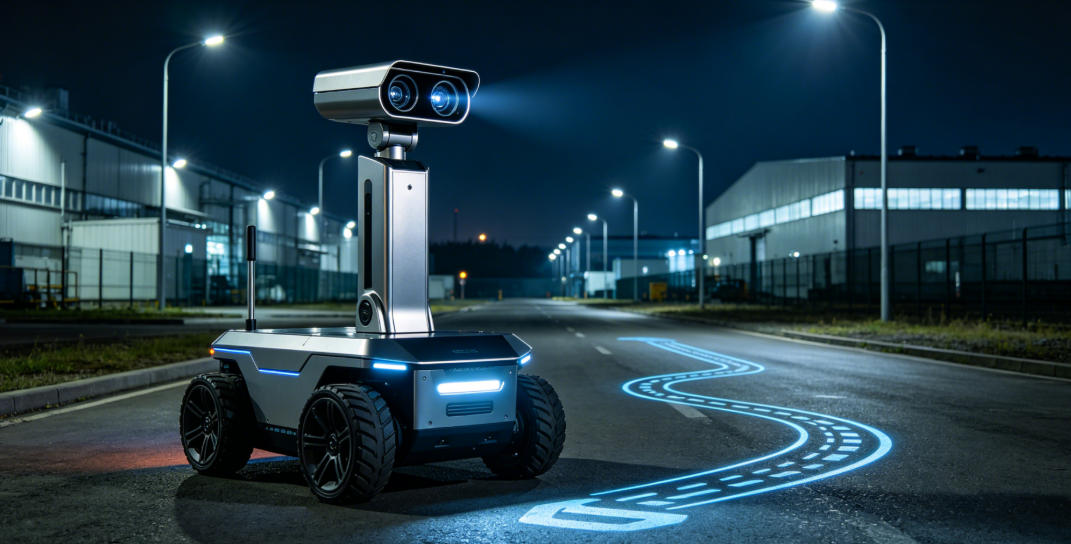
An autonomous security camera system is an advanced security solution that combines a mobile robot platform with an AI-based vision system. By integrating cameras, multi-sensors (such as LiDAR and infrared sensors), edge computing, and AI algorithms, the system can autonomously navigate environments, perform dynamic patrols, and conduct real-time video capture and intelligent analysis without human intervention, enabling a more flexible and high-coverage security framework.
Compared to traditional fixed camera systems, its key advantage lies in shifting from passive monitoring to active patrolling. The system enables multi-angle mobile surveillance, covering blind spots that static cameras cannot reach. It also provides real-time AI-based analysis to detect crowd behavior, intrusion events, abnormal loitering, falls, or hazardous actions, triggering immediate alert mechanisms. With SLAM (Simultaneous Localization and Mapping) and path planning algorithms, the robot can autonomously navigate, avoid obstacles, and follow predefined or adaptive patrol routes.
In modern security ecosystems, autonomous security cameras are typically integrated with robot surveillance systems and cloud-based platforms, forming a unified architecture of 'mobile patrol + AI recognition + cloud management.' This significantly improves coverage, response speed, and operational efficiency, while reducing reliance on human patrols. As a result, they are widely used in industrial parks, logistics warehouses, campuses, construction sites, large commercial complexes, and public event spaces.

2. Robot with Camera for Security Systems
A robot with camera for security is one of the fastest-growing applications in intelligent security. It is typically built on an Autonomous Mobile Robot (AMR) platform and integrates HD cameras, infrared night vision, AI vision algorithms, and multi-sensor systems to replace or enhance traditional human patrols and fixed surveillance systems.
The core value of this system is the integration of mobility, visual perception, and AI analytics into a single autonomous unit. This allows the robot to continuously patrol and detect risks in complex environments. Compared to traditional security solutions, it enables higher-frequency and higher-coverage dynamic monitoring, making it especially suitable for large-scale and complex environments with high labor costs.
Core capabilities include:
- Live Video Surveillance: Continuous high-definition video streaming with remote access
- Human Detection & Tracking: AI-based recognition of faces, bodies, and movement trajectories for tracking targets
- Anomaly Detection: Identification of intrusion, loitering, falls, or violent behavior with automatic alerts
- Autonomous Patrol Routing: AI-driven path planning based on maps and task rules, with dynamic adjustments
In industrial parks, logistics warehouses, and large facilities, these robots can operate 24/7 continuous patrols, significantly reducing manual workload while improving incident response speed and evidence collection capabilities. Some systems also integrate with access control, alarm systems, and fire safety systems, forming a complete security ecosystem.
3. AMR Camera Systems
An AMR camera system is the core perception module mounted on an Autonomous Mobile Robot (AMR) platform, providing the robot with “visual and environmental understanding capabilities.” Beyond video capture, it enables environmental modeling, object recognition, and intelligent decision-making, acting as the system’s “perception hub.”
Modern AMR camera systems integrate multiple sensing and computing technologies, allowing stable operation and high-precision perception in dynamic environments. By fusing visual and spatial data, the robot evolves from simply 'seeing the environment' to truly 'understanding the environment.'
Common technical components include:
- RGB HD Camera + Depth Camera: Enables fusion of 2D and 3D spatial perception
- LiDAR (Light Detection and Ranging): High-precision mapping and obstacle detection
- Edge AI Computing Chips: On-device real-time detection and analysis with low latency
- Panoramic Vision Capability: Reduces blind spots and improves environmental awareness
With these technologies, AMR systems can identify not only “what is happening,” but also “why it is happening” and “whether it is a risk.” For example, in warehouse environments, they can detect:
- Human movement and crowding patterns
- Abnormal cargo stacking or collapse risks
- Safety violations (e.g., missing protective equipment or restricted access entry)
- Obstructions in operational pathways affecting logistics flow
All data can be transmitted in real time to security control centers or cloud platforms for analysis, storage, and coordination, enabling intelligent security management and operational optimization.
4. Robot Surveillance Systems
Robot surveillance represents a major evolution toward automation and proactive security. It replaces traditional fixed cameras and manual patrols with mobile robots, enabling integrated dynamic inspection, continuous monitoring, and real-time response.
Unlike conventional systems, robot surveillance is not just about recording events—it focuses on actively detecting risks. Robots continuously patrol predefined areas and dynamically adjust routes based on environmental conditions, effectively covering blind spots that static cameras cannot reach.
Key advantages include:
- No Blind Spots Coverage: Mobile patrol routes ensure complete area coverage
- Dynamic Route Planning: Optimized based on crowd density, risk levels, or emergencies
- Instant Alert System: Immediate notifications sent to security centers or mobile devices
- Multi-Robot Collaboration: Coordinated patrols across large-scale environments for efficiency and redundancy
In complex environments such as airports, factories, energy plants, ports, and large commercial facilities, robot surveillance significantly improves response speed, risk detection capability, and operational efficiency, while reducing dependence on human patrol labor.
5. Core System Architecture
A complete autonomous security camera system consists of multiple interconnected modules forming a closed-loop intelligent architecture of 'perception – decision – execution – feedback.'
Core components include:
- AMR Platform: Provides autonomous mobility and serves as the execution layer
- Robot Surveillance Camera System: Captures video and multi-angle environmental data
- AI Vision System: Performs object detection, behavior analysis, and anomaly recognition
- LiDAR & Depth Sensors: Enable mapping, localization, and obstacle avoidance
- Cloud Monitoring & Analytics Platform: Handles data storage, remote management, and advanced analytics
System workflow:
- Autonomous Navigation: SLAM-based mapping and route planning
- Environmental Perception: Real-time sensing of people and obstacles
- AI-powered Analysis: Edge or cloud-based behavioral and event detection
- Security Event Handling: Automatic alerts, recording, or target tracking
- Data Feedback Loop: Continuous optimization through cloud data analytics
This architecture enables true autonomous patrol, real-time analysis, and closed-loop security management, transforming security from reactive monitoring into proactive, intelligent protection.

6. Application Scenarios
Industrial Security Patrols
Used for night patrols, equipment monitoring, and intrusion detection in factories.
Warehousing & Logistics
Supports inventory monitoring, personnel safety, and cargo anomaly detection.
Public Safety in Smart Cities
Used for crowd monitoring, event security, and emergency response.
Energy & Critical Infrastructure
Applies to substations, oil & gas facilities for equipment inspection and thermal anomaly detection.
7. Future Trends
The evolution of autonomous security camera systems will focus on:
- Enhanced deep learning-based AI recognition
- Multi-robot collaborative patrol systems
- 5G real-time data transmission
- Edge AI for on-device processing
- Lighter and more efficient AMR platforms
In particular, advancements in AMR camera systems will significantly improve environmental perception in complex scenarios.
8. Conclusion
With the rapid advancement of intelligent security technologies, robot surveillance systems are evolving from auxiliary tools into core security infrastructure.
By integrating robot with camera for security, autonomous security cameras, and AMR camera systems, modern security solutions are transitioning from passive monitoring to proactive patrol and intelligent decision-making.
In the future, mobile security robots will become a fundamental component of both urban and industrial safety ecosystems, driven by continued convergence of AI and robotics technologies.
Synexens 3D Camera Of ToF Sensor Soild-State Lidar_CS20

After-sales Support:
Our professional technical team specializing in 3D camera ranging is ready to assist you at any time. Whether you encounter any issues with your TOF camera after purchase or need clarification on TOF technology, feel free to contact us anytime. We are committed to providing high-quality technical after-sales service and user experience, ensuring your peace of mind in both shopping and using our products
