

CES 2026 LiDAR: Hesai, RoboSense & More Redefine Robotic Vision
CES 2026 LiDAR Preview: How Innovations from Hesai, RoboSense & Others are Redefining Robotic Perception
Publication Date: January 8, 2026
CES 2026, Robotic LiDAR, Hesai Technology, RoboSense, Seyond, LiDAR manufacturers, Autonomous vehicle sensors, Robotic lawn mower
The annual global tech barometer, the Consumer Electronics Show (CES 2026), officially opened today. Although the number of Chinese exhibitors has been adjusted this year, the 'hard tech' content has reached new heights. Among the 4,500+ exhibitors, LiDAR (Light Detection and Ranging) has emerged as the bridge connecting the digital world and the physical world.
Unlike previous years where the focus was solely on automobiles, CES 2026 highlights the integration of 'Physical AI' and 'Embodied Intelligence'. From autonomous vehicles to domestic service robots, LiDAR is expanding from 'automotive-grade' applications into the broader field of general robotics.
This article provides an in-depth review of the core technologies and manufacturers in the robotics and automotive LiDAR sectors at CES 2026.
I. Domestic LiDAR Giants: From Automotive to Embodied Intelligence
1. Hesai Technology: The 'Eye' of Robotics
As a global leader in LiDAR, Hesai demonstrated its formidable technological barriers at CES 2026.
- Key Products: The refreshed ATX (powered by the Fermi C500 chip) and the JT Series (dedicated to robotics).
-
Robotics Application Highlights: Hesai has clearly defined the concept of 'Robotics LiDAR.' Its JT Series, a miniature high-performance 3D LiDAR, is becoming the 'visual center' for robots thanks to its extremely compact size.
- Real-world Applications: Demonstrations included the V-Dragon intelligent companion robot, Dreame robotic lawn mowers, and the Ruishi 3D scanner. The JT series has surpassed 200,000 units in delivery within just one year of launch.
- Capacity Plan: Annual production capacity will double to 4 million units in 2026, further solidifying its dominance in perception hardware.
2. RoboSense & Weilanda: Digital Upgrades for Smart Lawn Mowers
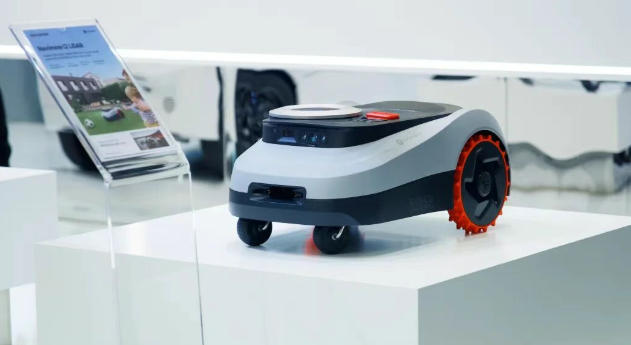
RoboSense and Weilanda jointly launched a major new product at the exhibition, marking a deep penetration of LiDAR into the consumer robotics sector.
- Key Collaboration: Navimow i2 LiDAR.
-
Technical Breakthrough: Equipped with the world's first fully solid-state digital LiDAR for robotics, the E1R.
- Specifications: A massive 120°×90° Field of View (FOV), 144 lines, scanning nearly 200,000 points per second.
- AI Capabilities: Combined with AI vision, it can identify 200+ types of obstacles (e.g., pets, hanging objects) and build full-color real-scene maps ('Geo-Sketch™').
- Advantages: The solid-state design has no moving parts, making it highly impact-resistant and perfectly solving the perception challenges of lawn mowers in complex garden environments.
3. Seyond: Full-Scenario Perception Matrix
Seyond is not only leading in the automotive sector (Falcon series) but also showcasing strong implementation capabilities in robotics.
- Key Product: The Hummingbird D1 won the "CES 2026 Best-in-Show" award, marking one of the first instances of pure solid-state LiDAR entering mass production for passenger cars.
- Robotics Case: A joint demonstration featured the Jiuzhi Z5 unmanned delivery vehicle. Equipped with Seyond's Wren W LiDAR, it achieves all-weather, high-reliability autonomous transportation, accelerating the commercialization of unmanned freight.
4. LightIC: The World's Smallest FMCW Radar
LightIC brought a disruptive product, the FR60—the world's first pocket-sized 4D FMCW LiDAR.
- Core Highlights: The world's smallest volume, enabling real-time point cloud velocity sensing.
- Application Scenarios: Designed specifically for robotics and space-constrained platforms. It (breaks) the balance between performance and cost, making it ideal for AMRs, AGV navigation, and smart factories.
5. VanJee: Solid-State and Blind-Spot Solutions
VanJee focused on perception solutions for autonomous driving and robotics.
- Key Product: The WLR-750 fully solid-state FLASH LiDAR.
- Robotics Adaptation: With a massive 128°×96° FOV, it completely solves high-reflection interference issues (e.g., metal glare), significantly reducing algorithm processing difficulty.
- Service Robots: The lightweight 16-line radar, WLR-722, made its international debut and has been applied to robotic dogs, two-wheeled robots, and lawn mowers, featuring low noise and low power consumption.

II. International Players: Technological Innovation and Cross-Industry Integration
1. Innoviz: Ultra-Thin Design for Robotics
Innoviz launched the InnovizThree, which reduces costs by over 35% compared to its predecessor, with a slimmer profile (only 600g).
- Robotics Potential: Its compact design and low cost make it an ideal choice for humanoid robots, micro-robots, and drones, providing developers with a high-performance, cost-effective perception solution.
2. Aeva: Windshield Integration and 4D Perception
Aeva showcased its Atlas Ultra 4D LiDAR and introduced a windshield-integrated design.
- Technical Features: Based on FMCW technology, it can not only measure distance but also directly measure velocity. This 4D perception capability is crucial for robots to avoid obstacles in complex dynamic environments.
3. Voyant Photonics & Lumos: Silicon Photonics
Both companies showcased LiDAR based on Silicon Photonics.
- Trend: By integrating optical functions onto chips, they are achieving system miniaturization and cost reduction. Voyant's Carbon platform and Lumos's CITEYE™ system demonstrate the future of LiDAR in industrial automation and smart city infrastructure.
III. 2026 LiDAR Industry Trend Summary
Based on the exhibitions at CES 2026, three key trends in the LiDAR industry are clear:
- The Boom of Physical AI: LiDAR is no longer just an accessory for cars but the core sensor enabling robots to perceive the physical world. From lawn mowers to unmanned delivery vehicles, perception technology is bringing machines to life.
- Diversification of Technology Roadmaps: From traditional mechanical types to FMCW (Frequency Modulated Continuous Wave), SPAD (Single-Photon Avalanche Diode), and Silicon Photonics technologies, manufacturers are using fundamental innovations to reduce costs and enhance performance (e.g., directly acquiring velocity information).
- From 'Hardware' to 'Ecosystem' Manufacturers are no longer just selling hardware; they are providing complete solutions that include AI algorithms (such as Vueron's VueX platform), mapping, and obstacle avoidance.
Conclusion:
CES 2026 is not just a consumer electronics show; it is a feast of robotic perception technology. With the global expansion of Chinese manufacturers like Hesai, RoboSense, and Seyond, and the maturation of new technologies like FMCW and solid-state radar, we are accelerating toward an era of intelligent robotics empowered by LiDAR.
CES 2026 is not just a consumer electronics show; it is a feast of robotic perception technology. With the global expansion of Chinese manufacturers like Hesai, RoboSense, and Seyond, and the maturation of new technologies like FMCW and solid-state radar, we are accelerating toward an era of intelligent robotics empowered by LiDAR.
