

AI People Count System: Smart ToF People Counting Solution for Retail
- von TofSensor
What Is an AI People Count System and How Does ToF-Based People Counting Work in Smart Retail and Buildings?
In today’s era of digital operations and intelligent decision-making, the people count system has become a critical infrastructure for retail, commercial real estate, smart cities, and public space management. By combining AI vision algorithms with 3D depth sensing technology, modern people counting systems can accurately and non-intrusively track human flow in real time, providing high-value data insights for business optimization.
Compared with traditional manual counting or basic video-based systems, solutions powered by ToF depth cameras and AI algorithms deliver significantly higher accuracy and stability, even in complex environments, making them a core component of smart retail and intelligent building systems.
What Is a People Count System?
A people count system is an intelligent analytics solution that uses computer vision, depth sensing, and artificial intelligence algorithms to automatically detect, identify, and count people in a defined space.
Its core value is not just counting people, but transforming raw human movement into structured, actionable business data.
Modern systems typically rely on either AI-based visual recognition or 3D depth sensing (such as ToF cameras) to capture spatial human information. AI algorithms then perform detection, tracking, and de-duplication to ensure continuous and stable counting performance.
Compared to traditional manual counting or infrared sensors, a people counting system offers significant advantages in accuracy, real-time processing, and scalability.
From a data perspective, these systems break down human flow into multiple operational metrics, including In/Out flow, real-time occupancy or occupancy rate, dwell time, crowd density variations, and advanced behavioral analytics such as heatmaps and flow tracking.
Together, these metrics provide a complete understanding of how people interact with a space—when they enter, where they stay, how they move, and when they leave.
Therefore, a people count system is not just a counting tool, but a comprehensive data analytics platform for commercial and spatial operations. It is widely used in retail performance analysis, commercial real estate optimization, smart office management, and public space monitoring. With the rise of AI and IoT technologies, it is evolving into a foundational infrastructure for digital urban and business intelligence systems.

Technical Implementation of People Counting Systems
Modern people count systems have evolved from single-sensor solutions into multi-modal intelligent platforms that integrate AI vision, 3D depth sensing, and data fusion technologies. Different approaches vary in accuracy, cost, deployment complexity, and application scenarios, but the overall trend is toward higher precision, real-time performance, and privacy-friendly design.
1. 3D ToF Depth Camera (Mainstream High-Accuracy Solution)
Time-of-Flight (ToF) 3D depth cameras are currently one of the most widely used core technologies in commercial people counting systems.
They work by actively emitting infrared light and measuring the time it takes for the light to return after reflecting off objects. This allows the system to directly obtain depth information for each pixel, reconstructing a true 3D spatial model.
Compared to traditional 2D vision systems, ToF cameras provide a much more reliable understanding of spatial geometry rather than relying on color or texture.
Key advantages include:
- High-precision 3D human detection
- Robust performance in all lighting conditions (bright, dark, or backlit environments)
- Privacy-friendly design (no facial recognition required)
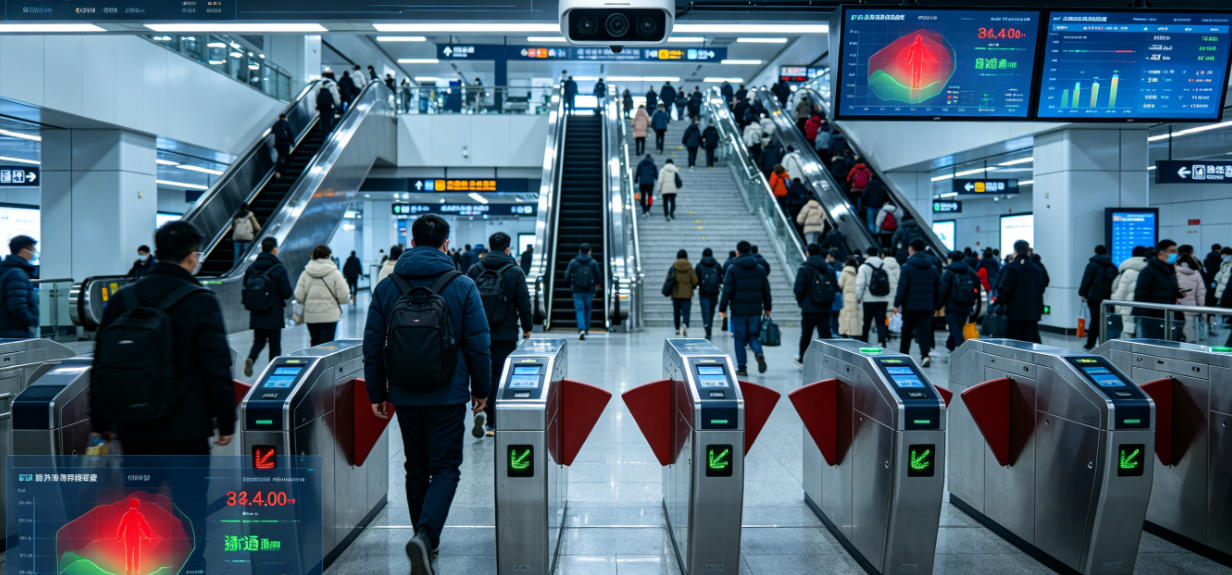
- Ideal for high-density environments such as mall entrances, subway gates, and exhibition halls
As a result, ToF-based people counting systems have become the dominant solution in retail analytics, smart buildings, and public space management, moving toward standardized and large-scale deployment.
2. AI Video Analytics (2D Vision Approach)
Another common approach is AI-based video analytics using standard RGB cameras. Computer vision models detect and track human figures in video streams to estimate crowd counts.
This method relies heavily on deep learning techniques such as object detection and multi-object tracking.
Key characteristics include:
- Lower deployment cost (uses existing cameras)
- Easy system integration with surveillance infrastructure
- Strong dependency on algorithm performance
- Sensitive to occlusion, lighting changes, and camera angles
In practice, AI video-based systems are more suitable for low to medium-density environments such as small retail stores or office spaces. However, their accuracy is generally less stable than 3D-based solutions in complex scenarios.
3. Infrared / WiFi / Bluetooth Sensing (Auxiliary Methods)
Non-visual approaches such as infrared sensors, WiFi probing, and Bluetooth detection estimate people flow by analyzing signal changes.
Examples include:
- Infrared beam interruption counting
- WiFi/Bluetooth device signal tracking
These systems are characterized by:
- Completely non-visual operation (no image capture)
- Low deployment cost
- Suitable for basic counting tasks
- Limited accuracy due to device dependency and signal interference
Therefore, these methods are typically used as supplementary tools rather than primary solutions in high-precision commercial analytics.
Overall Trend: 3D + AI Fusion Becomes the Standard
From a technological perspective, standalone solutions are gradually being replaced by integrated systems. Modern high-end people counting systems increasingly rely on a combination of 3D ToF depth cameras and AI algorithms to achieve higher accuracy and robustness.
This hybrid approach provides:
- Spatial depth perception combined with semantic AI understanding
- Stable performance in crowded and occluded environments
- Rich data outputs (people count, trajectory, heatmap, occupancy rate)
- Strong suitability for retail analytics, smart buildings, and smart city applications
With continued advancements in AI and 3D sensing technologies, the people counting system is evolving from a simple counting tool into a full-scale spatial behavior analytics platform.
System Architecture of People Counting Systems
Modern intelligent systems are typically structured into three layers:
1. Sensing Layer
3D depth cameras installed at entrances or ceilings capture:
- Depth data
- Infrared images
- Optional RGB images
2. AI Processing Layer
AI algorithms perform:
- Human detection
- Multi-object tracking
- Trajectory analysis
- Re-identification (anti-duplicate counting)
- Direction recognition
3. Analytics Layer
The system outputs structured insights such as:
- Real-time occupancy
- Traffic trend curves
- Daily/weekly/monthly reports
- Heatmap analysis
- Conversion rate metrics
These outputs directly support business intelligence and operational decision-making.

Key Applications of People Count Systems
Retail & Store Analytics
Used for:
- Visitor counting
- Conversion rate analysis
- Product layout optimization
- Marketing effectiveness evaluation
Commercial Real Estate
Used for:
- Floor traffic distribution
- Tenant value evaluation
- Space performance optimization
- Revenue per area improvement
Smart Office & Building Management
Used for:
- Occupancy monitoring
- Meeting room usage analysis
- Energy optimization (HVAC integration)
- Space utilization improvement
Transportation Hubs
Used for:
- Passenger flow monitoring
- Queue optimization
- Congestion prevention
- Operational efficiency improvement
Events & Exhibitions
Used for:
- Crowd control
- Booth popularity analysis
- Visitor flow optimization
- Safety management
Key Advantages of People Count Systems
- High-precision real-time counting
- Privacy-by-design (no identity tracking)
- Real-time analytics and monitoring
- 24/7 stable operation in all environments
- Easy integration with APIs, cloud platforms, and IoT systems
Why Businesses Need a People Count System
In a data-driven economy, customer flow has become a critical business asset.
Deploying a people counting system enables:
- Higher conversion rates
- Improved space utilization
- Reduced operational costs
- Better marketing targeting
- Enhanced customer experience
It has become a fundamental infrastructure for digital transformation in retail, real estate, transportation, and corporate environments.
Conclusion
AI-powered people count systems based on 3D ToF technology are redefining how spaces are managed and analyzed. Far beyond simple counting tools, they provide comprehensive behavioral intelligence platforms for modern business operations.
As AI vision and smart sensing technologies continue to evolve, people counting systems will become even more intelligent, real-time, and automated—forming a core pillar of smart cities and digital commerce ecosystems.
Synexens 3D Camera Of ToF Sensor Soild-State Lidar_CS20

After-sales Support:
Our professional technical team specializing in 3D camera ranging is ready to assist you at any time. Whether you encounter any issues with your TOF camera after purchase or need clarification on TOF technology, feel free to contact us anytime. We are committed to providing high-quality technical after-sales service and user experience, ensuring your peace of mind in both shopping and using our products
