

Laser Distance Sensors for Industrial Automation & Robotics Guide
How Do Laser Distance Sensors Improve Industrial Automation and Robotics?
With the rapid development of Industry 4.0, smart manufacturing, and robotics technology, accurate and efficient distance measurement has become an essential part of modern automation systems. In smart factories, robotic control, automated production lines, and intelligent logistics, laser distance sensors are becoming a key sensing technology for achieving high-precision detection and measurement.
Compared with traditional ultrasonic sensors, infrared measurement devices, and mechanical measurement methods, laser distance sensors offer higher accuracy, faster response speeds, longer measurement ranges, and stronger environmental adaptability. As a result, they are widely used in industrial automation, robotics, smart manufacturing, AGV/AMR mobile robots, warehouse automation, and industrial inspection systems.
As companies continue their digital transformation journey, the demand for sensors that can provide real-time and accurate distance data is increasing rapidly. High precision laser distance sensors have become an important component for improving production efficiency, optimizing robot navigation, and enhancing industrial safety.
What Is a Laser Distance Sensor?
A laser distance sensor is a precision sensing device that uses laser technology to perform non-contact distance measurement. It works by emitting a laser beam toward a target object and receiving the reflected signal. By calculating the time of flight, phase difference, or laser angle variation, the sensor can accurately determine the distance between the sensor and the object.
In simple terms, the working process of a laser distance sensor includes four main steps: laser emission, target reflection, signal reception, and data calculation. The internal processing system analyzes the received data, calculates the distance, and sends the measurement results to the control system for applications such as robot motion control, automated equipment adjustment, and industrial inspection.
The most common laser measurement technologies used in industrial applications include Time-of-Flight (ToF), Phase Shift Measurement, and Laser Triangulation. Different technologies are suitable for different scenarios, including short-range precision inspection, long-distance industrial measurement, robot positioning, and smart logistics navigation.
Compared with traditional distance sensing solutions, laser distance sensors provide several important advantages. First, high-precision laser measurement can achieve millimeter-level or even higher accuracy, meeting the requirements of precision manufacturing, automated production lines, and robotic control systems. Second, because laser sensors perform non-contact measurement, they reduce mechanical wear and are suitable for detecting high-speed moving objects, high-temperature environments, and hazardous industrial areas.
In addition, modern industrial automation systems require fast response capabilities. Fast response laser distance sensors can complete distance detection within a very short time, providing real-time feedback for robot path planning and equipment control. Through advanced algorithms, signal filtering technology, and temperature compensation functions, industrial laser distance sensors can maintain stable performance even in dusty environments, strong lighting conditions, and complex reflective surfaces.

How Do Laser Distance Sensors Work?
Understanding how laser distance sensors work helps companies select the right measurement technology for industrial applications. Most industrial laser distance sensors use ToF, phase shift measurement, or triangulation technology.
Time-of-Flight (ToF) Laser Distance Measurement is one of the most widely used laser measurement methods today. Its working principle is based on measuring the time required for a laser pulse to travel to an object and return to the sensor. Since the speed of light is constant, the sensor can calculate the distance by measuring the laser travel time.
ToF laser measurement technology offers fast measurement speed, long detection range, and excellent performance for dynamic object detection. Therefore, it is widely used in AGV robot navigation, AMR warehouse robots, autonomous transportation systems, robot obstacle avoidance, and smart logistics equipment.
Phase Shift Measurement is another high-precision laser measurement method. It calculates distance by analyzing the phase change of a modulated laser signal after reflection. Compared with standard measurement methods, phase shift technology provides higher resolution and stability, making it suitable for precision industrial inspection, automated production control, and high-accuracy positioning applications.
Laser Triangulation is mainly used for short-distance and high-precision measurement. This technology calculates distance and height information by analyzing changes in the laser projection angle and the position of the reflected light spot. It is commonly used for product dimension inspection, surface defect detection, industrial quality control, and robot vision-assisted positioning.
Different types of laser distance sensors can meet various industrial requirements, from micrometer-level precision inspection to hundreds of meters of long-range measurement.
Applications of Laser Distance Sensors in Industrial Automation
With the development of smart manufacturing, laser distance sensors have become an essential component of industrial automation systems. In modern factories, robots, automated equipment, and intelligent logistics systems need continuous environmental awareness, and accurate distance information is the foundation for automated control.
In robotics applications, laser distance sensors help robots understand their surroundings, measure obstacle distances, and optimize movement paths. For example, in industrial robotic arms, laser sensors can detect workpiece positions and improve gripping accuracy. In mobile robots, sensors help achieve precise positioning and collision avoidance, improving operational safety.
For AGVs (Automated Guided Vehicles) and AMRs (Autonomous Mobile Robots), distance sensing capability is especially important. Traditional AGVs usually follow fixed routes, while modern AMRs need to independently plan paths based on changing environments. By using laser distance sensors for robotics, robots can continuously detect surrounding conditions, avoid obstacles, and achieve more flexible autonomous navigation.
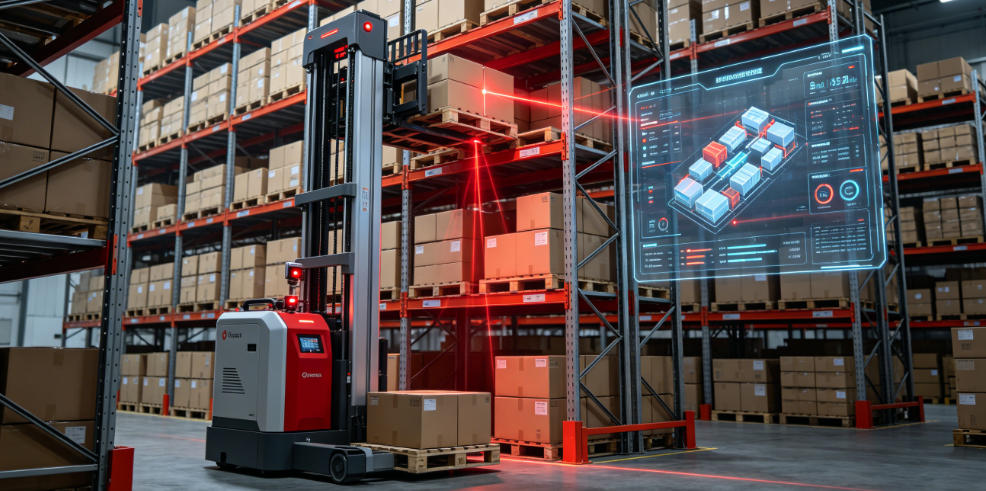
In smart warehouses, warehouse automation is developing rapidly. Automated transport robots, intelligent forklifts, and logistics robots require sensors to identify cargo locations and spatial information. Long range laser distance sensors help robots detect aisle distances, locate storage positions, and improve warehouse transportation efficiency.
In manufacturing production lines, laser distance sensors are also widely used for quality inspection and automated control. In industries such as automotive manufacturing, electronics production, and precision machining, sensors can monitor component dimensions, position changes, and assembly conditions in real time, improving production quality and reducing manual inspection errors.
Why Are Laser Distance Sensors Important for Smart Manufacturing?
Smart manufacturing requires not only automated operation but also intelligent perception and decision-making capabilities. As an important data source for Industrial Internet of Things (IIoT) systems, laser distance sensors continuously provide accurate distance information, helping factories achieve higher levels of automation.
By combining AI algorithms, machine vision, and industrial control systems, modern laser sensors support smarter production processes. For example, in automated assembly lines, robots can adjust their operating positions based on laser measurement data. In smart warehouses, logistics robots can optimize transportation routes according to real-time environmental changes.
Compared with traditional sensors, industrial laser distance sensors offer higher reliability and stronger adaptability, making them suitable for long-term operation in complex industrial environments. This is why more companies are adopting laser measurement technology as part of their smart factory development strategies.

Key Benefits of Using Laser Distance Sensors
Choosing the right industrial laser distance sensor can provide companies with multiple advantages. First, high-precision measurement improves the accuracy of automated equipment and reduces production errors. Second, fast response capabilities enhance the efficiency of robots and industrial machines. In addition, non-contact measurement reduces equipment wear and allows operation in high-speed, high-temperature, and hazardous environments.
The main benefits include:
-
High-precision distance measurement
-
Fast real-time data feedback
-
Long-range detection capability
-
Non-contact measurement
-
Stable and reliable operation
-
Support for robotic automation
-
Improved production efficiency
-
Reduced manual inspection costs
These advantages make laser distance sensors an essential technology for industrial automation, robotics, logistics, and smart manufacturing.
How to Choose the Right Laser Distance Sensor for Industrial Applications?
When selecting a laser distance sensor, companies need to evaluate their specific application requirements. First, the required measurement range should be considered. Short-distance inspection tasks may benefit from laser triangulation sensors, while robot navigation and warehouse logistics applications often require long range laser distance sensors.
Other important factors include measurement accuracy, response speed, environmental adaptability, and communication compatibility. For robotic applications, sensor size, weight, and software integration capabilities are also important considerations.
In challenging industrial environments, protection ratings, interference resistance, and long-term stability are key factors that determine sensor performance.
Future Trends of Laser Distance Sensors in Automation and Robotics
With continuous advancements in artificial intelligence, robotics, and smart manufacturing, laser distance sensors will play an even more important role in future industrial automation.
Future development trends include:
-
Smaller and more compact industrial sensors
-
Higher measurement accuracy
-
Longer detection ranges
-
AI-powered data processing
-
Integration with robotic vision systems
-
Support for real-time smart factory data management
Especially in AMR robots, unmanned warehouses, autonomous equipment, and industrial robotics, laser distance sensors will continue to be a critical sensing technology for improving automation capabilities.
Synexens Industrial Outdoor 4m TOF Sensor Depth 3D Camera Rangefinder_CS40

Conclusion: Why Laser Distance Sensors Are Essential for Industrial Automation
As industrial automation and robotics technology continue to evolve, accurate and reliable distance detection has become a fundamental requirement for modern manufacturing systems. Laser distance sensors are driving innovation in industrial automation, smart logistics, and robotics applications through their high accuracy, fast response, non-contact measurement, and excellent environmental adaptability.
Whether used in smart factories, AGV/AMR robots, automated production lines, or warehouse logistics systems, laser distance sensors for industrial automation help companies improve efficiency, reduce costs, and achieve smarter production processes.
In the future, as AI, machine vision, and robotics technologies continue to merge, laser distance sensors will remain one of the core sensing technologies supporting Industry 4.0 and the development of intelligent manufacturing.
