

Autonomous Mobile Robots in Manufacturing: Top 10 AMR Applications
- von LidarSensor
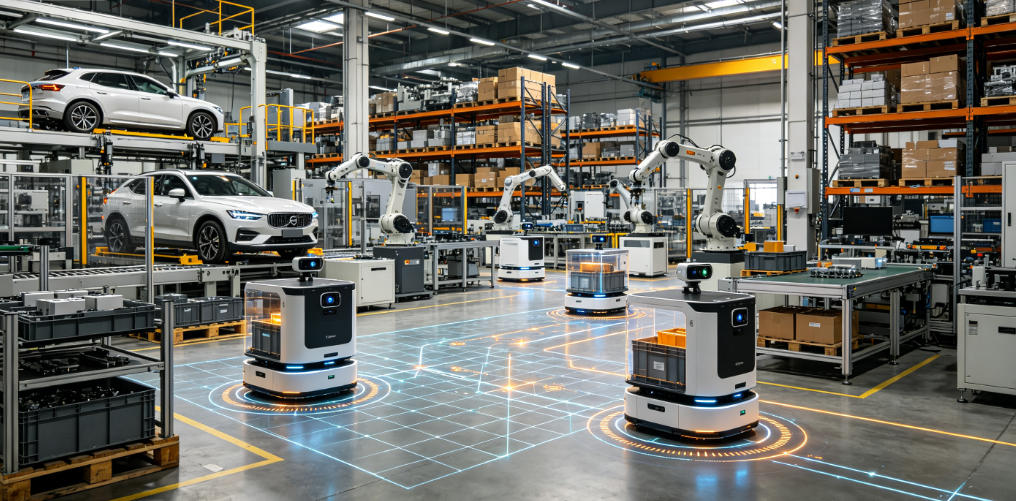
How Are Autonomous Mobile Robots Transforming Modern Manufacturing?
With the rapid development of Industry 4.0, Artificial Intelligence (AI), Internet of Things (IoT), and smart manufacturing technologies, global manufacturing companies are accelerating their automation transformation. During this process, Autonomous Mobile Robots (AMRs) have become a key technology for improving production efficiency, optimizing factory logistics, and promoting smart factory development.
Compared with traditional Automated Guided Vehicles (AGVs), the new generation of robots móviles autónomos offers stronger environmental perception, autonomous navigation, and intelligent decision-making capabilities. By utilizing SLAM navigation technology, LiDAR (Light Detection and Ranging), 3D vision sensors, and AI algorithms, AMR robots can achieve precise movement and task execution in complex industrial environments.
Today, more and more manufacturing companies are adopting AMR robots to perform tasks such as material transportation, warehouse management, production line delivery, quality inspection, and human-robot collaboration. By connecting with Manufacturing Execution Systems (MES), Warehouse Management Systems (WMS), and Industrial Internet of Things (IIoT) platforms, autonomous mobile robots are becoming essential infrastructure for smart factories, helping enterprises achieve more efficient, flexible, and intelligent production models.
What Are Autonomous Mobile Robots (Robots móviles autónomos)?
Autonomous Mobile Robots (AMRs) are advanced robotic systems equipped with autonomous perception, positioning, navigation, and intelligent decision-making capabilities. They can independently perform transportation, material handling, inspection, and task execution without relying on fixed tracks, magnetic strips, QR codes, or manual remote control.
As an important component of smart manufacturing and industrial automation, robots móviles autónomos are being widely used in smart factories, automated warehouses, logistics centers, automotive manufacturing, electronics production, and medical equipment manufacturing.
Unlike traditional industrial robots that mainly perform repetitive operations at fixed positions, the biggest advantage of AMR robots is their ability to provide 'mobile intelligence.' They can integrate multiple advanced sensing technologies, including:
- LiDAR sensors (Light Detection and Ranging)
- ToF depth sensors
- RGB-D cameras
- Industrial vision systems
- Ultrasonic sensors
- Inertial Measurement Units (IMU)
These sensors enable robots to collect real-time environmental information and use artificial intelligence algorithms to understand surroundings and make intelligent decisions.
During operation, autonomous mobile robots can create maps of factory environments through SLAM (Simultaneous Localization and Mapping) technology while accurately determining their own positions.
When encountering moving workers, forklifts, production equipment, or temporary obstacles, AMR robots can quickly analyze environmental changes and re-plan optimal paths, achieving safe and efficient autonomous movement.
This capability allows AMR robots to adapt to complex and changing industrial environments without requiring large-scale modifications to existing factory infrastructure.

From a technical architecture perspective, modern robots móviles autónomos are usually composed of multiple core modules, including:
- Robotic mobile platforms
- Navigation control systems
- Sensor fusion systems
- Artificial intelligence algorithms
- Task scheduling software
Among these components, the navigation system is responsible for path planning and positioning, while vision and sensing systems provide environmental perception. The AI control system uses real-time data to optimize task execution.
For example, in a smart warehouse, AMR robots can automatically identify shelf locations, plan transportation routes based on order requirements, and accurately deliver goods to designated areas.
Compared with traditional AGVs (Automated Guided Vehicles), the greatest advantages of autonomous mobile robots are flexibility and intelligence.
Traditional AGVs usually depend on magnetic strips, tracks, QR codes, or predefined routes. When factory layouts change, companies need to modify the infrastructure or redesign routes.
However, AMR robots do not rely on fixed paths. They can use real-time mapping and intelligent algorithms to independently plan routes. Even in dynamic environments involving human movement, equipment changes, and production area adjustments, AMRs can quickly adapt.
In addition, AMR robots support multi-robot collaboration and intelligent scheduling.
Through centralized management systems, multiple robots can operate simultaneously and automatically assign tasks based on:
- Task priority
- Distance
- Load status
- Traffic conditions
This helps prevent route conflicts and improves overall logistics efficiency.
Therefore, robots móviles autónomos are not only transportation devices but also important nodes connecting smart manufacturing systems, warehouse management systems, and industrial data platforms.
With the continuous development of artificial intelligence, robotic vision, 3D sensing technologies, and industrial IoT, the application scope of AMR robots is expanding rapidly.
In the future, autonomous mobile robots will further integrate AI foundation models, digital twins, edge computing, and intelligent control technologies to achieve more autonomous and intelligent industrial applications.
As a result, AMR has become one of the most important technologies driving manufacturing companies toward Industry 4.0, smart factory development, and flexible production.
Why Do Manufacturing Companies Need Autonomous Mobile Robots?
Modern manufacturing industries are facing multiple challenges, including:
- Rising labor costs
- Increasing demands for production efficiency
- Growing customized order requirements
- More complex supply chains
Traditional manual material handling methods are not only limited in efficiency but are also greatly affected by workforce availability and working conditions.
By deploying Autonomous Mobile Robots (AMRs), companies can achieve automated logistics transportation around the clock, reduce manual handling workloads, and improve production continuity.
At the same time, robots can optimize transportation routes through intelligent scheduling systems, reduce waiting times, and improve overall factory operational efficiency.
In addition, AMR robots offer excellent scalability. Companies can increase the number of robots according to production requirements without major modifications to factory infrastructure.
This makes AMR one of the most important solutions for achieving smart manufacturing transformation and industrial automation upgrades.
Top 10 Applications of Autonomous Mobile Robots in Manufacturing
1. Smart Factory Internal Logistics Transportation
In modern manufacturing facilities, material transportation takes up a significant amount of production time. Traditional methods usually rely on manual forklifts or fixed conveyor systems. However, AMR robots can achieve automated material handling, transporting raw materials, components, semi-finished products, and finished goods to designated locations automatically.
By integrating with warehouse systems and production management software, robots can automatically receive transportation tasks based on production requirements and calculate the optimal routes, significantly improving internal factory logistics efficiency.
For industries such as automotive manufacturing, electronics production, and mechanical processing, autonomous mobile robots have become an essential part of smart factory logistics automation.
2. Automated Warehouse Management
With the rapid growth of e-commerce and smart manufacturing, the demand for intelligent warehouse solutions continues to increase.
AMR warehouse robots can perform tasks such as goods transportation, order picking, and inventory management in warehouse environments, greatly improving operational efficiency.
Compared with traditional manual operations, robots can work continuously and optimize transportation routes through intelligent algorithms, reducing unnecessary warehouse movement and improving space utilization.
When integrated with Warehouse Management Systems (WMS), AMR robots can achieve automated workflows from order generation to product delivery, creating a fully connected intelligent warehouse process.
3. Production Line Material Delivery
Manufacturing companies need a continuous supply of components and materials to production lines.
By deploying robots móviles autónomos, enterprises can establish automated line-side logistics systems.
AMR robots can deliver required materials to different workstations according to production schedules, preventing production interruptions caused by material shortages.
At the same time, robots can support high-mix, low-volume manufacturing models, improving production flexibility and enabling manufacturers to respond more efficiently to changing market demands.
4. Applications in Automotive Manufacturing
Automotive manufacturing is one of the industries where AMR robots are most widely adopted.
Modern automotive factories need to transport large quantities of components, including:
- Engine assemblies
- Battery modules
- Vehicle body parts
- Electronic components
Autonomous mobile robots help automotive manufacturers achieve automated parts delivery, production line integration, and intelligent logistics management.
Especially in the production of new energy vehicles (NEVs), AMR robots can improve safety and efficiency during battery manufacturing, assembly, and material transportation processes.
With the increasing complexity of automotive production, flexible AMR-based logistics systems are becoming a critical technology for future smart automotive factories.
5. Electronics and Semiconductor Manufacturing
The electronics manufacturing industry requires extremely stable production environments and highly accurate material transportation.
Products such as:
- Semiconductor chips
- Printed Circuit Boards (PCBs)
- Electronic components
usually require protection from contamination, vibration, and physical damage during transportation.
By combining 3D vision sensors, ToF cameras, and high-precision navigation systems, AMR robots can perform precise material transportation tasks in electronics factories, improving production reliability and manufacturing accuracy.
In semiconductor environments, AMRs can also help reduce unnecessary human contact, supporting cleaner and more controlled manufacturing processes.
6. Medical Equipment and Precision Manufacturing
Medical equipment manufacturing often involves high-value and high-precision components, requiring strict production conditions.
AMR robots can be used for:
- Cleanroom logistics
- Precision component transportation
- Production area material delivery
- Internal factory distribution
By reducing direct human involvement in certain processes, AMR robots help improve manufacturing consistency, production stability, and operational safety.
For medical device manufacturers, autonomous logistics systems provide an effective solution for maintaining high-quality production standards while improving efficiency.
7. Quality Inspection and Intelligent Industrial Inspection
With the development of AI vision technology, AMR robots are evolving beyond simple transportation functions and becoming intelligent inspection platforms.
By integrating:
- Industrial cameras
- 3D cameras
- AI vision algorithms
- Advanced sensing systems
AMR robots can perform:
- Automated factory inspections
- Equipment condition monitoring
- Product quality inspection
- Production environment analysis
These capabilities help manufacturers improve quality control processes, detect potential problems earlier, and reduce the risk of production failures.
In the future, AI-powered AMR inspection robots will play an increasingly important role in predictive maintenance and intelligent manufacturing management.
8. Automated Operations in Hazardous Environments
Some industrial environments involve risks such as:
- High temperatures
- Toxic gases
- Dangerous operating areas
- Heavy industrial conditions
These environments may not be suitable for long-term human operation.
Autonomous mobile robots can replace workers in hazardous areas to perform tasks such as material transportation, environmental monitoring, and equipment inspection, improving industrial safety.
By reducing human exposure to dangerous conditions, AMR robots help companies create safer workplaces while maintaining operational efficiency.
Industries such as chemical manufacturing, energy production, and heavy industry can benefit significantly from robotic automation solutions.

9. Integration with Digital Twins and Smart Factories
Future smart manufacturing will increasingly rely on digital twin technology.
AMR robots can serve as intelligent data collection terminals within smart factories, connecting with:
- IoT devices
- Cloud platforms
- Digital twin systems
- Industrial data platforms
Operational data collected by robots can help companies analyze:
- Logistics efficiency
- Production workflows
- Equipment utilization
- Factory layout optimization
Through digital twin integration, manufacturers can simulate factory operations, identify bottlenecks, and optimize production processes before making physical changes.
This creates a more intelligent, data-driven approach to factory management.
10. Human-Robot Collaborative Manufacturing
The future of manufacturing is not about completely replacing humans but about using robots to enhance human capabilities.
In collaborative manufacturing environments:
- AMR robots handle repetitive, physically demanding transportation tasks
- Human workers focus on complex operations, decision-making, and technical processes
Through human-robot collaboration, companies can achieve:
- Higher productivity
- Improved workplace safety
- Reduced physical workload
- More flexible production systems
AMR robots provide manufacturers with a balanced automation approach where humans and machines work together efficiently.
Future Development Trends of Autonomous Mobile Robots
With the rapid advancement of Artificial Intelligence (AI), robotic vision, smart sensors, edge computing, and industrial automation technologies, robots móviles autónomos (Autonomous Mobile Robots) will play an increasingly important role in future manufacturing.
Future AMR robots will no longer be limited to simple material transportation tasks. Instead, they will gradually evolve into intelligent manufacturing platforms with capabilities including:
- Environmental perception
- Autonomous learning
- Intelligent decision-making
- Task optimization
By integrating AI algorithms, big data analytics, and real-time data processing technologies, robots will be able to automatically adjust their tasks according to:
- Production schedules
- Equipment conditions
- Logistics requirements
This will help companies improve production efficiency and build more flexible, intelligent, and adaptive smart factory systems.
Future AI-driven autonomous decision-making capabilities and multi-robot collaboration technologies will become key development directions for AMR systems.
The next generation of robots móviles autónomos will use machine learning technologies to continuously optimize operational strategies. Based on changes in factory environments, order priorities, and transportation requirements, AMR robots will automatically calculate the most efficient routes and improve overall task execution performance.
At the same time, multiple AMR robots will be able to share information and collaborate through intelligent scheduling systems. In large warehouses, automotive manufacturing plants, and smart production lines, fleets of robots can work together to complete complex logistics tasks, significantly improving transportation efficiency and reducing operational bottlenecks.
With continuous improvements in LiDAR sensors, ToF depth sensors, RGB-D Cameras, 3D vision systems, and AI vision algorithms, AMR robots will achieve more accurate spatial perception capabilities.
Future AMR systems will be able to quickly recognize:
- Workers
- Industrial equipment
- Materials
- Vehicles
- Dynamic obstacles
and safely navigate through complex industrial environments with greater stability and reliability.
Advanced sensor fusion technologies will enable robots to understand surrounding environments more comprehensively, making them suitable for increasingly complex manufacturing scenarios.
At the same time, future AMR robots will become deeply integrated into the smart manufacturing ecosystem.
By connecting with:
- MES (Manufacturing Execution Systems)
- ERP (Enterprise Resource Planning Systems)
- WMS (Warehouse Management Systems)
- Industrial Internet of Things (IIoT) platforms
AMR systems will enable seamless integration between production, logistics, and data management.
This integration will allow manufacturers to achieve:
- Real-time production monitoring
- Intelligent logistics scheduling
- Automated workflow optimization
- Data-driven operational decisions
Through the combination of AMR robots and digital manufacturing platforms, factories will become more transparent, connected, and intelligent.
Combined with Digital Twin technology, enterprises will be able to monitor AMR robot operations in real time, analyze transportation routes, evaluate production efficiency, and optimize factory layouts and operational processes through data-driven insights.
Digital twins can create virtual representations of physical factories, allowing manufacturers to simulate different production scenarios, identify potential problems, and improve decision-making before implementing changes in real-world environments.
This will further accelerate the development of intelligent and flexible manufacturing systems.
Meanwhile, human-robot collaboration will become another major trend in the future development of AMR technology.
Instead of replacing human workers completely, AMR robots will work alongside employees by taking over:
- Repetitive tasks
- Heavy transportation work
- Dangerous operations
while human workers focus on:
- Production management
- Technical operations
- Creative problem-solving
- Complex decision-making
This collaborative approach will create safer, more efficient, and more flexible manufacturing environments.
As Industry 4.0 continues to advance, Autonomous Mobile Robots (AMRs) will become one of the most important infrastructures for smart factories.
By combining:
- Artificial intelligence
- Intelligent sensors
- Robotics technology
- Industrial IoT
- Digital twins
- Advanced automation systems
AMR robots will continue to drive manufacturing companies toward:
- Higher intelligence
- Greater flexibility
- Improved efficiency
- Stronger competitiveness
and accelerate the global transformation toward digital and intelligent manufacturing.
Synexens 3D Camera Of ToF Sensor Soild-State Lidar_CS20

Conclusion: Robots móviles autónomos Are Transforming the Future of Manufacturing
From smart warehouses to automated production lines, from automotive manufacturing to electronics industries, Autonomous Mobile Robots (AMRs) are becoming one of the most important technologies driving the future of smart manufacturing.
By combining advanced technologies such as:
- SLAM navigation
- AI vision
- LiDAR sensors
- 3D sensing technology
- Intelligent scheduling systems
robots móviles autónomos can help enterprises improve production efficiency, reduce operational costs, and achieve more flexible industrial automation.
As global manufacturing continues to move toward intelligence and digital transformation, AMR robots will play an increasingly critical role in:
- Smart factories
- Industrial logistics
- Automated production systems
- Flexible manufacturing environments
For manufacturers seeking to improve competitiveness, deploying Autonomous Mobile Robots has become an important step toward achieving Industry 4.0 transformation.
