

ToF Smart Elderly Care and Fall Detection for Safer Remote Monitoring
- Posted by TofSensor
How Can ToF Technology Enable Fall Detection and Smart Remote Elderly Care?
With the global acceleration of aging populations, the demand for remote monitoring of the elderly and fall warning systems continues to rise. Traditional manual caregiving methods have blind spots and cannot provide 24/7 continuous monitoring. By integrating TOF (Time-of-Flight) depth sensing technology into intelligent care systems, it is possible to achieve non-contact monitoring, accurate fall detection, and automatic alerts, providing elderly individuals with a safe, smart, and reliable care experience, while promoting the development of a smart elderly care ecosystem.
1. Background: Aging Society and Increasing Care Needs
The elderly population is growing annually, with rising rates of chronic diseases, frequent falls, and an increasing number of people living alone. This makes remote health monitoring and safety alerts an urgent need. Traditional caregiving methods relying on manual checks or call buttons face several limitations:
-
Limited monitoring coverage, unable to provide round-the-clock supervision
-
Slow response to fall events, delaying emergency assistance
-
Incomplete data collection, making it difficult to analyze health trends
Therefore, the application of ToF smart fall detection sensors and non-contact health monitoring systems provides a new solution for families and care institutions, enabling remote, real-time, and accurate safety management of the elderly.
What is a ToF time of flight sensor?
A ToF (Time-of-Flight) sensor calculates the distance to an object by measuring the time it takes for light or another signal to travel from the sensor to the target and back. Its core principle: the sensor emits light pulses or infrared signals, which reflect off the object and return; by calculating the round-trip time of the light, the precise distance between the sensor and the object can be determined.
Key features include:
-
High-precision distance measurement: Capable of millimeter or even micrometer-level accuracy.
-
Non-contact measurement: Measures distance and depth without physical contact.
-
Fast response: Achieves millisecond-level measurement, suitable for dynamic scenarios.
-
3D depth perception: Can generate 3D depth maps for environment sensing, obstacle detection, or posture recognition.
Applications are extensive, including robot navigation, unmanned gas station vehicle recognition, elderly fall detection, and smart home gesture recognition—typical examples of using ToF sensors for spatial awareness and real-time monitoring.

2. The Key Role of ToF in Elderly Care — Innovative Non-Contact Monitoring and Smart Alerts
With global aging accelerating, elderly care and health management have become a societal focus. Traditional caregiving relies on manual inspections or wearable devices, which have limitations such as high labor intensity, long monitoring intervals, and discomfort. ToF (Time-of-Flight) depth sensing technology–based smart elderly care solutions are revolutionizing caregiving by providing non-contact, all-weather, intelligent health management.
1. Non-Contact Health Monitoring — Around-the-Clock Protection
ToF depth sensing modules can continuously capture the elderly’s spatial posture, motion trajectories, and activity patterns without the need for wearable devices or physical contact. By installing ToF sensors in bedrooms, living rooms, hallways, or activity areas, the system can monitor sitting, standing, walking, stretching, and other daily activities, generating health data curves to provide caregivers with quantifiable references.
Compared with traditional infrared detectors or cameras, ToF technology offers notable advantages:
-
High-precision motion capture: Detects subtle movements such as hand tremors or posture adjustments, providing detailed data for health assessment.
-
Privacy protection: Only collects depth information, avoiding capturing personal images and reducing privacy concerns.
-
Stable all-weather monitoring: Resistant to changes in lighting, it works reliably day or night, even in complex indoor light environments.
This non-contact monitoring method allows caregivers to understand activity status without frequent checks, providing reliable data for early interventions and personalized care.
2. Fall Detection and Smart Alerts — Enhancing Safety for the Elderly
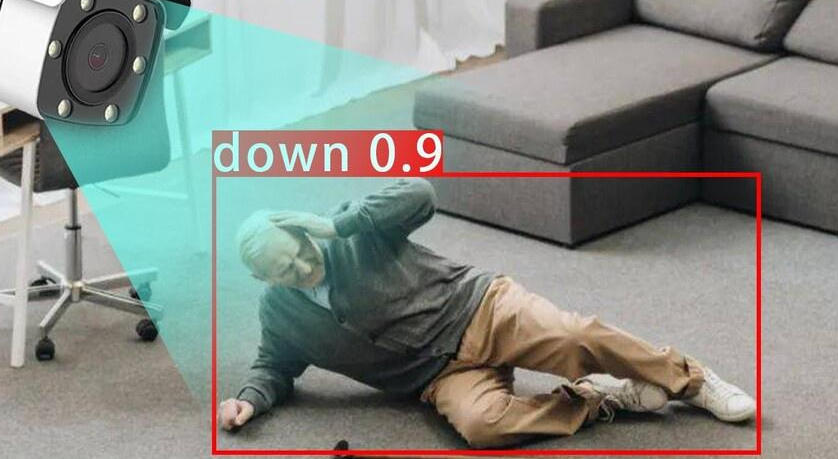
Falls are one of the most common and dangerous accidents among the elderly, making timely detection and intervention critical. By combining ToF depth sensors with AI motion analysis algorithms, the system can generate 3D human posture models in real-time, accurately determine activity states, and quickly identify fall events.
Key functional applications include:
-
Fall motion recognition: Analyzes fall angle, speed, and posture to distinguish between actual falls and everyday actions like sitting or lying down, reducing false alarms.
-
Multi-point depth data fusion: Collects 3D point clouds from multiple ToF sensors to improve posture analysis accuracy, ensuring reliable detection even in complex environments.
-
Immediate alerts: Once a fall occurs, the system instantly notifies caregivers, family members, or remote monitoring platforms, supporting rapid response and assistance.
This real-time fall detection and smart alert system significantly reduces accident risks while providing elderly individuals and their families with a greater sense of security.
3. Smart Alerts and Remote Management — Building a Closed-Loop Care System
Using the health and motion data collected by ToF modules, the system can implement smart alerts and remote management, forming a complete closed-loop care system:
-
Real-time notifications: Falls, abnormal behaviors, or prolonged inactivity events can be instantly pushed to smartphones, tablets, or caregiver dashboards, ensuring rapid response.
-
Cloud data recording: Activity trajectories, fall events, daily behavior patterns, and health data are continuously stored in the cloud to support health analysis, risk assessment, and medical decision-making.
-
Remote collaborative management: Integration with medical services, emergency response, or elderly care institution systems enables automatic task dispatch, remote intervention, and allocation of emergency resources, optimizing caregiving efficiency.
Smart alerts and remote management allow caregivers to reduce the need for frequent manual checks while ensuring timely and safe care for the elderly.

4. Advantages of ToF-Based Elderly Care Systems
-
Non-contact monitoring for comfort and safety: No need for wearable devices, minimizing discomfort for elderly users.
-
All-weather and highly stable: Operates reliably under various lighting, environmental, and time conditions.
-
High-precision motion capture: Detects subtle movement changes, providing reliable data for health analysis.
-
Timely fall warnings: Integrated with AI analysis to deliver real-time alerts with low false alarm rates.
-
Remote management and data closure: Supports cloud recording, remote notifications, and medical integration, optimizing caregiving resources.
5. Future Outlook: ToF + AI + IoT for Smart Elderly Care
In the future, with the integration of ToF modules, AI algorithms, and IoT platforms, smart elderly care systems will become more intelligent and personalized. ToF sensors can work alongside wearable devices, health monitoring instruments, and smart home devices to achieve:
-
Automatic health data collection and analysis
-
Prediction of abnormal behaviors and proactive interventions
-
Remote medical and caregiving coordination
-
Personalized health assessments and lifestyle guidance
This ToF + AI + IoT smart elderly care model not only improves safety and quality of life for elderly individuals but also provides institutions with efficient management tools, promoting the digitalization and intelligence of both home-based and institutional care.
6. Technical Challenges: Precision, False Alarms, and Low Power Consumption
Although ToF technology holds great potential in elderly care, its practical application faces several challenges:
-
High measurement precision requirements: Subtle elderly movements require sensors to capture even minor changes to ensure accurate fall detection.
-
False alarm control: Daily actions such as sitting, lying down, or bending may be mistakenly classified as falls, requiring AI algorithms to optimize detection logic.
-
Low power consumption and long-term stability: ToF modules must operate 24/7 indoors, making low-power design and interference resistance key performance indicators.
Addressing these challenges requires manufacturers to optimize algorithms, sensor placement, hardware selection, and system integration, ensuring the reliability and practicality of elderly care systems.

7. Optimization Recommendations for Medical and Care Equipment Manufacturers
To fully leverage ToF in smart elderly care, manufacturers can focus on:
-
Selecting high-precision, low-power ToF sensors: Ensures accurate and stable monitoring of elderly movements and fall detection.
-
Integrating AI algorithms for recognition optimization: Uses deep learning to analyze human posture, reduce false alarms, and improve alert reliability.
-
System integration and IoT platform connectivity: Uploads ToF data to the cloud for remote monitoring, data recording, and health trend analysis.
-
Multi-scenario testing and optimization: Conducts real-world tests in bedrooms, hallways, and bathrooms to optimize sensor placement and algorithm parameters.
These measures enhance elderly safety while providing families and institutions with higher operational efficiency and service quality.
8. Future Outlook: Building a Smart Elderly Care Ecosystem with ToF + AI + IoT
In the future, with deep integration of AI algorithms, IoT platforms, and ToF technology, elderly care will enter a fully automated, intelligent era. ToF sensors can not only detect falls and provide non-contact monitoring but also work with AI to analyze health data, enabling:
-
Intelligent health monitoring and behavior analysis
-
Automatic alerts and remote handling of abnormal events
-
Data-driven personalized care plans
-
Integration with smart medical services and home IoT devices to create a complete elderly care ecosystem
Through a ToF + AI + IoT smart elderly care system, elderly individuals gain a safer and more comfortable living environment, while caregivers improve efficiency, achieving coordinated care across homes, communities, and institutions.
Conclusion
ToF technology plays a core role in elderly care and fall detection, providing non-contact health monitoring, accurate fall detection, and smart alerts, delivering reliable technical support for smart elderly care. Combined with AI and IoT platforms, ToF enhances safety and detection accuracy, optimizes caregiving workflows, and lays a solid foundation for the future construction of intelligent elderly care ecosystems.
Synexens 3D Of RGBD ToF Depth Sensor_CS30

Our professional technical team specializing in 3D camera ranging is ready to assist you at any time. Whether you encounter any issues with your TOF camera after purchase or need clarification on TOF technology, feel free to contact us anytime. We are committed to providing high-quality technical after-sales service and user experience, ensuring your peace of mind in both shopping and using our products.
