

Laser Distance Sensors for Industrial Automation and Robotics
How Do Laser Distance Sensors Improve Industrial Automation and Robotics?
With the rapid development of Industry 4.0, smart manufacturing, artificial intelligence (AI), and industrial robotics, accurate and reliable sensing technology has become essential for modern automation systems.
Among various industrial sensing solutions, laser distance sensors have become one of the most important technologies for precise measurement, object detection, robot navigation, and automated control.
A laser distance sensor, also known as a laser measurement sensor or industrial laser sensor, uses laser technology to measure the distance between the sensor and a target object without physical contact. With advantages such as high accuracy, fast response, long measurement range, and excellent reliability, laser distance sensors are widely used in manufacturing, logistics, robotics, automotive production, and intelligent factories.
From AGV navigation and AMR positioning to robotic arms and automated inspection systems, laser distance measurement technology is helping industries achieve higher efficiency, improved safety, and smarter production processes.
This article explores how laser distance sensors work, their key advantages, and their applications in industrial automation and robotics.
What Is a Laser Distance Sensor?
A laser distance sensor is a non-contact measurement device that uses laser light to determine the distance between the sensor and an object.
Unlike traditional contact measurement tools, laser sensors can detect distance without touching the target surface. This allows them to measure moving objects, fragile materials, and complex industrial components with high precision.
A typical laser distance sensor works by:
- Emitting a laser beam toward the target object.
- Receiving the reflected laser signal.
- Calculating the distance based on the returned signal.
Depending on the technology used, laser distance sensors can operate through different measurement principles, including:
- Time of Flight (TOF)
- Phase shift measurement
- Laser triangulation
- LiDAR technology
Each technology provides different advantages depending on measurement range, accuracy requirements, and application environments.
How Does a Laser Distance Sensor Work?
Understanding how a laser distance sensor works helps explain why it has become an essential component in automation systems.
1. Laser Emission
The sensor generates a focused laser beam and projects it toward an object.
The laser travels through the environment until it reaches the target surface.
2. Signal Reflection
When the laser reaches the object, part of the light reflects back to the sensor receiver.
The reflected signal contains distance information that can be analyzed by the internal processing system.

3. Distance Calculation
The sensor calculates the distance based on:
- Laser travel time
- Phase difference
- Reflection position
Advanced industrial laser sensors can process measurement data in real time and provide accurate feedback for automated equipment.
Why Are Laser Distance Sensors Important for Industrial Automation?
Modern factories require faster production, higher accuracy, and improved operational efficiency.
A laser distance sensor for industrial automation provides several important advantages.
High Precision Distance Measurement
One of the biggest advantages of laser measurement technology is its excellent accuracy.
High precision laser distance sensors can detect small position changes and provide reliable measurement data for:
- Robotic systems
- Production equipment
- Automated inspection
- Machine positioning
This helps manufacturers improve product quality and reduce production errors.
Non-Contact Measurement
Traditional measurement methods often require physical contact, which may cause:
- Surface damage
- Mechanical wear
- Measurement limitations
A non-contact laser distance sensor eliminates these problems.
It can measure:
- Moving objects
- Hot materials
- Fragile products
- Hard-to-reach areas
This makes laser sensors ideal for automated manufacturing environments.
Fast Response Speed
Industrial automation systems require real-time data.
Laser distance sensors can provide rapid measurements, enabling:
- Faster robot movement
- Accurate positioning
- Real-time process control
- Improved production efficiency
Long Measurement Range
Compared with many traditional sensors, laser distance sensors can achieve longer measurement ranges.
They are suitable for:
- Large machinery
- Warehouse systems
- Outdoor equipment
- Industrial transportation
Applications of Laser Distance Sensors in Industrial Automation
1. Robotics and Robot Navigation
Robots require accurate environmental perception to operate safely and efficiently.
A laser sensor for robots provides distance information for:
- Object detection
- Collision avoidance
- Position adjustment
- Path planning
In robotic arms, laser distance sensors help determine the exact position of components during assembly and manufacturing.
2. AGV and AMR Navigation
Autonomous mobile robots (AMR) and automated guided vehicles (AGV) are widely used in smart factories and warehouses.
A laser distance sensor acts as an important navigation component by providing:
- Obstacle detection
- Environmental mapping
- Position correction
- Route optimization
Combined with SLAM technology, laser sensors enable robots to move autonomously in complex environments.
3. Smart Manufacturing Systems
In intelligent factories, laser measurement sensors support automated production processes.
Common applications include:
- Product inspection
- Equipment positioning
- Material detection
- Assembly monitoring
By integrating laser sensors with AI and industrial control systems, manufacturers can build more flexible and intelligent production lines.
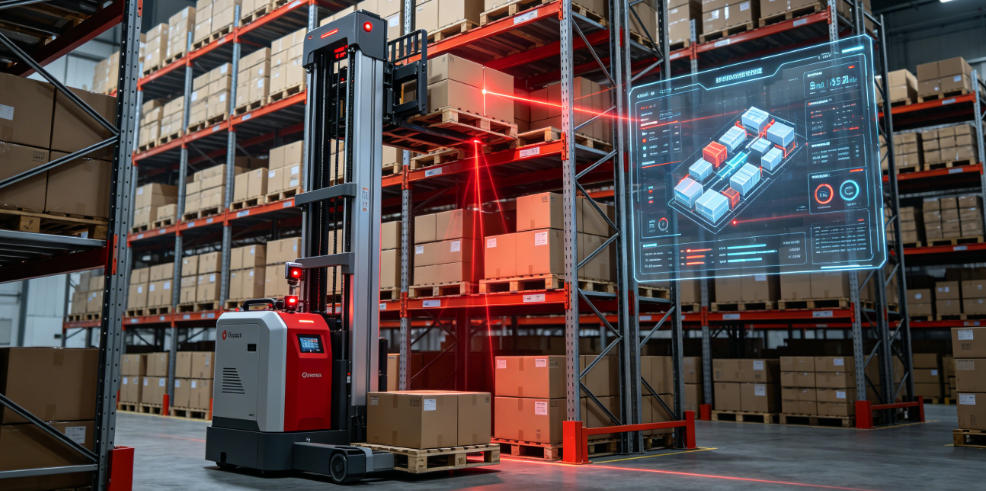
4. Warehouse Automation
Modern warehouses rely on automation technologies to improve logistics efficiency.
Laser distance sensors are used for:
- Package detection
- Pallet positioning
- Storage management
- Robot navigation
They help autonomous warehouse robots operate accurately in dynamic environments.

5. Automotive Manufacturing
The automotive industry requires extremely accurate measurement during production.
Laser distance sensors are used for:
- Body inspection
- Component positioning
- Assembly verification
- Quality control
They help improve manufacturing accuracy and reduce production defects.
Laser Distance Sensor vs Other Industrial Sensors
Different sensors have different advantages depending on application requirements.
| Sensor Type | Advantages | Applications |
|---|---|---|
| Laser Distance Sensor | High accuracy, long range, non-contact | Automation, robotics, measurement |
| Ultrasonic Sensor | Low cost, simple detection | Basic object detection |
| Camera Vision Sensor | Image recognition capability | Inspection and recognition |
| LiDAR Sensor | 3D perception and mapping | Autonomous navigation |
Compared with traditional sensors, laser distance sensors provide a better balance between accuracy, speed, and reliability.
Laser Distance Sensor Technologies for Future Automation
With the development of AI, robotics, and intelligent manufacturing, laser sensing technology continues to evolve.
Future trends include:
AI-Based Laser Measurement
Combining AI algorithms with laser sensors enables:
- Intelligent object recognition
- Automatic inspection
- Predictive maintenance
3D Measurement and LiDAR Integration
Advanced laser sensors are increasingly combined with:
- 3D vision systems
- LiDAR technology
- Digital twin platforms
This allows factories to create accurate digital representations of physical environments.
Multi-Sensor Fusion
Future robots will combine multiple sensing technologies, including:
- Laser sensors
- Cameras
- TOF sensors
- IMU systems
This improves perception accuracy and enables more intelligent automation.
How to Choose the Best Laser Distance Sensor for Industrial Applications?
When selecting an industrial laser sensor, several factors should be considered.
Measurement Range
Choose a sensor according to the required working distance.
Short-range sensors are suitable for precision inspection, while long-range sensors are better for logistics and outdoor applications.
Accuracy Requirements
High precision applications require sensors with:
- Better resolution
- Higher repeatability
- Stable measurement performance
Environmental Conditions
Industrial environments may include:
- Dust
- Vibration
- Temperature changes
- Strong lighting
Choose a sensor designed for your specific operating conditions.
Communication Interface
Industrial laser sensors may support:
- Ethernet
- RS485
- CAN
- Industrial communication protocols
Proper connectivity ensures easy integration with automation systems.
3D Safe Guarding Privacy RGBD Camera Synexens CS30

Conclusion
Laser distance sensors have become a key technology driving the future of industrial automation, robotics, and smart manufacturing.
With advantages including high precision, fast response, long-range detection, and non-contact measurement, laser sensors provide reliable solutions for robot navigation, AGV systems, production automation, and intelligent factories.
As industries continue moving toward greater automation and digital transformation, laser distance measurement technology will play an increasingly important role in creating safer, smarter, and more efficient industrial systems.
