

RGBD Cameras in Industrial Robots : Applications & Benefits
What is an RGBD Camera and How Does It Improve Industrial Robots and Smart Factory Efficiency?
With the rapid development of smart manufacturing, industrial automation, and robotics technologies, the RGBD camera has become a critical sensing device for industrial robot perception and intelligent production lines. Compared with traditional 2D vision cameras, RGBD cameras can simultaneously capture color information (RGB) and depth information (Depth), enabling accurate 3D spatial perception. They are widely used in robot picking, quality inspection, logistics sorting, and human-robot collaboration scenarios.
What Is an RGBD Camera?
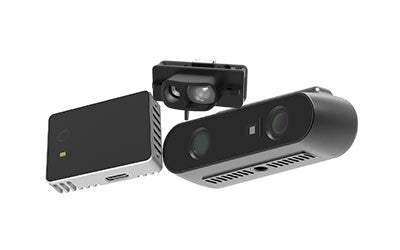
An RGBD camera (Red, Green, Blue + Depth camera) is a 3D vision sensor that integrates both color imaging and depth sensing capabilities. It not only captures high-resolution color images like a standard industrial camera but also simultaneously measures distance information for each pixel, enabling the construction of a complete 3D spatial model.
In smart manufacturing, industrial automation, and robotic vision systems, RGBD cameras are widely used in industrial robot grasping, AGV/AMR navigation, intelligent inspection, 3D measurement, and human-robot safety systems. They are a core enabling technology for allowing machines to 'understand the physical world.'

Key Features of RGBD Cameras
The main advantage of RGBD cameras lies in the integration of 2D vision + 3D perception, including:
- Simultaneous acquisition of color (RGB) and depth (Depth) information
- Real-time generation of dense 3D point cloud data
- 3D spatial modeling and environment reconstruction in complex industrial scenes
- High-precision distance measurement, volume estimation, and shape recognition
- Continuous tracking and recognition of dynamic objects
By combining RGB and depth data, RGBD cameras enable machines to both 'see color' and 'understand spatial structure.'
How Does an RGBD Camera Work?
RGBD cameras typically generate depth information through the following methods:
- Capture RGB images using a color sensor
- Obtain depth data using ToF (Time-of-Flight), structured light, or stereo vision
- Perform pixel-level alignment between RGB and depth data (depth alignment)
- Output unified RGB-D data streams or 3D point clouds
The result is a computable and analyzable digital 3D representation of the real world.
Advantages Over Traditional Cameras
Compared with conventional 2D industrial cameras, RGBD cameras offer significant advantages:
- 2D cameras only provide flat images without distance information
- RGBD cameras provide both spatial position and depth structure
- Ability to understand occlusion relationships
- Accurate measurement of real-world dimensions (L/W/H/volume)
- Better suited for complex industrial automation environments
Therefore, RGBD cameras are rapidly replacing traditional 2D vision systems in industrial robot applications.
Typical Industrial Applications of RGBD Cameras
1. Industrial Robot Grasping and Positioning
RGBD cameras enable high-precision robot positioning and path planning, including:
- Detecting randomly placed components
- Automatically calculating optimal grasp points
- Avoiding collisions and misgrasping
- Improving flexible manufacturing capabilities
2. Intelligent Quality Inspection and 3D Detection
In automated inspection scenarios, RGBD cameras are used for:
- 3D dimensional measurement
- Surface defect detection (scratches, dents, deformation)
- Assembly completeness inspection
- Batch sorting and defect removal
3. AGV/AMR Intelligent Navigation
In mobile robot systems, RGBD cameras provide:
- Real-time 3D environment mapping (3D Mapping / SLAM)
- Dynamic obstacle detection
- Path planning and collision avoidance
- Warehouse logistics optimization and dispatching
4. Human-Robot Collaboration and Safety Monitoring
In collaborative robot environments, RGBD cameras enable:
- Human detection and posture recognition
- Safety zone monitoring (Virtual Safety Fence)
- Intrusion detection in hazardous areas
- Support for Area and Perimeter Robot Safety systems
Core Value of RGBD Cameras
RGBD cameras are not just upgraded imaging devices—they are foundational infrastructure for industrial intelligence. Their core value includes:
- Enabling robots to understand true 3D space
- Improving flexibility and intelligence in production lines
- Reducing manual intervention and increasing efficiency
- Supporting intelligent decision-making in complex environments
- Accelerating Industry 4.0 and smart factory transformation
RGBD cameras combine RGB vision + depth perception, becoming a key sensor in industrial robotics, smart manufacturing, and automated logistics systems. They transform machines from simply 'seeing the world' to truly 'understanding the world.'

Applications of RGBD Cameras in Industrial Robots
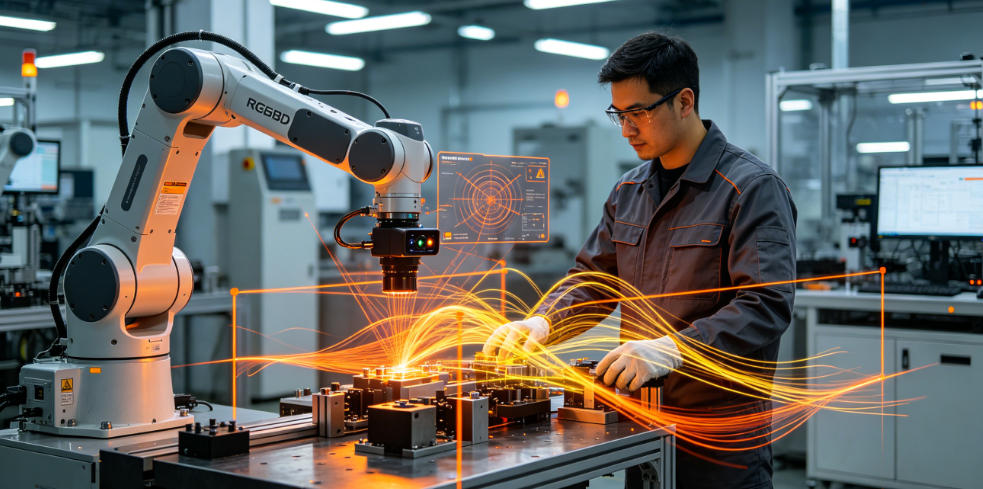
With the rapid development of smart manufacturing and industrial automation, RGBD cameras have become a core sensing component in industrial robot vision systems. By integrating color (RGB) and depth (Depth) information, RGBD cameras enable robots to perceive both 'appearance' and 'spatial structure,' significantly improving perception and decision-making capabilities in complex industrial environments.
In industrial robots, AGVs/AMRs, collaborative robots, and intelligent logistics systems, RGBD cameras are widely used in grasping, inspection, navigation, and safety applications.
1. Precise Grasping and Material Handling
In smart factories, automated warehouses, and flexible production lines, robots must handle objects of various shapes, sizes, and random stacking patterns, which is challenging for traditional 2D vision systems.
With RGBD cameras, robots can:
- Obtain precise 3D position and pose estimation
- Recognize object height, orientation, edges, and occlusion
- Plan optimal grasp paths (Pick Path Planning)
- Avoid collisions between robotic arms and objects
- Handle irregular, stacked, or randomly placed objects
- Improve flexible, multi-product manufacturing capabilities
In logistics systems, RGBD cameras also enable AGVs/AMRs to perform automated picking, handling, and dynamic route adjustment, greatly improving warehouse automation efficiency.
2. Intelligent Quality Inspection and Defect Detection
Traditional inspection systems relying on 2D cameras are limited by lighting conditions, occlusions, and object pose variations, leading to missed or false detections. RGBD cameras significantly improve inspection performance by introducing depth information.
Typical applications include:
- 3D dimensional measurement (L/W/H/volume)
- Surface defect detection (scratches, dents, cracks)
- Assembly completeness inspection
- Product consistency and deviation analysis
- Automated sorting and defect removal
Combined with AI vision algorithms, RGBD cameras enable high-speed inline inspection, improving production efficiency and reducing labor costs.
3. Human-Robot Collaboration and Safety Monitoring
With the rapid growth of Collaborative Robots, shared human-robot workspaces have become a key trend in smart factories, requiring higher safety standards.
RGBD cameras enable intelligent safety mechanisms by perceiving spatial relationships between humans and robots:
- Dynamic 3D safety zones (Virtual Safety Fence)
- Real-time detection of human entry into hazardous areas
- Monitoring body and hand motion trajectories
- Triggering robot slowdown, pause, or emergency stop
- Multi-level safety zones (warning / slowdown / danger zones)
- Improved HRC safety and reliability
Combined with Area and Perimeter Robot Safety technology, RGBD cameras enable a shift from passive protection to proactive sensing and intelligent decision-making.
4. Intelligent Navigation and Mobile Robot Applications
In modern warehouses and smart factories, AGVs/AMRs are responsible for material transportation, automated delivery, and flexible scheduling, requiring accurate perception in complex environments.
RGBD cameras provide powerful 3D perception capabilities:
- Real-time 3D mapping (SLAM)
- Dynamic obstacle detection (humans, forklifts, equipment)
- Complex path planning and collision avoidance
- Narrow corridor and warehouse navigation
- Multi-robot coordination
- Optimized logistics routing and efficiency
Compared with LiDAR, RGBD cameras are more cost-effective and provide richer visual semantic information (color + structure), making them ideal for small-to-medium factories and flexible production environments.
Core Advantages of RGBD Cameras
- High-precision depth sensing (millimeter-level accuracy)
- 3D spatial modeling (point cloud, mesh, voxel)
- Multi-scenario adaptability (lighting, dust, complex backgrounds)
- Easy integration with robots, AGVs/AMRs, and production lines
- Improved production efficiency and reduced error rates
Future Trends
With the evolution of Industry 4.0 and artificial intelligence, RGBD cameras will play an increasingly important role in industrial robots, automated warehouses, smart logistics, collaborative robots, and virtual safety monitoring systems. Key trends include:
- Higher resolution and higher frame rate RGBD cameras
- Deep integration with AI for autonomous learning and optimization
- Integration with cloud platforms and digital twin systems
- Wider adoption in small and medium-sized enterprises due to cost reduction
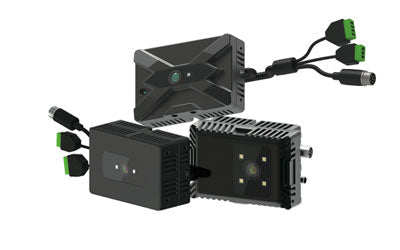
3D Safe Guarding Privacy RGBD Camera Synexens CS30

Conclusion
By integrating RGBD camera technology, enterprises can achieve precise perception and automation control in industrial robotics and smart factories. This improves production efficiency, enhances operational safety, and lays a solid foundation for the future of intelligent manufacturing.
