

Arduino Laser Distance Sensor Guide: Setup, Uses & LiDAR Projects
How Does an Arduino Laser Distance Sensor Work and How Can You Use It?
With the rapid development of robotics, automation, IoT devices, and smart hardware, Arduino laser distance sensor technology has become increasingly popular among engineers, makers, and developers. By combining precise laser measurement technology with the flexible Arduino platform, users can easily build intelligent projects that require accurate distance detection, object positioning, and real-time measurement.
Many developers search for solutions such as laser distance sensor Arduino, Arduino laser sensor module, or Arduino laser range finder when building robotics and automation projects. Compared with traditional ultrasonic sensors and infrared sensors, laser-based distance measurement provides higher accuracy, faster response speed, and stronger resistance to environmental interference.
So, what is an Arduino laser distance sensor? How do you connect a laser distance sensor to Arduino? What projects can you build with an Arduino laser sensor?
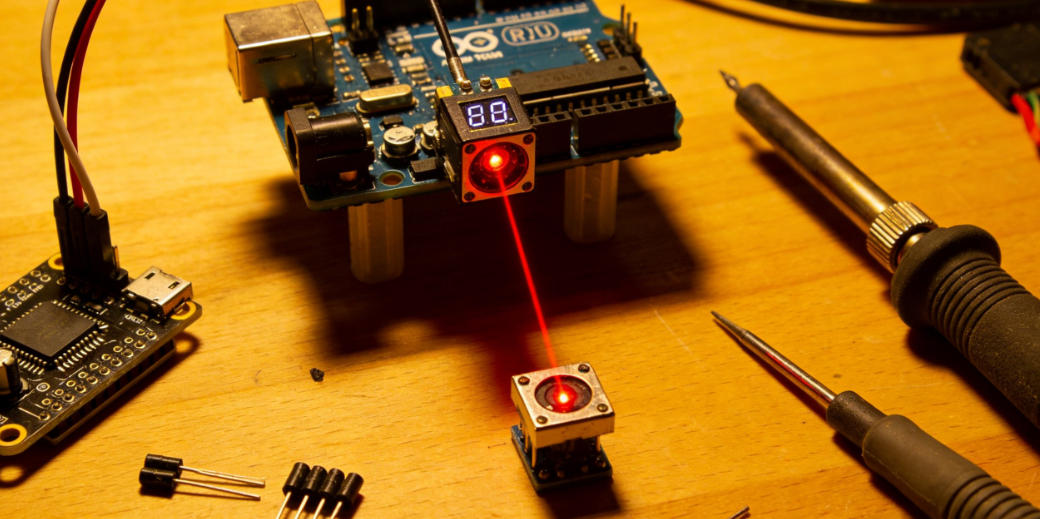
An Arduino laser distance sensor is a sensor module that combines laser ranging technology with an Arduino microcontroller board. The sensor emits a laser beam toward an object, receives the reflected signal, and calculates the distance between the sensor and target through advanced measurement algorithms.
The measured distance data can then be transferred to Arduino boards such as:
- Arduino Uno
- Arduino Nano
- Arduino Mega
- Arduino Leonardo
through communication interfaces including:
- I2C
- UART
- SPI
- Analog output
- Digital trigger signals
This makes Arduino laser distance sensors widely used in:
- Robot obstacle avoidance
- Autonomous mobile robots
- Smart home devices
- Industrial automation prototypes
- Drone altitude measurement
- Warehouse monitoring systems
- DIY maker projects
Unlike simple proximity sensors, a laser distance sensor can provide accurate distance information instead of only detecting whether an object exists.
In short, an Arduino laser distance sensor combines laser measurement technology with easy Arduino integration, making it an ideal solution for developing intelligent sensing systems.
How Does an Arduino Laser Distance Sensor Work?
An Arduino laser distance sensor works by emitting laser light toward a target and analyzing the returned signal. According to different measurement principles, laser distance sensors can be divided into several categories, including Time-of-Flight (ToF), phase-shift measurement, and laser triangulation.
Each technology has different advantages depending on measurement range, accuracy requirements, and application scenarios.
1. Time-of-Flight (ToF) Laser Distance Sensor
ToF laser sensors are among the most popular solutions for Arduino projects.
The working principle is based on measuring the time required for a laser pulse to travel to the target and return to the sensor.
The formula is:
Distance = (Speed of Light × Travel Time) / 2
Because light travels at a constant speed, the sensor can calculate the distance accurately by measuring the flight time.
Advantages of ToF laser sensors:
- Fast response speed
- High measurement accuracy
- Compact size
- Low power consumption
- Easy Arduino integration
Common applications include:
- Arduino robot obstacle avoidance
- Small autonomous robots
- Smart home devices
- UAV altitude detection
- IoT distance monitoring
Popular ToF modules include:
- VL53L0X
- VL53L1X
- Other compact ToF laser ranging modules
These modules are widely used because they support simple communication protocols such as I2C and can be directly connected to Arduino development boards.

2. Phase-Shift Laser Distance Measurement
Phase-shift measurement uses a continuously modulated laser signal. The sensor compares the phase difference between the emitted and reflected laser signals to calculate distance.
This method provides excellent accuracy and stability, making it suitable for more advanced applications.
Main advantages:
- High measurement precision
- Stable long-term operation
- Strong anti-interference capability
Typical applications:
- Industrial measurement systems
- Robot positioning
- Precision manufacturing
- Laboratory measurement equipment
Compared with basic Arduino distance sensors, phase-based laser measurement systems are usually used in professional applications requiring higher accuracy.
3. Laser Triangulation Sensor
Laser triangulation determines distance by analyzing the geometric relationship between:
- Laser emitter
- Target reflection point
- Optical receiver
The reflected laser position changes according to object distance, allowing the sensor to calculate the measurement result.
Advantages:
- High accuracy at short distances
- Fast response
- Simple structure
Common applications:
- Small robot navigation
- Object detection
- Surface inspection
- Precision assembly
For close-range laser proximity sensor Arduino projects, triangulation sensors are often a practical choice.


