

Automated Guided Vehicle (AGV): Advantages, Disadvantages & Types
- 投稿者TofSensor
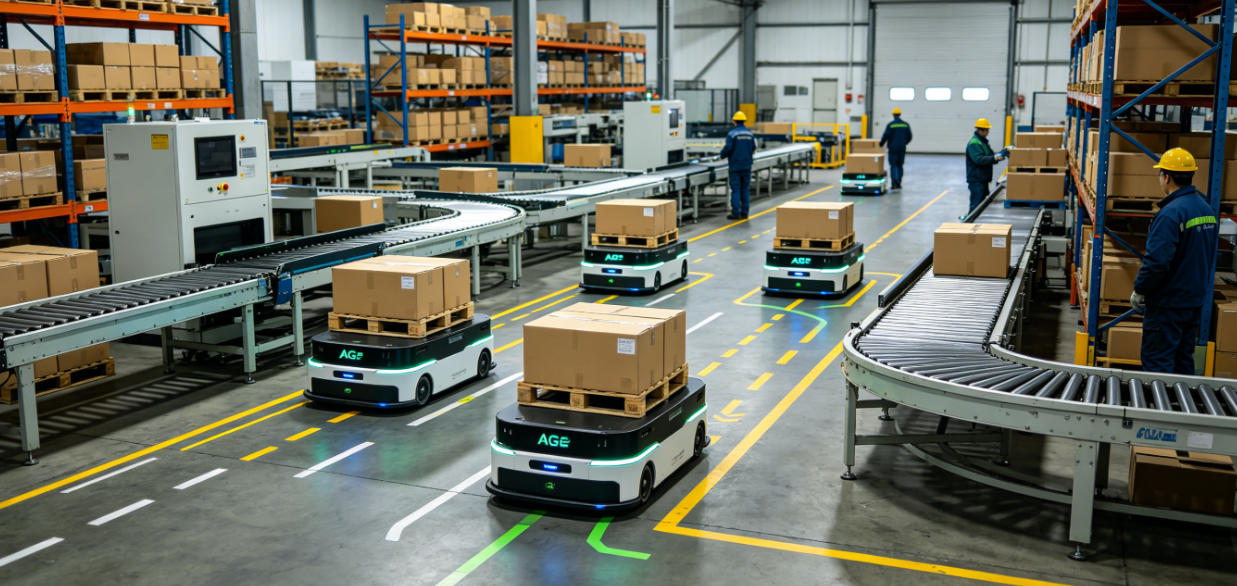
What Is an Automated Guided Vehicle (AGV) and How Does It Improve Warehouse Automation?
In modern smart manufacturing and automated warehousing systems, the Automated Guided Vehicle (AGV) has become a critical solution for improving logistics efficiency. With the development of Industry 4.0, more companies are focusing on the application of autonomous guided vehicles in production lines and warehouse operations.
This article provides an in-depth analysis of advantages of AGV, automated guided vehicle advantages disadvantages, and mainstream AGV navigation methods, helping businesses choose the most suitable intelligent logistics solution.
1. What Is an Automated Guided Vehicle (AGV)?
An Automated Guided Vehicle (AGV) is an intelligent unmanned material handling system that combines mechanical engineering, sensor technology, and artificial intelligence. It can automatically transport, move, and sort materials without human driving, following predefined paths or autonomous navigation routes.
In modern industrial systems, AGVs have become a core component of smart logistics and automated warehousing, especially in Smart Manufacturing and Industry 4.0 environments.
Basic Working Principle of AGV
AGVs operate using multiple navigation technologies, including:
- Laser navigation
- Vision-based navigation
- Magnetic tape or QR-code navigation
- SLAM-based simultaneous localization and mapping
These technologies together form AGV navigation methods, enabling vehicles to achieve high-precision positioning and route planning in complex environments.
Modern advanced systems often combine AI algorithms, sensor fusion, and real-time route optimization, evolving toward more intelligent autonomous guided vehicles.
Typical Applications of AGV
AGVs are widely used across multiple industries:
1. Smart Warehouse Systems
In e-commerce and third-party logistics warehouses, AGVs handle goods transportation, picking, and distribution, significantly improving warehouse automation.
2. Factory Automated Production Lines
In industries such as automotive and electronics manufacturing, AGVs deliver materials and enable seamless production flow.
3. Medical Material Transport
Hospitals use AGVs to transport medicines, laboratory samples, and sterile supplies, reducing human contact and improving safety.
4. E-commerce and Logistics Centers
In high-volume order environments, AGVs support fast sorting and transportation, improving fulfillment efficiency.
Core System Components of AGV
A modern AGV typically includes:
- Navigation system (determines route and positioning)
- Control system (task scheduling and motion control)
- Sensor system (LiDAR, cameras, ultrasonic sensors)
- Drive system (motors and wheels)
- Communication system (connects with WMS/MES systems)
In advanced systems, laser guided AGVs and vision guided vehicles are the most common technologies.
Core Value of AGV
From a business perspective, AGVs are not just transportation tools but essential infrastructure for intelligent logistics systems. Their value includes:
- Improving logistics automation
- Reducing human operational errors
- Optimizing warehouse and production workflows
- Enabling 24/7 continuous operation
- Supporting flexible manufacturing and smart factory upgrades
Therefore, AGVs are widely regarded as a key technology for building 'unmanned factories.'

2. AGV Navigation Methods
Navigation is one of the most critical technologies in AGVs, directly affecting performance and application scenarios.
1. Laser Guided AGV
A laser guided AGV uses reflective markers and laser scanning for positioning.
Advantages:
- High positioning accuracy
- Flexible and adjustable routes
- No need for physical tracks
Disadvantages:
- Higher cost
- Sensitive to environmental conditions (lighting, reflectivity)
2. Vision Guided Vehicles
Vision guided vehicles use cameras and SLAM algorithms to recognize environments.
Advantages:
- No additional infrastructure required
- High flexibility in complex environments
- Lower cost compared to laser systems
Disadvantages:
- Affected by lighting conditions
- Still developing in maturity and stability
3. Magnetic Tape / QR Code Navigation
Advantages:
- Low cost
- Easy deployment
- Suitable for fixed-path environments
Disadvantages:
- Limited flexibility
- Best suited for traditional warehouse systems
3. Advantages of AGV
When analyzing advantages of automated guided vehicles, they can be understood from safety, efficiency, cost reduction, and operational stability perspectives.
1. Enhanced Safety
AGVs are equipped with advanced sensors such as LiDAR, infrared sensors, ultrasonic sensors, and cameras, allowing strong environmental awareness.
They can:
- Detect obstacles (people, equipment, or goods)
- Slow down or stop automatically
- Plan safe detours
- Avoid collisions in complex environments
Compared with forklifts or manual handling, AGVs significantly reduce workplace accidents, especially in high-frequency or unmanned environments.
2. Improved Efficiency and Productivity
AGVs can operate 24/7 without fatigue or shift changes, significantly improving logistics efficiency.
They can:
- Enable continuous automated transport
- Optimize internal logistics routes
- Reduce waiting time and empty runs
- Integrate with WMS/MES systems for task automation
This is especially valuable in peak e-commerce periods and continuous manufacturing lines.
3. Reduced Labor Costs
With rising labor costs, AGVs reduce dependence on manual workers such as forklift operators.
Benefits include:
- Fewer manual logistics staff
- Lower training and management costs
- Reduced human errors
- Improved workforce allocation efficiency
Although initial investment is high, long-term ROI is significant.
4. High Accuracy and Stability
AGVs achieve much higher precision than manual operations.
Depending on technology:
- Laser guided AGVs
- Vision guided systems
- SLAM-based navigation
They can achieve centimeter-level or higher accuracy.
This makes them ideal for precision manufacturing and automated assembly lines.
5. Ideal for Repetitive Tasks
AGVs are best suited for structured and repetitive tasks such as:
- Warehouse material transport
- Production line delivery
- Line-side replenishment
- Fixed-point shuttle transportation
Their standardized operation ensures stable long-term performance.

4. Disadvantages of AGV
When evaluating automated guided vehicle advantages disadvantages, limitations include:
1. High Initial Investment
Including equipment, software, and infrastructure upgrades.
2. Limited Flexibility
Less adaptable in highly dynamic environments.
3. Environmental Requirements
Laser-based systems require stable reflective conditions and clear pathways.
4. Maintenance Requirements
Requires professional technical support and system maintenance.
5. Future Trends of AGV Technology
With advances in AI and computer vision, AGVs are evolving toward higher intelligence:
- AI + SLAM navigation systems
- AI-based route optimization
- Fusion of laser and vision navigation
- Integration with AMR systems
Future smart logistics systems will increasingly adopt hybrid solutions to improve flexibility.
6. Conclusion
Automated Guided Vehicles play a crucial role in modern intelligent logistics, offering significant advantages in efficiency, safety, and automation.
Different navigation technologies such as laser guided AGV and vision guided vehicles are suitable for different industrial scenarios.
When selecting an AGV system, companies should consider:
- Cost investment
- Application environment
- Navigation methods
- System scalability
Proper selection ensures maximum value in smart manufacturing and automated warehousing systems.
3D Safe Guarding Privacy RGBD Camera Synexens CS30

After-sales Support:
Our professional technical team specializing in 3D camera ranging is ready to assist you at any time. Whether you encounter any issues with your TOF camera after purchase or need clarification on TOF technology, feel free to contact us anytime. We are committed to providing high-quality technical after-sales service and user experience, ensuring your peace of mind in both shopping and using our products.
:%20Advantages,%20Disadvantages%20%26%20Types)